

Use the audio-player above to listen here, or click one of the following links to listen on
Apple Podcasts or Spotify. Or click on the photo below to watch on YouTube.
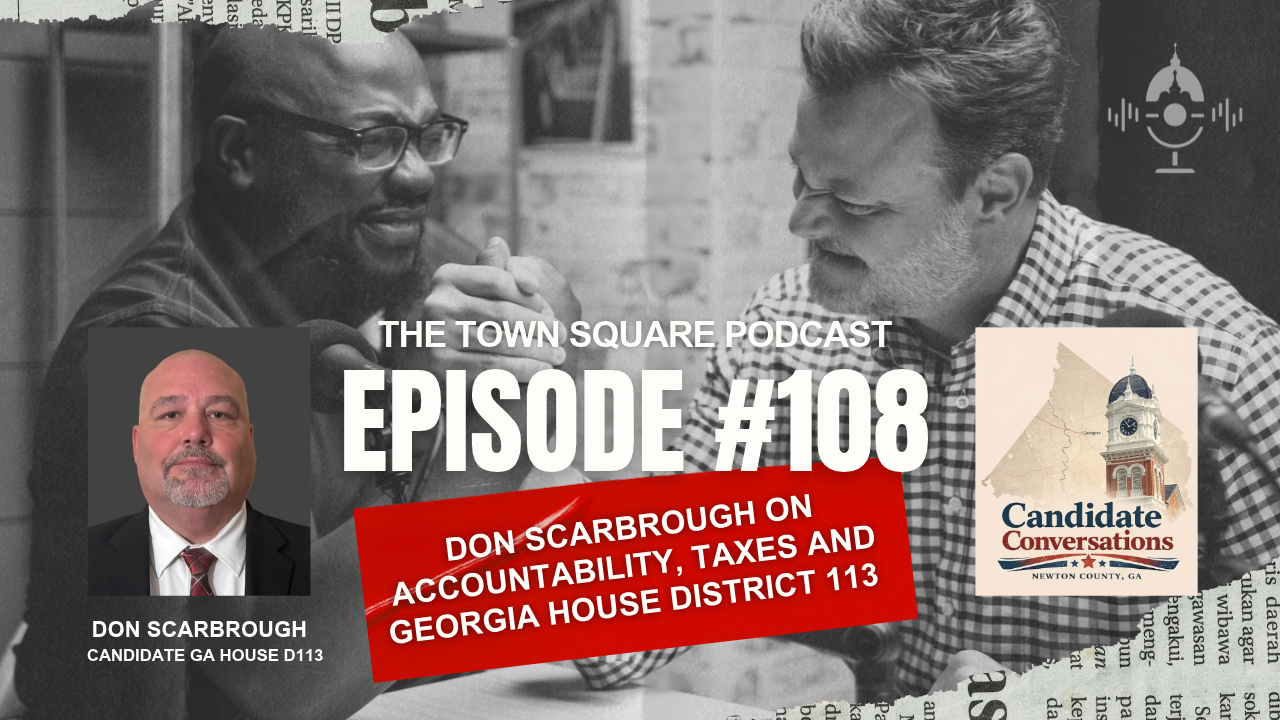
Who Pays and Who Answers
Don Scarbrough on taxes, data centers, and accountability | Town Square Podcast Episode 108 | Candidate Conversations
Listen to Episode 108 in your favorite podcast app by searching for Town Square Podcast. Watch the full conversation on YouTube: https://youtu.be/dEDjt44eNjs
You work, pay your bills, and pay your taxes. How much should government ask of you, and how clearly should it explain what happens to that money?
For Don Scarbrough, those questions sit at the center of his campaign for Georgia House District 113. In Episode 108 of the Town Square Podcast, our Candidate Conversations series continues with a candidate who describes himself as a working man, an IT professional, and a Christian constitutional conservative.
He has strong opinions about taxes, public spending, and the role of government. Trey asks him to explain what those convictions would mean for schools, law enforcement, health care, and the data centers drawing so much attention in Newton County.
The conversation also gets into the harder part of running for office: turning a principle into something that can work alongside other lawmakers and serve people who may disagree with you.
A working man with firm convictions
Scarbrough says he did not set out to become a politician. People who knew him encouraged him to run, and he describes his motivation in familiar terms: taking care of his family, practicing his faith, and wanting government to stop making life harder for working people.
That perspective shapes his approach to the District 113 race. He wants voters to understand his principles before they decide whether he should represent them. He also acknowledges that people across party lines have much in common, even as the conversation explores some sharp ideological differences.
When Trey asks about his campaign language opposing the Democratic agenda, Scarbrough narrows his objection to what he calls a Democratic Socialist agenda. His concern, as he explains it, is the growth of government power and its effect on individual freedom. Trey brings the conversation back to affordability and why people who feel shut out of homeownership might become open to different economic ideas.
Taxes and the question of who should pay
Scarbrough uses blunt language to describe his frustration with taxation. But he also says taxes are necessary to support basic services. His argument is that government takes too much, spends too loosely, and makes it too difficult for people to see whether programs deliver what they promise.
He favors exploring a consumption-based tax approach and discusses a simpler system with possible relief for people living in poverty. This is a statement of direction in the interview, rather than a costed legislative proposal. He also recognizes that federal tax administration is outside the office he is seeking.
The discussion becomes especially local when it turns to school taxes. Scarbrough questions why people without children in public schools should have to pay them, including families using private schools and people without school-age children. Trey presses on the shared-service principle behind that argument and asks whether rising property assessments are part of what makes the burden feel so heavy.
It is a real disagreement about how communities fund services. The interview gives voters a chance to hear both Scarbrough’s objection and the questions it raises about paying for public education.
Education and the ability to think independently
Education comes up as both a spending question and an opportunity question. Scarbrough argues that larger budgets should be judged against results. Trey raises the science of reading, phonics, and the importance of getting the fundamentals right.
Scarbrough emphasizes independent thought: students should learn the basics and develop the ability to research, evaluate information, and make decisions for themselves. That concern resurfaces later when he discusses AI and the risk of relying on technology to do the thinking for us.
For local readers, the connection is straightforward. Literacy and critical thinking affect a person’s ability to work, support a family, and participate in community life. The interview explores what Scarbrough thinks schools should accomplish without laying out a detailed education funding plan.
Public safety with an emphasis on training
Scarbrough’s views on crime are informed in part by personal experiences he recounts during the conversation, including a house fire while he was in Iraq and theft from his property afterward. He also describes more recent vehicle break-ins.
He supports law enforcement, stronger enforcement of existing laws, and Second Amendment rights. When Trey asks what safer communities would require, Scarbrough discusses hiring more officers and investing in training, especially constitutional law and knowledge of the laws officers enforce.
He also calls for accountability when judges make decisions involving repeat offenders. He clarifies that his point is about whether a judge should remain in office. Throughout this portion of the interview, his stated priorities are public safety, fairness, and constitutional protections.
An IT perspective that calls for slowing down data centers
An IT background might lead you to expect an enthusiastic pitch for data centers. Scarbrough takes a more skeptical position.
He questions the pace of development, the assumptions behind AI demand, and the consequences for local power, water, and infrastructure. He supports a moratorium while those issues receive closer scrutiny. Trey presses him on the services data centers already support, including cloud computing, business operations, and the platform carrying this very conversation.
Scarbrough acknowledges that data centers are useful. His position centers on how many are needed, whether the technology and demand justify the buildout, and who carries the cost. He also raises concerns about AI errors, bias, privacy, and dependence on technology.
His clearest line is about infrastructure: private enterprises should pay for the demands they create. “Taxpayers do not need to pay for private enterprise,” he says. That principle also drives his skepticism toward public subsidies more broadly.
Follow the money before expanding programs
On Medicaid, Scarbrough says he wants fraud and waste addressed before considering expansion. He argues that government should understand where existing money goes and what it achieves before asking taxpayers to support more spending.
He calls for audits and public access to their findings. His broader goal is to make spending traceable so residents can see what was purchased, what it cost, and whether it worked. The conversation presents his case for oversight; it does not establish how much an audit would recover or whether those savings would meet additional health care needs.
“Accountability is my number one goal here,” he says.
The flashlight candidate
Near the end, Trey gives Scarbrough a memorable description: the flashlight candidate. The idea is to shine a light on spending and let the public see what is happening.
Scarbrough is careful about promising results. He can commit to trying, he says, but cannot honestly guarantee what he would accomplish in a first term. That distinction matters in a conversation full of firm convictions: governing would still require working with other members of the House.
That is why we do Candidate Conversations. Voters deserve time to hear a candidate explain his priorities, respond to follow-up questions, and work through the places where a slogan leaves something unanswered.
Watch Episode 108 and hear Don Scarbrough’s perspective in full. Bring your questions to the messy middle. Unity does not require uniformity.
Links Mentioned
Watch Episode 108: https://youtu.be/dEDjt44eNjs
Don Scarbrough campaign website, shared in the episode: https://caariga.com
Campaign email, shared in the episode: Don_Scarbrough@caariga.com
Town Square Insiders: https://TheTownSquarePodcast.com/insiders
Sponsors and Advertisers
Headbangers Taphouse
Cold beer, food, and live entertainment in Covington, as featured in the episode’s sponsor message. Gather some friends and check them out.
https://headbangerstaphouse.com
SteelCo Buildings
Custom pre-engineered metal building systems for commercial, agricultural, and other projects. Planning a building? Visit SteelCo to explore the options.