

Chief Royce Turner: Building a Culture of Service, Safety, and Sustainability – Episode 69
Use the audio-player above to listen here, or click one of the following links to listen on
Apple Podcasts or Spotify. Or click on the photo below to watch on YouTube.
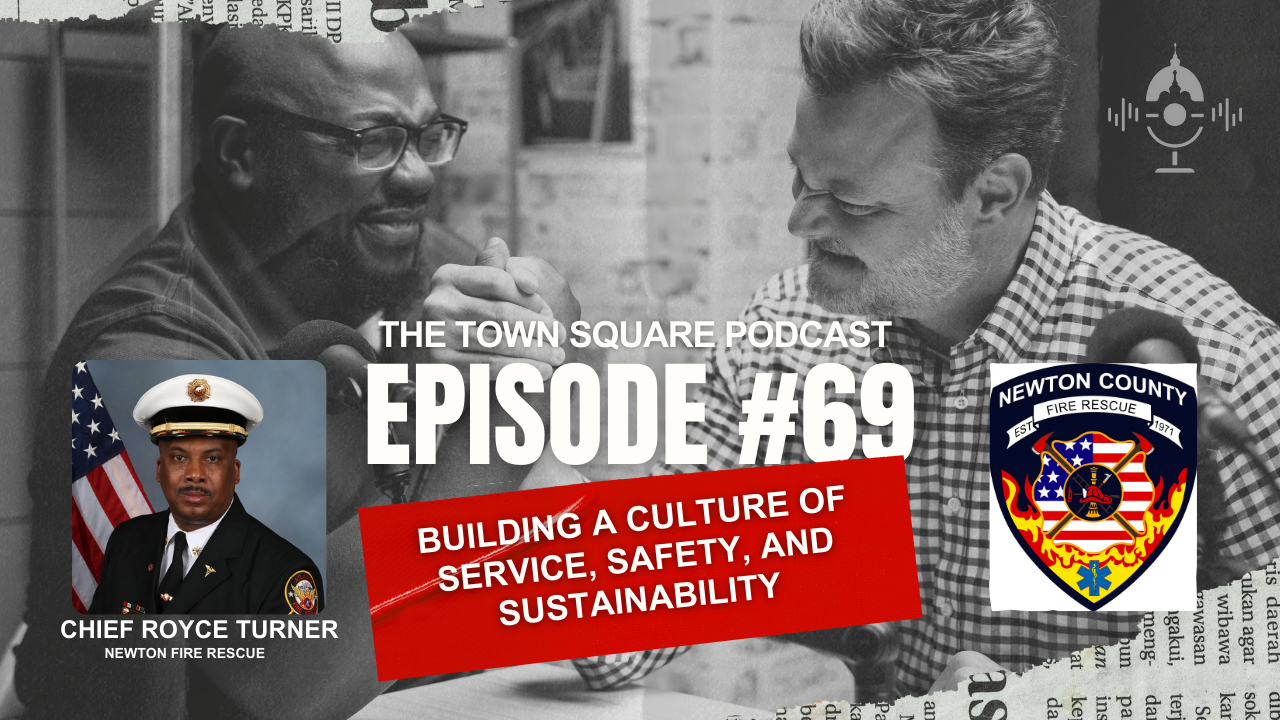
A Chief With a Story—and a Calling
Chief Turner didn’t stumble into public safety. In fact, he told me he believes he was raised into it without realizing it.
He grew up in a family culture where helping people wasn’t a hobby—it was the posture. That theme showed up again and again in our conversation: service as identity, not just occupation.
But before fire service ever entered the picture, Chief Turner was a sports guy. A real sports guy. He played anything with a ball and was good enough to earn a full basketball scholarship. That shaped him—teamwork, discipline, pressure, leadership, competitiveness. And like most athletes with talent, he had the same dreams a lot of young men have: NBA, NFL… something big.
Then college ended.
And as his mom put it, it was time to go into “the real world.”
That’s where the path got interesting.
He Worked Every Side of Public Safety Before Fire Service
When Chief Turner says he’s been in public safety, he means it. Before becoming a firefighter, he had already worked in multiple public safety arenas:
Department of Corrections
He started in corrections, working at a facility in Hall County known for housing young offenders—young people whose trajectories were hard to watch. He described it as disheartening. For him, the big question became: “Can I make an impact here?” And after a lot of reflection and prayer, he realized the answer was no.
Sheriff’s Department / Law Enforcement
He transitioned to a sheriff’s department environment (in and around Atlanta) and again ran into that same internal tension. Could he make an impact? Could he thrive in an environment that felt like it was swallowing people more than helping them?
Again, the answer was no.
And that’s when his father asked the question that changed everything:
“Have you ever thought about fire service?”
Chief Turner’s response was honest and almost funny in the moment:
“Absolutely not. I’m scared of fire.”
Which is about as logical as it gets.
The Application He Forgot About
Here’s the part that feels like a movie scene.
Chief Turner applied to the City of Atlanta Fire Department, but the hiring process took so long—about three years—that he literally forgot he had applied.
Then one day the call came.
They asked if he was still interested.
And he had to remember what job they were even talking about.
But the timing was perfect. He was already in that transitional season, searching for something that fit. So he took the leap.
He called it faith.
I call it courage.
Finding His Niche: Competition + Teamwork + Helping People
Once he got into fire service, something clicked immediately.
He described it like finding his niche—because fire service combined the elements that were already wired into him:
Competition
Team dynamics
Brotherhood
Mission
Helping people
And he talked about mentors—especially one named William Jucks—who didn’t just teach him the job, but helped him see the career. Not just “firefighter,” but growth, development, and leadership.
That mentor pushed him toward paramedic training, and Chief Turner’s initial reaction was relatable:
“I don’t want to go back to school.”
But he was told something important:
If you want to be relevant in fire service, you need to be a paramedic.
So, he did it.
And he didn’t quit.
He admitted it was hard. He said he wanted to quit multiple times, and he was surrounded by people who found reasons to drop out, which made quitting feel easy.
But his upbringing wouldn’t allow it:
If you start something, you finish it.
That mindset became a pattern. Year after year, he challenged himself to grow.
And eventually, he rose all the way through the ranks in Atlanta—starting as a recruit and reaching Deputy Chief in one of the largest departments in the region.
Why Newton County? Because It’s Family
Chief Turner could’ve stayed in Atlanta. He even thought he might be next in line for Fire Chief there.
But leadership shifts happen. Politics happen. Timing happens.
And he made a decision: it was time to lead his own department.
That’s when Newton County came into the picture in a deeper way, because while he grew up in Atlanta, he told me something I didn’t know:
Newton County is his second home.
His grandmother was born and raised here. Many of his relatives are here. He attended church here as a kid—specifically Bethel Grove Baptist Church.
And he said his mom added some “peer pressure” with a line that hit hard:
“I’m not going to be here forever… your grandma would be proud.”
So, when the opportunity opened, the choice wasn’t just career—it was personal.
Newton County wasn’t a stop.
It was a return.
“I’m Like a Reptile”: Leadership and Adaptability
At one point, I asked him about leadership—because nobody becomes Fire Chief by accident.
His answer was unexpected and honestly memorable:
“I’m like a reptile.”
He explained what he meant: he can adapt to the environment. He knows when to step back and let someone else lead, and he knows when to step up.
That adaptability matters in fire service because the culture is competitive. It’s full of strong personalities, “alpha attitudes,” and high-stakes teamwork.
And then he said something that framed fire service in a way I’ve never heard:
Fire service can start as a blue-collar job and evolve into a white-collar job.
Meaning: early on, you’re hands-on, task-driven, on the truck, in the work. As you rise, you become more responsible for strategy, policy, culture, sustainability—building systems that prevent emergencies, reduce risk, and support the team.
That’s where Chief Turner is now.
The Culture He’s Building in Newton County
When I asked what culture he’s trying to establish in Newton County Fire, he didn’t hesitate. He listed it clearly:
Consistency
Policy-driven operations
Sustainability
Retention
Camaraderie
Service excellence for citizens
He said one of the biggest realities today is that public safety staffing is hard across the board. People move from department to department, chasing better pay and benefits. Loyalty looks different than it used to.
And the younger generation is coming in with a challenge older leaders have to understand:
social skills are weaker than they used to be.
He contrasted his childhood—being kicked outside to play, knowing neighbors, building face-to-face community—with today’s reality: screens, isolation, less conversation, less interpersonal confidence.
His solution isn’t complaining about “kids these days.”
It’s meeting people where they are.
That stuck out to me as real leadership.
Do Firefighters Really Get Cats Out of Trees?
I had to ask.
And Chief Turner gave the honest answer:
Yes… and no.
He said if they’re going to be a “full service” department, they meet community needs when appropriate—but they don’t have to, and they won’t put firefighters in unnecessary danger.
Then he delivered the line every firefighter has probably wanted to say out loud:
“If the cat went up the tree, he can come down. If he gets hungry, he’ll come down.”
Fair enough.
The Biggest Challenge: Education and Communication
When we got into obstacles, he framed it around something most citizens don’t think about:
Fire service isn’t just “what the department wants.”
There are compliance standards they’re required to follow:
NFPA compliance
Georgia fire standards and training
State Office of EMS requirements
So, when he talks about budget, staffing, equipment, and infrastructure, he sees it as risk management:
“I’m here to manage liabilities.”
He also made a strong case that prevention is the number one priority—even though firefighters naturally love action.
His perspective was blunt but true:
When firefighters respond to an emergency, that’s often someone’s worst day.
Preventing that worst day is the better outcome.
A Huge Surprise: 60% of Calls Are EMS
This is the stat that made me pause in the studio.
Chief Turner said roughly 60% of their call volume is EMS—medical emergencies.
That means a lot of the time when you see a fire truck show up, it’s not because something’s burning. It’s because:
someone is having a medical crisis
someone is injured
there’s trauma from a wreck
someone needs urgent care right now
He addressed the common reaction people have when a fire truck arrives instead of an ambulance:
“I didn’t call for a fire truck.”
And he explained it clearly: fire personnel are cross-trained and often carry the same life-saving equipment. The ambulance’s key difference is transport.
Fire trucks show up to save lives, not just fight fire.
Training and ISO: Why It Matters to Homeowners
Chief Turner broke down something that impacts every homeowner: ISO ratings.
ISO (Insurance Services Office) ratings are tied to fire department capabilities and directly affect homeowners insurance risk evaluations. He explained the rating system, the components, and how the score is built.
Newton County Fire is currently at an ISO 3, which is very good.
But Chief Turner’s goal is bold:
ISO 1—the highest rating possible.
He explained that ISO scoring is tied to:
Fire department staffing/equipment/service delivery (50%)
Water supply and access (40%)
911 systems (10%)
Additional credit for community risk reduction (extra 5 points)
And he gave Newton County credit: our water resources are strong.
Community Risk Reduction: Smoke Detectors and Car Seats
Chief Turner shared several ways the department engages beyond emergencies:
partnering with the Board of Education
working in senior communities
community events and visibility
installing free smoke detectors
partnering with organizations like the Red Cross for victim assistance
exploring a car seat safety program (because yes, installing car seats correctly is an art)
This is what prevention looks like in real life.
Growth, Development, and “Don’t Sign Off on Bad Development”
I asked how the department keeps up with Newton County’s rapid growth—because growth means risk and demand.
He emphasized the role of the fire prevention division, working closely with planning and zoning, reviewing plans, inspecting developments, and ensuring infrastructure supports what’s being built.
He said it plainly: the department can’t be in the business of signing off on bad development.
He also referenced industrial risk—pointing out the importance of inspections and mitigation capacity to prevent incidents like “another BioLab situation.”
That’s not fear-mongering.
That’s stewardship.
His Big Vision: Accreditation and Internal Leadership Pipeline
Chief Turner is aiming for something beyond day-to-day performance:
Fire department accreditation.
He said something I loved:
“We can all say we’re good… but can we prove we’re good?”
Accreditation is tedious and time-consuming, but it creates accountability, standards, and excellence that doesn’t depend on one person.
He also said he wants to grow internal leadership so future chiefs come from within Newton County Fire. His line was strong:
“I want to be the last outside chief you get.”
That’s a culture statement.
Hiring: “We Can Train Skill… But We Can’t Train Heart”
We talked recruiting and what he wants in future firefighters.
He said fire service is open to anyone willing to do the work—and the department can train almost everything:
skills
procedures
tactics
certifications
But there’s one thing they can’t train:
heart.
If you bring heart, they can get you to the finish line.
He also encouraged Newton County residents to apply because locals have a vested interest in the community they serve.
(And yes, he mentioned recruitment classes moving through certification and staffing stations—real momentum happening.)
The Five Priorities Hanging in Every Station
One of the most impressive leadership details he shared: when he started, he completed a 100-day evaluation using a SWOT analysis—strengths, weaknesses, opportunities, threats.
He involved staff, created the package, and shared it with the county manager and every commissioner. Because for him, improving the department isn’t a solo burden—it’s shared accountability.
Out of that, Newton County Fire established five priorities, and he said these priorities are posted in every station:
Human Resources – recruit and retain the best people
Professional Development – invest in growth and career support
Training, Facilities, Equipment, Technology – give members what they need
Customer Service – meet the needs of the public daily
Public Relations / Public Education / Branding – educate and build trust
That’s a blueprint for sustainable excellence.
A Mustache Requirement?
I couldn’t resist asking if the firefighter mustache is mandatory.
Chief Turner laughed and basically said: not required… but tradition is hard to shake.
Some people just like the image.
And yes, you really can spot a firefighter sometimes.
Advice for Young People: The “Double F”
We ended with one of my favorite questions: what advice would you give a high school junior or senior considering fire service?
Chief Turner gave a thoughtful answer. He said if you’re not going to the military and not going to college, fire service can be a strong career path. You won’t get rich, but you can be stable. You can contribute. You can become a positive fixture in society.
Then he gave what he calls the “double F”:
Faith and Follow-Up
Believe in something, commit to it, and keep moving forward—even when the answers aren’t right in front of you.
He said he didn’t always have the answers, but he had support—family, friends, people helping keep him on the path.
And I told him the truth in the moment: that message hit me personally.
Because some seasons require faith.
And follow-up.
Final Thoughts: A Leader Who’s Building More Than a Department
What I appreciated most about Chief Turner is that he doesn’t talk like someone protecting his ego or his title. He talks like a man trying to serve the community well. He talks like someone who understands that public trust is earned through transparency, performance, prevention, and relationships.
He’s building more than response times and station counts.
He’s building a culture.
And Newton County will be safer because of it.
If you’d like to listen to the full conversation, search The Town Square Podcast – Episode 69 wherever you get your podcasts, or watch on YouTube.
And if you’re someone who has heart and is interested in fire service… Chief Turner made it pretty clear:
They can train the rest.
Helpful Links:
A Big Thank You to Our Sponsor
This episode is made possible in part by our community sponsor:
Angel Pitts, United Bank Wealth Management Advisor
Serving Covington & Madison, GA
Phone: 770-412-4932
Website: https://www.accessunited.com
United Bank Wealth Management Services – Building relationships that go beyond investments.