
Wendell McNeal: Workhorse, Not Show Horse | Candidate Conversations — Episode 87
Use the audio-player above to listen here, or click one of the following links to listen on
Apple Podcasts or Spotify. Or click on the photo below to watch on YouTube.
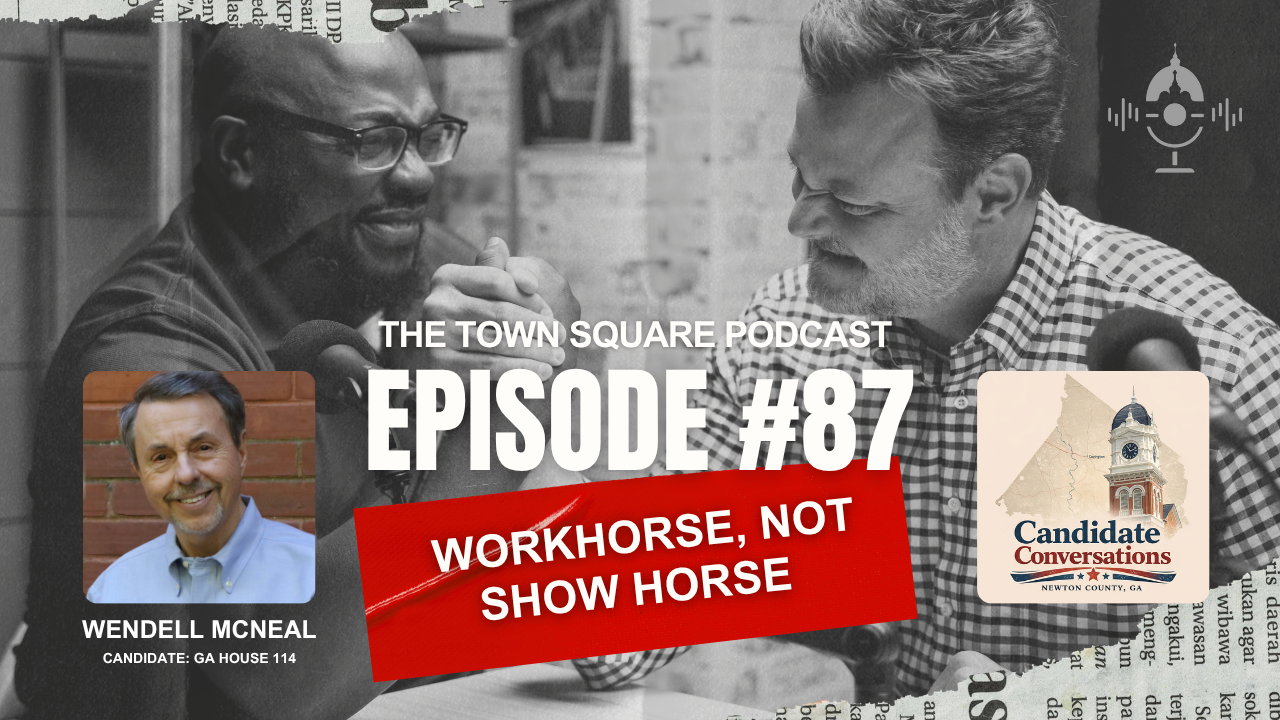
In this episode of The Town Square Podcast, Trey Bailey sits down with Wendell McNeal, candidate for Georgia House of Representatives District 114, as part of the ongoing Candidate Conversations series.
District 114 includes all of Morgan County, portions of Newton County, and part of Walton County, including communities such as Mansfield, Newborn, Social Circle, and areas near Good Hope. As the district continues to experience growth, development pressure, tax concerns, and shifting political boundaries, this race carries significance for voters across several communities.
McNeal is running in the Republican primary for the open House seat against Brett Mauldin, who has also appeared on The Town Square Podcast as part of the Candidate Conversations series. As with every episode in this series, the goal is not to endorse a candidate, but to give voters direct access to the people asking to represent them.
For McNeal, that story begins long before politics.
From Gordon to Milledgeville
Wendell McNeal was born in Gordon, Georgia, a small town south of Milledgeville. He described growing up in a 975-square-foot house — what people today might call a tiny home — before tragedy changed the course of his childhood.
When McNeal was eight years old, his parents were involved in a car accident. His father did not survive, and his mother was left handicapped. After that, the family moved to Milledgeville, which is why many of his bios list Milledgeville as his hometown.
But McNeal was quick to clarify the full story.
He came from Gordon. He carried lessons from Gordon. And those early life experiences helped shape his worldview.
Throughout the conversation, McNeal returned to themes of resilience, common sense, hard work, and learning how to figure things out when no one hands you a blueprint.
Learning the Legislative Process
Before building his business career, McNeal spent time working around state politics. After moving to Atlanta to work for a candidate running for statewide office, he was later connected to an opportunity with the Georgia House of Representatives.
That job placed him with the House Judiciary Committee.
McNeal said he told the committee chairman that he was not a lawyer. The chairman already knew — and apparently viewed that as part of what made him interesting for the role.
That experience gave McNeal an early understanding of how legislation works, how laws are developed, and how important it is to understand the process before trying to change it.
He said one of the most important lessons he learned is that disagreement does not have to become hostility.
If someone disagrees, McNeal said, his response is simple: tell me why.
That approach — asking people to explain their position rather than dismissing them — became one of the recurring themes of the conversation.
Building a Business From Scratch
McNeal eventually decided he wanted to go into business for himself.
He did not inherit a family business. He did not come from a built-in business structure. He simply decided to start.
With a background in electronics, McNeal opened a Curtis Mathis store in Covington’s Newton Plaza. Many longtime Newton County residents may remember the store, especially from the days when renting a VCR was still part of normal life.
Eventually, McNeal moved the business to a building on Highway 278 and expanded into Conyers. Over time, he grew the business to four stores and approximately 50 employees.
That experience, he said, taught him how to read financial statements, manage operations, handle lenders, understand cash flow, and make decisions based on facts.
McNeal talked about being required to prepare individual financial statements for each location, then a separate financial statement for the home office, then consolidated financial statements for the company as a whole.
He described it as a crash course in business discipline.
If financials were not ready by the fifth of the month, he said, the credit line could be cut.
That kind of pressure taught him how to manage carefully, plan ahead, and avoid making decisions without understanding the numbers.
Property Taxes and the State Budget
When asked what he believes is one of the most important issues facing District 114, McNeal quickly pointed to property taxes.
He said many residents have seen property taxes double or even triple, especially as home values have increased and assessments compare properties against nearby renovated homes.
McNeal specifically raised the issue of homestead exemptions. He noted that Morgan County’s homestead exemption is $2,000, while Newton County’s is $4,000, and questioned why those numbers have not been significantly updated over time.
But he also cautioned that tax policy cannot be handled casually.
Change one part of the system, he said, and it can affect something else.
For McNeal, tax relief must be approached carefully so it does not harm school systems, public employees, or essential services.
He described attending legislative committee meetings during the summer and listening to presentations on various revenue options, including cigarette taxes and hotel-motel taxes. Some of those presentations lasted hours, but McNeal said his business background made him interested in the numbers.
His point was not simply that taxes are too high.
His point was that Georgia needs people in the legislature who can understand the numbers, examine the full picture, and think through unintended consequences.
Public Education and Teacher Retention
One of the strongest portions of the conversation centered on public education.
McNeal said he does not want tax reform to harm public schools. He specifically raised concerns about teacher retention and asked why more state funding is not reaching classrooms and teachers.
He noted that a large portion of Georgia’s state budget goes toward education and said that raises an important question: if the state is spending that much on education, how can lawmakers better support teachers in Newton, Morgan, and Walton counties?
Trey added that Georgia’s public school funding formula, the QBE-Quality Basic Education formula, dates back to 1985 and that schools today face far more complex demands than they did decades ago, including technology, safety, security, special education, and expanded student needs.
McNeal agreed that public education should not be hurt and that experienced teachers should not be lost because of funding pressures.
For him, the issue comes back to distribution.
Like a household or business budget, he said, the state must decide what matters most and how to spend accordingly.
Senior Tax Relief and Protecting Homeowners
McNeal also spoke about the importance of protecting older homeowners and widows who may be struggling to stay in their homes.
He drew a clear distinction between residential tax relief and tax benefits for commercial property owners, rental property owners, or apartment complexes.
As someone who owns rental property himself, McNeal said he does not believe changes in tax structure should be designed primarily to benefit commercial or rental property owners. In his view, the priority should be homeowners — especially seniors and widows who may be forced to choose between basic needs and property taxes.
He said other counties have found ways to reduce or eliminate certain taxes for residents at a certain age, and he believes District 114 should study those models to see what might work locally.
McNeal said he may not always be the smartest person in the room, but he believes in finding people who understand the issue and asking them how they made it work.
A Vested Interest in the Community
Although McNeal lives in Morgan County, he emphasized that he has a vested interest across the district, including Newton County.
He owns rental property in Newton County and has employees who live in the district, including one in Mansfield. For McNeal, that means the decisions made in District 114 affect him personally, professionally, and financially.
He said people sometimes claim to have a vested interest in a community, but in his case, he believes his investments and relationships make that statement real.
Presidential Elector and Political Involvement
One of the more unique parts of the conversation came when McNeal shared that he served as a presidential elector in Georgia.
He described going through the formal process at the Capitol, meeting in the Senate chamber, and signing legal documents to authenticate the popular vote for president and vice president.
McNeal said the process gave him a deeper appreciation for the Electoral College and the structure of American government.
He also shared stories about being invited to Mar-a-Lago and attending events where he met national political figures. But even in those settings, McNeal said what stood out most was the reminder that people are still people.
His larger point was that relationships matter, and that sometimes being connected to people in government allows you to help someone else.
He gave an example of helping connect a municipality with someone in federal government regarding a bond issue and another example of helping someone who had been working through an SBA loan.
McNeal said he does not need much for himself, but he enjoys using relationships to help others.
Data Centers, Rivian, and Responsible Growth
Trey also asked McNeal about economic development, data centers, and the balance between growth and quality of life.
McNeal said he supports good, clean industry and considers himself pro-business. However, he expressed concern about the number of data centers being proposed in Newton County and surrounding areas.
His concerns center on water usage, energy demands, and potential impacts on quality of life.
He said citizens must come first, especially during times of drought or infrastructure pressure.
On Rivian, McNeal said he believes the process was handled poorly. His concern was not simply about economic development itself, but about whether citizens had enough opportunity to understand the project, ask questions, and provide input.
He said when major zoning or development decisions happen, citizens are usually notified through signs, newspapers, and public hearings. In his view, a project of Rivian’s scale should involve meaningful public input.
McNeal said he feels for residents in the Rutledge area who moved there for a certain way of life.
For him, the challenge is balancing economic development with the needs and concerns of the people already living in the community.
“Workhorse, Not Show Horse”
Near the end of the episode, McNeal was asked why voters should choose him.
His answer was simple:
He believes he is a workhorse, not a show horse.
McNeal said some people in politics are gifted speakers, but voters should look beyond speeches and examine what a candidate has actually done.
He pointed to his business background, his community investments, his relationships, his concern for quality of life, and his desire to work for the people of the district.
He said elected officials must remember who they work for.
Not the system.
Not the title.
The people.
Candidate Contact Information
To learn more about Wendell McNeal’s campaign:
Website: www.wendellmcneal.com
Phone: 706-752-7400
McNeal encouraged voters to reach out, ask questions, request campaign signs, and talk with him directly about the issues affecting their communities.
Election Reminder
Early voting is underway for the May 19 primary.
Voters are encouraged to confirm their district, polling location, and election information before casting a ballot.
Visit: www.thetownsquarepodcast.com/vote
May matters.
Thank You to Our Episode Sponsors
Relevant IT Services
Relevant IT Services partners with businesses and nonprofits to increase productivity and cybersecurity through technology that fits each individual client. From computers and networks to printers, phone systems, cybersecurity training, and proactive threat protection, Relevant IT helps organizations stay secure and efficient.
Call Relevant IT Services at 470-864-4037 or visit their website to schedule a free assessment. Mention The Town Square Podcast to receive 25% off onboarding.
Luther Rice College and Seminary
Luther Rice College and Seminary offers biblically based, affordable, accredited, and 100% online education for students pursuing their calling. Their programs include dual enrollment, undergraduate degrees, certificates, and doctoral-level study designed for high school students, adult learners, ministry leaders, and working professionals.
Learn more at LutherRice.edu.