

DJ Seals: Scams, Second Chances & the Happiest Place on Earth — Episode 92
Use the audio-player above to listen here, or click one of the following links to listen on
Apple Podcasts or Spotify. Or click on the photo below to watch on YouTube.
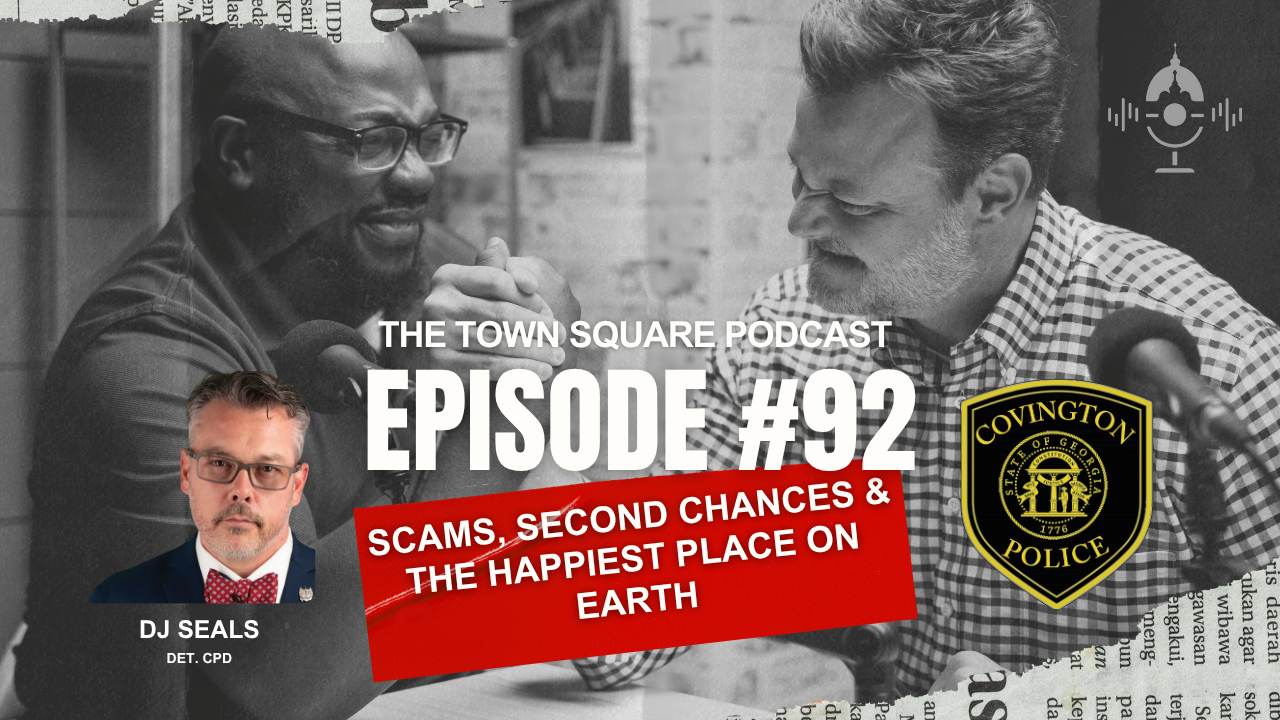
After a full season of Candidate Conversations, The Town Square Podcast is back to regular programming — and Episode 92 brings us right back into the heart of what this show was built to do.
This week, Trey Bailey sits down with Detective DJ Seals of the Covington Police Department for a conversation that is equal parts informative, funny, practical, personal, and deeply local.
If you’ve been around Covington or Newton County for any amount of time, there’s a good chance you know DJ Seals — or at least you know his voice.
Some know him from radio. Some know him from law enforcement. Some know him as the booming, joyful voice announcing Miracle League baseball games. Others know him from his years of community service, public safety work, and willingness to show up wherever he is needed.
But in this episode, listeners get a fuller picture of DJ Seals: the broadcaster, the detective, the fraud investigator, the storyteller, the community servant, and the guy who has somehow lived enough interesting chapters to make Trey compare him to “the most interesting man in the world.”
DJ, of course, laughed that off.
But by the end of the episode, it was pretty clear Trey wasn’t completely wrong.
From Radio Voice to Detective Seals
The conversation begins with DJ’s name — literally.
DJ stands for Daniel Jonathan, though almost everyone has always called him DJ. That made things especially amusing when he worked in radio, because people naturally assumed “DJ” was his radio name.
It wasn’t.
It was just his name.
DJ talked about his early days in radio, including time at WGFS 1430 and later with Atlanta’s 104.7 The Fish. Trey remembered first connecting with him during his Eastridge Church days, when the church was hosting concert events and The Fish brought out its van and promotional team.
That radio background matters because it helps explain part of what makes DJ such a compelling guest. He knows how to tell stories. He knows how to communicate. And now, in his role with the Covington Police Department, he is using those same skills to educate the public about fraud, scams, identity theft, and personal safety.
DJ previously served with CPD before stepping away after a serious car accident and later moving into the world of law enforcement software. In that role, he worked with agencies across all 50 states and eight countries, helping teach best practices around real-time crime centers, drone systems, investigations, SWAT support, and technology tools.
But recently, a conversation with Chief Brent Fuesting led DJ back to the badge.
He had gone to the police department to drop off backpacks his church had prepared for homeless individuals and children who may be present during difficult law enforcement scenes. Those backpacks included small items like fidgets and comfort tools — simple things that can help a child regulate during stressful moments.
One conversation with the chief turned into another.
About a week later, DJ was back with the Covington Police Department.
Fraud, Forgery, Identity Theft — and a Changing World
DJ now focuses heavily on fraud, forgery, identity theft, and scams.
Some of that work is familiar to him from his earlier law enforcement career, but the world has changed dramatically. Identity theft was still a relatively new concept when DJ first worked in this space. Laws were still catching up. Technology was evolving. Investigators often had to do much of the work by hand.
Today, the tools are better.
Unfortunately, so are the criminals.
DJ explained that the core work of investigation is still the same, but the process has changed. Technology gives investigators more ways to track patterns and gather information, but it also gives scammers more ways to deceive, manipulate, and hide.
And the scams themselves have evolved.
The old stereotype was the “Nigerian prince” email — someone promising gold bars or a giant inheritance in exchange for a fee.
DJ said today’s scams are often much more realistic.
They look official.
They use familiar institutions.
They rely on public information.
And most importantly, they are built around emotion.
Fear and Love: The Two Big Hooks
One of the strongest themes from the episode is DJ’s explanation that modern scams are less about greed and more about emotion.
The old scams often worked by promising people money.
Today’s scams usually work by creating fear or exploiting love.
Fear shows up in fake toll notices, fake warrant threats, fake court documents, fake postal service claims, and fake Federal Trade Commission threats. A person receives a text, email, or phone call saying they owe money, missed court, have a warrant, or need to pay immediately to avoid arrest.
Love shows up in relationship scams.
DJ said relationship fraud is one of the biggest things he is seeing right now.
These scams often begin on social media. A stranger comments on a photo, sends a message, finds a point of connection, and slowly builds trust. It is what DJ described as a “long con.” The scammer may spend weeks or months building what feels like a real relationship.
Eventually, the request comes.
Money for a car repair.
Money for a child.
Money for travel.
Money for a medical issue.
And once money starts moving, the losses can become devastating.
DJ shared that his own aunt lost $180,000 in a relationship scam before the family knew what had happened. DJ confirmed that these stories are not rare, and they are heartbreaking because the victim often believes the relationship is real.
That makes the investigator’s job even harder.
DJ said one of the most difficult parts is not simply investigating the crime. It is helping the victim understand that they have been deceived.
There is grief.
There is shame.
There is embarrassment.
And DJ was clear: victims should not carry that shame.
These scammers are professionals. This is what they do. They are trained, organized, and skilled at manipulation.
The Rise of Bitcoin Scams
Another major warning from DJ: be extremely cautious if anyone asks you to pay through a Bitcoin ATM.
Fake warrant scams, relationship scams, and other fraud schemes increasingly route victims toward Bitcoin machines. The scammer tells the victim to deposit thousands of dollars into a Bitcoin ATM to clear a warrant, pay a fee, help a loved one, or resolve an urgent problem.
DJ explained why this is so dangerous.
Traditional financial institutions can be subpoenaed. Banks have fraud departments. Investigators can track certain transactions.
Bitcoin is different.
It is largely unregulated, often international, and can be extremely difficult to recover once money is sent.
DJ described Bitcoin as the “Wild West.”
His advice was blunt: if someone is asking you to put money into a Bitcoin machine, that is almost certainly a scam.
Fake Warrants, Toll Texts, Funeral Scams, and More
DJ walked through several common scams circulating right now.
One is the fake toll text. Many people have received messages claiming they owe money for unpaid tolls. Those scams became so widespread that scammers eventually shifted into other tactics.
One newer version is the fake warrant scam.
A person receives a document or message saying there is a warrant for their arrest because they missed court. The document may include real-sounding language, fake seals, judge names, county references, or courthouse addresses.
But DJ said there are usually clues.
The county may not match.
The judge may be from the wrong jurisdiction.
The address may be wrong.
The language may sound official, but the details do not hold together.
The problem is that panic makes people miss those clues.
DJ told the story of a friend who was standing at a gas station, ready to put thousands of dollars into a Bitcoin machine because he believed he had a warrant. DJ told him to walk away, calm down, sit in his truck, and actually read the document.
Once the panic faded, the errors were obvious.
Another emerging scam DJ mentioned is the funeral scam.
Scammers read obituaries, gather family information, identify the funeral home, and call grieving relatives pretending to be from the funeral home. They may claim that insurance did not cover a final bill and ask for a credit card payment.
It is cruel.
It is targeted.
And it works because people are grieving and vulnerable.
Social Media: Would You Do This in Person?
DJ offered a simple rule that may be the most memorable piece of advice from the episode:
Would you do this in person?
Would you give a stranger on the Covington Square $5,000 because they said their car broke down?
Would you walk up to someone you have never met and tell them about your grandkids, your dog, your family, your church, your schedule, and your personal life?
Most people would say no.
But online, the barrier feels lower.
There is a screen between people. There is a sense of safety. A person can seem kind, familiar, interested, and trustworthy.
DJ said that is exactly what scammers exploit.
His advice is not to stop talking to people altogether. It is to keep your guard up. Ask questions. Verify details. Do not assume a person is who they claim to be simply because they know a few facts about you.
And if someone begins asking for money, gift cards, Bitcoin, favors, or urgent help — slow down.
Ask questions.
Call someone you trust.
Call DJ.
Call law enforcement.
Do not let urgency make the decision for you.
Protecting Older Adults and Vulnerable Loved Ones
One of the most practical parts of the conversation centered on family members and caregivers.
DJ said he currently has cases where the victim did not initiate the report. A caregiver or relative noticed something odd and reached out because they suspected their loved one was being scammed.
That matters.
If you have an older parent, aunt, uncle, grandparent, or friend who spends time on social media, pay attention.
Not in a controlling way.
In a caring way.
If you see unfamiliar people commenting frequently or appearing in their online circle, ask gentle questions.
Who is that?
How do you know them?
Where are they from?
Have they asked you for anything?
DJ said those questions can help identify a scam before money is lost.
He also emphasized that many victims are not careless or foolish. Many are lonely, trusting, grieving, or simply unaware of how sophisticated these scams have become.
And some are very tech savvy.
This can happen to anyone.
Fraud Prevention Classes for the Community
One of the most encouraging parts of the episode is that DJ is not just investigating these crimes after they happen.
He wants to prevent them.
DJ is offering free fraud prevention conversations for schools, churches, civic organizations, retirement communities, and other local groups. These sessions are designed to be practical and conversational. He wants people to bring questions, share concerns, and learn how to spot scams before they become victims.
He made it clear that these are not credit repair classes or technical financial seminars.
They are awareness conversations.
What scams are happening right now?
What should people look for?
Who should they call?
What are the red flags?
How do families protect vulnerable loved ones?
DJ’s goal is simple: if one person recognizes a scam before sending money, it is worth it.
To schedule a fraud prevention conversation with Detective DJ Seals:
Phone: 770-385-2127
Email: daniel.seals@covingtonpolice.com
The Team Behind the Badge
DJ also made a point to emphasize that this work is not done alone.
He talked about the detectives and officers at CPD who each bring different strengths to the table. Some are especially strong with social media. Some are strong with research. Some specialize in other investigative tools or processes.
When a case gets complicated, the team works together.
DJ said he has never had a problem asking for help, and he sees that as a strength.
That spirit of teamwork matters because fraud cases can involve multiple victims, stolen identities, out-of-state actors, international phone numbers, fake accounts, financial records, and larger criminal networks.
Sometimes a small local case reveals a much larger machine.
DJ said when investigators can identify patterns and connect cases, they may be able to bring in larger agencies and pursue bigger targets.
The goal is not just to catch the small cog.
The goal is to expose the larger network.
The Joy of Miracle League Baseball
After a heavy conversation about scams, fraud, fear, and vulnerability, the episode ends on a joyful note.
For many in Newton County, DJ Seals is the voice of Miracle League baseball.
He has been announcing games for more than 11 years, and it is obvious that the Miracle League holds a special place in his heart.
DJ told the story of how his wife first heard that the league needed help with announcing. He showed up, sat down, and quickly realized there was a lot of space between names being called.
So he started calling the games like a real baseball broadcast.
A kid hit the ball, and DJ launched into full announcer mode.
The crowd loved it.
The players loved it.
And he has been doing it ever since.
What began with four teams of six players has grown dramatically. DJ said the most recent season included 16 teams and 195 players.
He described Miracle League as a place of pure joy — so much so that he joked it deserves the title “the happiest place on earth.”
For DJ, it is also personally restorative.
After a difficult day, he can put on his Miracle League jersey, head to the field, hear the first song, and feel the weight of the day lift.
That part of the conversation captures something important about DJ Seals.
Yes, he is a detective.
Yes, he investigates serious crimes.
Yes, he works fraud cases that involve real pain and real victims.
But he is also deeply connected to the community in ways that go beyond the badge.
He serves.
He shows up.
He brings joy.
And he uses his voice — literally and figuratively — to make Newton County a better place.
Final Thoughts
Episode 92 is a reminder of why The Town Square Podcast exists.
This is not just a show about politics, elections, or public issues. It is a show about people who are working in different corners of the community to make life better, safer, stronger, and more connected.
Detective DJ Seals brings a rare combination of humor, experience, compassion, technical knowledge, and old-fashioned community care.
He understands the scams.
He understands the victims.
He understands the systems.
And he understands that education may be one of the most powerful tools we have.
Whether you are a parent, caregiver, church leader, business owner, older adult, or just someone who has ever received a suspicious text message, this episode is worth your time.
Because the scams are changing.
The criminals are getting better.
And the best defense is a community that knows what to look for.
Episode Sponsors:
All Air
This episode is also sponsored by All Air, serving Covington and the greater Atlanta area with heating, cooling, maintenance, repairs, full system installations, free replacement estimates, free second opinions, and flexible financing options. All Air offers 10% off for military veterans and senior citizens. Mention The Town Square Podcast for $25 off your next repair service.
Call 770-761-9914 or visit allairservices.com.
The Appalachia Group Insurance
This episode of The Town Square Podcast is sponsored by The Appalachia Group Insurance. Bobby Stevens and his partner Matt McLean are licensed in Georgia and Tennessee and bring more than 36 years of combined insurance experience. As an independent agency, they are not limited to one carrier, which allows them to shop for coverage that fits the needs of each client.
They offer auto, home, life, commercial, and special event insurance coverage.
Contact: Bobby Stevens
Phone: 770-728-1880
Email: bobby@appgroupins.com