

Fr. Justin Clemente on Anglicanism, Daily Prayer, and Planting Lamb of God Church — Episode 94
Use the audio-player above to listen here, or click one of the following links to listen on
Apple Podcasts or Spotify. Or click on the photo below to watch on YouTube.
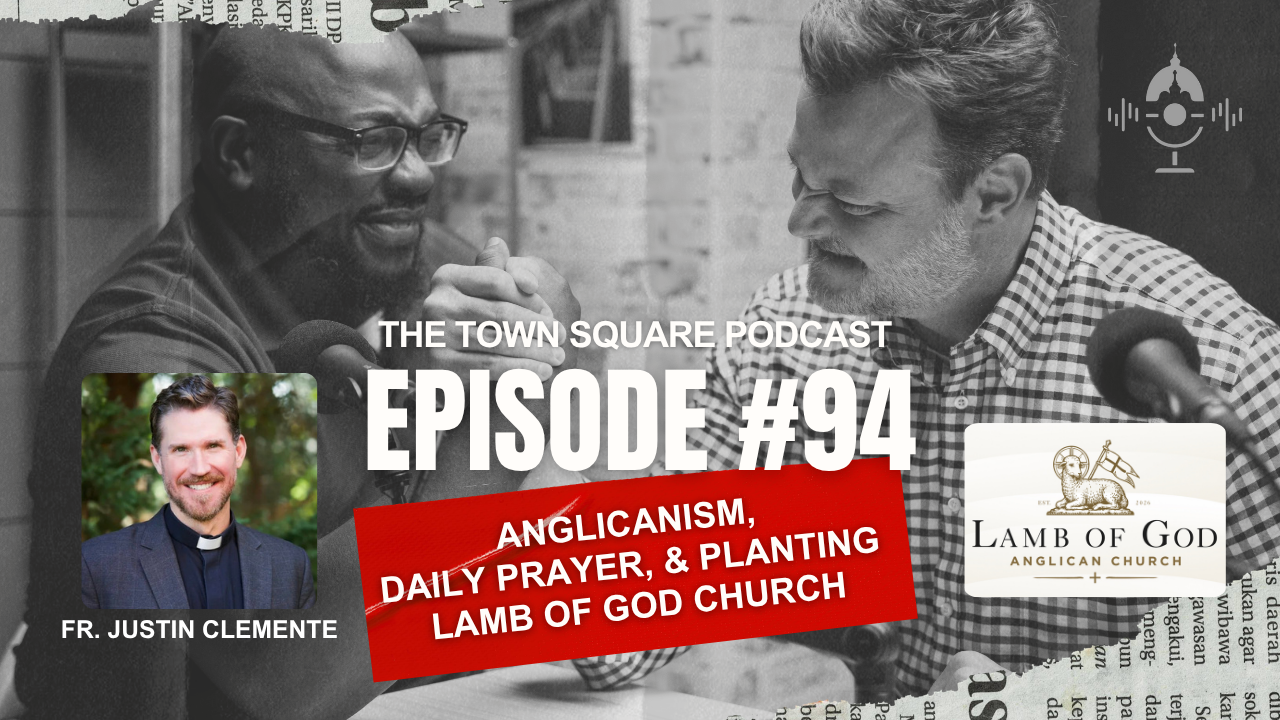
Ancient Faith, Daily Prayer, and a New Anglican Church in Covington
For many Christians, words like liturgy, Anglicanism, the Daily Office, and the Book of Common Prayer can sound like they belong in a church-history classroom—or at least somewhere with stained glass, incense, and a vocabulary quiz waiting at the door.
But for Father Justin Clemente, these aren’t museum pieces.
They are living tools: ways Christians have worshiped, prayed, learned, and followed Jesus together for centuries. And now, Fr. Clemente is bringing that tradition to Covington through a new congregation called Lamb of God Anglican Church.
In Episode 94 of The Town Square Podcast, Fr. Justin joins Trey Bailey and guest co-host Dr. Gregory Brown for a wide-ranging conversation about Anglican history, embodied worship, structured prayer, church leadership, and what Fr. Clemente describes as a “quiet revival” among young men searching for a deeper and more rooted expression of Christian faith.
It’s part theology lesson, part church-history tour, and part introduction to a new local congregation.
And, somehow, it remains a conversation ordinary people can follow.
“The Most Important Title I Have”
The conversation begins with a question that many people outside Anglican circles may wonder about: Why call a priest “Father”?
Fr. Clemente explains that, within the parish, the title is intended as a term of spiritual trust and endearment—a picture of someone called to offer fatherly care in Christ. But before any ministerial title, Fr. Clemente describes himself more simply.
His most important identity, he says, is “redeemed child of God.”
Then comes husband, father, Anglican priest, writer, editor, and—because, as he jokes, he is apparently “a glutton for punishment”—church planter once again.
Fr. Clemente previously spent a decade planting a church in western Maryland, where his family lived for 18 years. After moving to Georgia, he served at Holy Cross Cathedral in Loganville. He also writes and edits for Anglican Compass, a national resource designed to explain Anglican belief, worship, and practice with clarity.
His most recent book, At the Cross: Reflections on the Stations of the Cross, explores the 14 biblical Stations of the Cross as a devotional journey through Christ’s passion.
Fr. Clemente describes meditating on the cross as being like trying to hold the ocean in your hands. You cannot contain the whole thing—but you may be able to receive a drop and understand its depth a little more.
That image sets the tone for much of the episode.
This isn’t about knowing everything at once.
It’s about slowing down long enough to see more.
What Is Liturgy?
One of the episode’s most helpful sections begins with a basic question: What does liturgy actually mean?
Fr. Clemente describes liturgy as the work of the people—the shape and substance of what Christians do together in worship in response to God’s grace. Anglican worship also emphasizes that God is the primary actor: Christians gather not only to offer worship but to receive God’s gifts.
And every church has a liturgy.
Some churches write theirs down. Others follow an unwritten pattern that members understand instinctively. There may be opening music, announcements, prayer, preaching, an invitation, and a closing song. Change that order too dramatically and people quickly realize that even an “informal” church has expectations about how worship should proceed.
The real question, then, isn’t whether a church has a liturgy.
It’s what that liturgy teaches—and what kind of people it forms.
Worship You Can See, Hear, Smell, Taste, and Touch
Anglican worship is deliberately physical.
Scripture is read aloud. Congregants stand, kneel, speak, pray, exchange the peace, receive consecrated bread and wine, and sometimes experience the scent of incense moving through the sanctuary.
Those practices are not meant to be empty ceremony. Fr. Clemente explains them as ways of involving the whole person in worship.
Incense, for example, recalls biblical images of prayer ascending before God. It marks important moments: the gathering of the congregation, the reading of the Gospel, Communion, and the church’s movement back into the world. By the time worshipers leave, the aroma may literally remain on their clothing—a physical reminder of their calling to carry the “aroma of Christ” into the coming week.
The Gospel reading may be carried into the congregation rather than delivered only from a distant platform. The table remains visually central. White robes, or albs, are intended not to draw attention to the person wearing them, but to point toward baptism, purity in Christ, and the worship of heaven depicted in Scripture.
For Dr. Brown, the educator at the table, the multisensory nature of the service raises an interesting point: people learn in different ways. When worship involves hearing, seeing, tasting, touching, and even smelling, theological truth can move beyond abstract explanation and become something the congregation experiences together.
Liturgy teaches.
But it also forms.
Anglicanism: Protestant and Catholic?
The conversation also attempts something ambitious: explaining Anglican history in plain English.
Fr. Clemente places Anglicanism within the long history of Christianity in Britain, rather than beginning its story solely with King Henry VIII or the Protestant Reformation. He describes an English Christian heritage reaching back into the early centuries of the church and continuing through figures such as Patrick and the Celtic missionaries.
At the Reformation, Anglicanism chose reform rather than complete reinvention.
One metaphor offered during the conversation compares the church to a house. The foundation—Jesus Christ—remains secure. But over time, parts of the house may need repair, cleaning, or restoration.
Anglicanism, in Fr. Clemente’s telling, seeks to hold together the best of Protestantism and the historic catholic tradition, using catholic in its broad sense of the universal Christian church.
That means a high view of Scripture alongside deep respect for the early church, historic creeds, sacraments, ordered worship, bishops, priests, deacons, and the accumulated wisdom of Christians who came before us.
It also means acknowledging that the church can make mistakes.
As Fr. Clemente puts it, the church cannot ultimately fall—but it can trip.
Bishops, Priests—and the People of God
Anglican church government includes a visible structure of bishops, priests, and deacons, but Fr. Clemente is careful to explain that this does not eliminate the role of ordinary members.
A local congregation is typically guided by a vestry composed primarily of lay leaders and headed by the rector or senior priest. Regional churches belong to dioceses under bishops, while broader provincial structures connect Anglicans across larger geographical areas.
The result is neither purely congregational nor exclusively clergy-driven.
There is order, Fr. Clemente explains, but the people of God still have a genuine role and responsibility in the life of the church.
The episode also distinguishes the Anglican Church in North America (ACNA) from the Episcopal Church in the United States. Fr. Clemente describes the Anglican Church in North America, founded in 2009, as a movement committed to historic, biblically faithful Christianity after serious theological divisions within the Episcopal Church.
He acknowledges that separation came at a cost for many early leaders and congregations. But the deeper issue, he says, was whether the church still believed and proclaimed the Gospel—including the call for every person to repent, believe, and receive the grace of God.
The Book of Common Prayer: “Scripture Arranged for Worship”
Perhaps the most immediately practical part of the episode centers on the Book of Common Prayer.
Fr. Clemente’s description is refreshingly simple:
It is “Scripture arranged for worship.”
Rather than replacing the Bible, the prayer book organizes biblical language into patterns of personal, family, and corporate prayer. One of its best-known practices is the Daily Office, which provides forms for morning prayer, midday prayer, evening prayer, and Compline before bed.
Most people will not pray every office every day.
That isn’t the point.
The point is to develop a sustainable pattern that brings Christians repeatedly back to Scripture, the Psalms, confession, thanksgiving, intercession, and prayer for the church and the world.
Fr. Clemente describes the Daily Office as a rock for his family during the previous year. For Trey, learning to use it sparked a renewed hunger for Scripture and prayer.
But Dr. Brown raises an important objection: Can written prayer become little more than reading someone else’s script? What about the personal concerns that do not appear on the page—the hurting ankle, strained marriage, depression, anger, or fear someone actually brings into the room?
Fr. Clemente responds with one of the episode’s strongest analogies.
The prayer book is like a fireplace.
The fireplace provides form and structure. The person brings the fire.
Written prayers do not prevent personal prayer; they give it a framework. They also train Christians to pray beyond their immediate concerns. A person left entirely to spontaneous prayer may repeatedly return to the same subjects and phrases. Historic prayers introduce other needs, biblical themes, and ways of approaching God.
In that sense, the Daily Office is both prayer and discipleship.
It gives us some reps.
The “Quiet Revival” Among Young Men
So why plant another church?
Fr. Clemente says he did not initially plan to return to church planting. After a decade of doing that work in Maryland, he moved to Georgia and served at Holy Cross Cathedral.
But the desire returned.
Part of that calling grew from a pattern he began seeing among young men. Again and again, they told him a version of the same story: They had become serious about Christianity, discovered historic Christian teaching online, and arrived at church looking for someone to help them grow.
Some have called this a “quiet revival.”
Fr. Clemente is less concerned about the label than the pastoral reality in front of him. Something different is happening, he says. Young men are seeking tradition, discipline, theological depth, and a faith substantial enough to shape their lives and families.
But enthusiasm alone is not enough.
Those men need pastors. They need community, correction, encouragement, and protection from the ditches waiting on both sides of the road.
Lamb of God Anglican Church hopes to meet some of that need by being confidently Anglican, deeply traditional, and genuinely welcoming.
A New Anglican Community in Covington
Lamb of God Anglican Church is still in its early stages.
At the time of this recording, the congregation was meeting on Sunday evenings at 4 p.m. at Lily & Sparrow Mercantile in Covington. Fr. Clemente expresses gratitude to Jason and Noelle Cosby for opening their space to the emerging church community.
The immediate priority is not creating an impressive Sunday production.
It is forming a people.
Fr. Clemente wants first-time visitors—especially those unfamiliar with Anglican worship—to encounter a hospitable community that will not make them feel foolish for not knowing when to stand, kneel, speak, or remain silent.
The goal is to combine conviction with welcome.
Or, as Fr. Clemente puts it, to say both: “This is who we are,” and “Come and see.”
That invitation becomes his final message to the community.
Anglicanism can be explained through history, theology, polity, liturgy, prayer books, robes, incense, and sacraments. But Fr. Clemente believes its strength is ultimately experienced in worship and life together.
If something in the conversation stirred your curiosity, his invitation is simple:
Come and see.
Lamb of God and Fr. Justin info:
Links Mentioned
Watch Episode 94 on YouTube: https://youtu.be/ng0jCBUobN4
Lamb of God Anglican Church: https://loganglican.org
Anglican Compass: https://anglicancompass.com
Fr. Justin Clemente’s book, At the Cross: https://anglicancompass.com/book/at-the-cross/
Lily & Sparrow Mercantile: https://www.lilyandsparrow.co
Luther Rice College & Seminary: https://www.lutherrice.edu
Sponsor / Advertiser
Luther Rice College & Seminary
Website: https://www.lutherrice.edu
What they do: Luther Rice College & Seminary provides biblically grounded, accredited education for students preparing to serve in ministry, the marketplace, and their communities. Its programs are offered 100% online, with options ranging from certificates and undergraduate degrees to master’s and doctoral programs.
Whether you are a high school student exploring dual enrollment, an adult seeking a stronger biblical foundation, or a working professional preparing for your next calling, Luther Rice offers flexible education shaped by a Christian worldview.
Take your next step at https://www.lutherrice.edu.