

Jonathan Chavez on Healthcare, Immigration, and Georgia’s 13th District—Episode 104
Click one of the following links to listen on
Apple Podcasts or Spotify. Or click on the photo below to watch on YouTube.
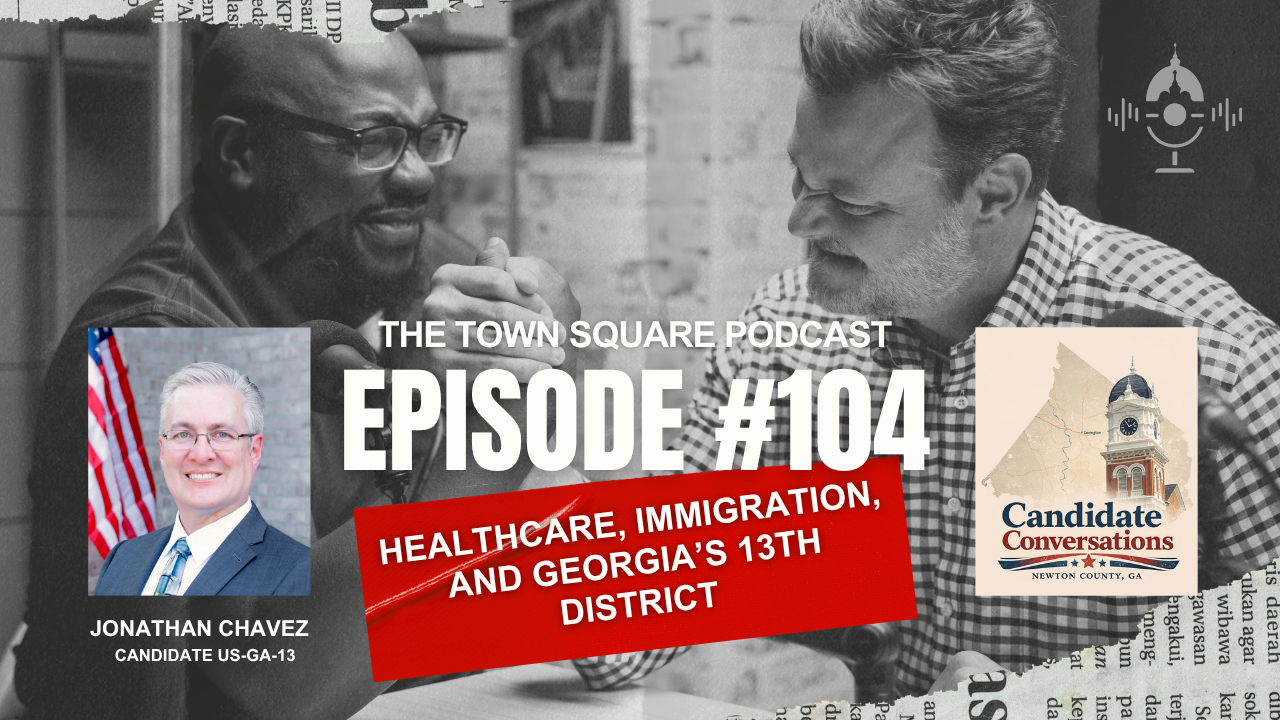
What does “meeting in the middle” actually mean when the conversation turns to healthcare, immigration, abortion, and the cost of living? It is easy to say we need more cooperation. The harder question is where a candidate is willing to practice it.
In Episode 104, our Candidate Conversation series continues with Jonathan Chavez, a Republican running for US Congress in Georgia’s 13th District. The Conyers resident joins us to discuss the experiences behind his positions, the problems he wants Congress to address, and the places where his answers depart from familiar party talking points.
There is also a surprisingly detailed conversation about loading a dishwasher. Around here, getting to know a candidate includes the person who goes home after the campaign event.
The family and work behind the campaign
Chavez describes a path from Albuquerque to Boston and eventually to Conyers, where his wife’s family helped draw them to Georgia. He talks about raising four children, his family’s decision to homeschool, and the work ethic his father passed down to him.
Those family stories help explain how he approaches opportunity and responsibility. He recalls working as a teenager and learning to keep a goal in view when setbacks came. Today, he says, his children are a central reason he keeps pushing himself.
His professional background brings another perspective. Drawing on his military medical service and work in healthcare administration, Chavez describes leadership as a responsibility to make decisions with the best information available, including information that challenges your first instinct.
Why he wants people who will challenge him
One of the episode’s most revealing stories comes from a military training exercise. Faced with a simulated casualty lying on a grenade, Chavez had to decide how to protect his team while continuing to help other patients. He describes choosing to report the hazard and move the team forward.
The lesson he carried away was about making a decision under pressure, then learning from it. In his civilian work, he says that also means hiring people who will question his approach.
“I need to surround myself with not just yes people,” Chavez says. He wants respectful opposition because someone else may see the angle he missed. That idea becomes a recurring test throughout the conversation: how would it translate from a hospital team to Congress?
Healthcare beyond a yes or no on Obamacare
Healthcare produces some of the most detailed policy discussion. Chavez says he values the Affordable Care Act’s protections for people with preexisting conditions and wants to improve the system rather than reject it wholesale.
He proposes expanding public coverage for certain expensive medical conditions while giving health insurers more ability to compete across state lines, with a minimum coverage standard. In his view, taking on some of the costliest care could create room to press insurers for lower premiums. Those are his proposed changes and expected benefits, not established outcomes.
Chavez connects his ideas to the patients he encounters through his work, including people who struggle to afford copayments. He also describes efforts to shorten inpatient MRI turnaround times and develop cardiac imaging services. For him, the policy question starts with whether people can actually get the care they need.
The discussion leaves room for the implementation questions: how coverage would be financed, how quality would be protected, and what would make the promised savings reach patients. It gives listeners a clearer picture of what he wants to pursue.
Affordability and a different way to collect taxes
On affordability, Chavez discusses housing tax credits, business regulation, and support for small businesses. The hosts press him on the boundary between what Congress can change and what belongs to state or local government.
He also explains his interest in the FairTax proposal, a national consumption tax approach with a monthly household “prebate.” He sees potential in changing how federal taxes are collected, while saying the idea needs more research and questioning whether it would really eliminate the IRS.
For listeners, the useful question is what such a change would mean for a household’s full budget: take-home pay, purchases, and the monthly prebate together. Chavez’s expectations about prices and savings are part of his case for studying the proposal.
Border security and a pathway for longtime residents
Asked what securing the border means to him, Chavez argues for enforcement alongside a more workable legal immigration system. He also says some longtime undocumented residents who have contributed to their communities should have a pathway toward citizenship.
His grandfather’s immigration story helps shape that view. Chavez says this is one area where he differs from some people in his own party, and he describes wanting a process that is faster and better able to vet applicants.
The exchange gets at an important part of Candidate Conversations: a broad campaign phrase can hold very different ideas. Asking the next question is how listeners find out what a candidate actually means.
Schools and measuring student growth
Education brings the conversation back to the relationship between federal support and local decisions. Chavez favors expanding support for students facing poverty, educator development, and students from immigrant backgrounds while giving states and districts room to determine how resources are used.
He argues for measuring students’ progress from their starting points. When students struggle, he wants schools to receive help and resources to improve. He also supports assistance for homeschooling families, while acknowledging that homeschooling is not a workable option for everyone and that public schools will continue to serve families.
Faith, abortion and the limits of party labels
Chavez is direct about his Christian faith and opposition to abortion. He describes those convictions as central to his reasons for running, and he discusses wanting a larger place for prayer and Christian principles in public life.
The hosts also explore how voters weigh competing priorities. A person’s party affiliation does not necessarily tell you what they believe about every issue, or which concern will carry the most weight in their vote. That exchange adds context without resolving the disagreements.
Chavez says he once identified as a Democrat, and he credits conversations with his wife with challenging his views. His willingness to describe that change sits alongside firm positions that some listeners will share and others will question. Both are part of understanding the candidate.
Hear the reasoning and bring your questions
Near the end, the conversation returns to accountability: what should voters expect from the person they send to Washington, and how should they judge the results? Chavez argues for a change in representation and says he does not want a lifelong career in Congress.
This episode offers listeners time to hear his reasoning across several issues, including where he draws a firm line and where he sees room to work with others. Watch the full conversation, consider the proposals, and bring your own questions. That is the work of the messy middle.
Watch Episode 104: https://youtu.be/4b3pWEq1Cv8
Links Mentioned
Jonathan Chavez campaign website - https://jonathanchavezforcongress.com/
FairTax proposal discussed in the episode - https://fairtax.org/about/how-fairtax-works
Watch Episode 104 - https://youtu.be/4b3pWEq1Cv8
Become a Town Square Insider. Don't miss a single episode or the weekly blog posts. Click the link and enter your email address to be a Town Square Insider - https://TheTownSquarePodcast.com/insiders
Sponsors and Advertisers
Thank you to United Bank Mortgage for supporting Town Square Podcast and our Candidate Conversation series. United Bank offers mortgage services with local lenders who can help you explore buying or refinancing a home. Visit https://www.accessunited.com to learn more and connect with their team. Member FDIC. Equal Housing Lender.