

Zayvion Sheppard on For Atlanta. By Atlanta., Mentorship and Community Giving — Episode 103
Use the audio-player above to listen here, or click one of the following links to listen on
Apple Podcasts or Spotify. Or click on the photo below to watch on YouTube.
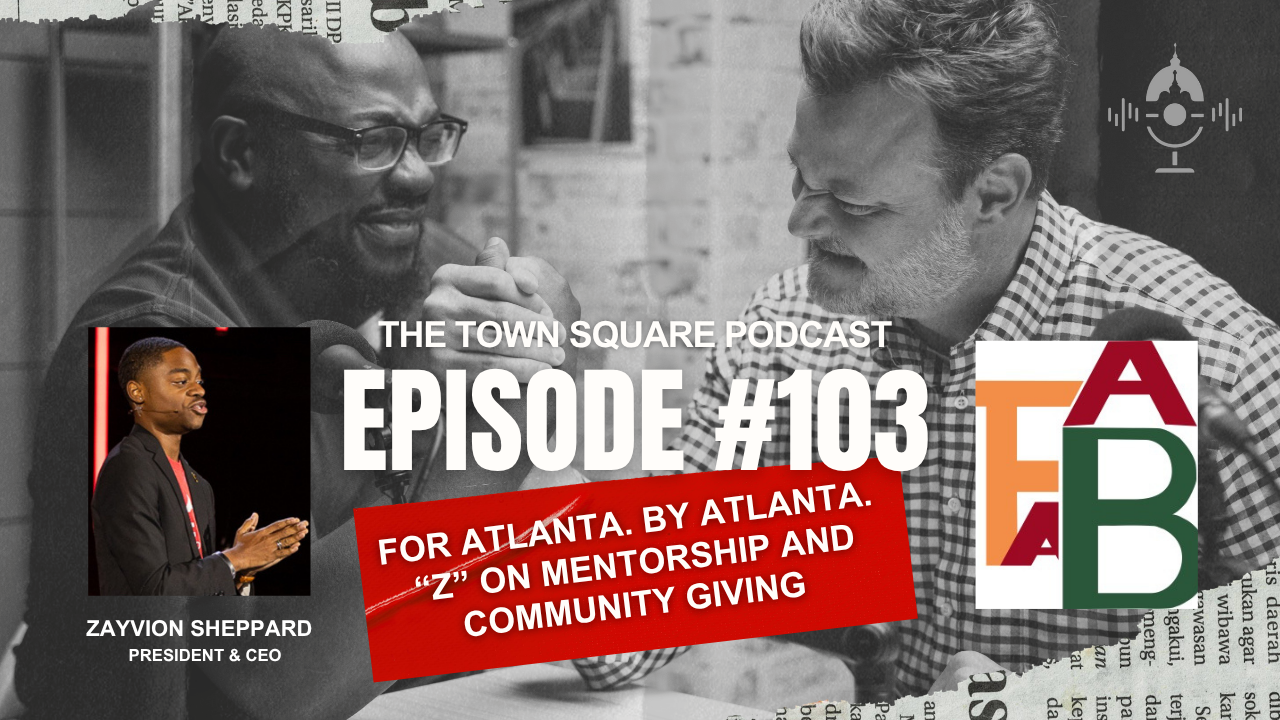
What Ten Dollars a Month Can Do for Your Community
Ten dollars a month may not sound like the beginning of a community investment strategy. Zayvion Sheppard thinks it is a perfectly good place to start. Get 50 people to commit, and those small gifts add up to $500 a month, or $6,000 over a full year. For a grassroots organization helping students prepare for college or neighbors find work, that can mean something practical.
Zay returns to The Town Square Podcast with an invitation to participate in that kind of giving through For Atlanta. By Atlanta., known as FABA. He also brings a book announcement, an honest account of nearly giving up on the organization, and a reminder that the people who invest in a young person may never see the full reach of what they started.
Making room for everyday donors
Zay describes attending an Atlanta benefit and leaving energized by the generosity in the room. He appreciated what large donors and corporate partners could make possible. He also wondered how more people could experience the same connection to the work without a high price of admission.
That question helped shape what he calls “affordable impact.” The FABA 50 invites 50 people to give $10 a month. It is a way to make regular community giving accessible to people who want to help but may never write a large check.
In the conversation, Zay is candid about how hard it can be to ask. At 22, he has had to challenge his own doubts about whether people will trust him with their money. The response from his network has pushed him to take that trust seriously and to stop assuming the answer will be no.
Raise invest and elevate
FABA’s approach centers on raising money, investing in community organizations, and sharing the stories of what those investments make possible. Zay wants donors to see the people and work behind a contribution.
He points to the Taylor Made Foundation as an example. In his account, FABA’s support helped the organization send five graduating students off to college with dorm-room supplies. Refrigerators, microwaves, toiletries and school supplies may not sound glamorous. For a family getting a student ready to leave home, they are real needs.
Zay also discusses support for after-school learning and workforce development. When asked whether education, housing and employment define the organization’s limits, he clarifies that fighting poverty is the broader purpose. The team wants to find trusted organizations doing effective work, including those that may not fit neatly into a predetermined category.
Finding the people a neighborhood already trusts
The way Zay describes finding partners is refreshingly local. Talk to people. Ask who has helped their children, their families or their neighbors. Pay attention to the organization that keeps showing up, even if its leader is too busy doing the work to promote it.
He wants that community knowledge to matter in funding decisions. Many of the leaders he describes hold another job while running their nonprofits. FABA aims to support their work without adding a heavy administrative burden. Follow-up conversations still matter: What did the support accomplish? What need remains? What could additional funding make possible?
That approach also puts responsibility on FABA. Zay describes board oversight and regular conversations about the organization’s decisions. He tells a particularly personal story about a donor who preferred to hand over cash: a $20 contribution covering two months of support. He does not know what it took for her to spare that money. He knows he has a responsibility to use it well.
The part of leadership people rarely announce
Zay admits that there was a point when he hoped FABA might quietly fade away. The ambition was big, and the team had overcommitted. Then someone at a professional program asked about the organization after Zay had deliberately left it out of his introduction.
That conversation helped him reconsider. Instead of trying to do everything, the team focused on work it knew it could carry out: raise funds, support organizations already serving their communities, and tell their stories. Starting with a small group of partners gave them room to learn how to manage an investment cycle responsibly.
It is a useful part of the story for anyone who has started something and then wondered whether they were qualified to keep going. Zay’s confidence has grown alongside that willingness to narrow the work, ask questions and accept help.
A book about the people who invested in him
Zay also shares that he has completed a manuscript. Its working title is A Dollar’s Worth of Impact, a callback to a story he told during his earlier Town Square appearance. The title and publication plans are still developing.
He hopes the book will speak to young people trying to lead and to the adults mentoring them. Writing it has meant revisiting family support, the loss of his grandfather, and the people who made room for him in places he had never been before.
The central idea is personal. Zay does not describe his path as proof that he was smarter than everyone around him. He points to the time, attention and opportunities other people gave him. He wants readers to consider what a similar investment might mean for someone else.
Taking Newton County with him
The conversation keeps returning to home. Zay talks about his work in government and community affairs at Georgia State University and the relationships he has built in Atlanta. He also makes clear that success elsewhere does not erase his connection to Newton County.
“I like home,” he says.
He connects that attachment to a question he uses to think about community decisions: “And how are the children?” For Zay, the value of an investment may become clearest years later, when a student who received support has the chance to help someone else.
His invitation is practical. Give if you can. Share the work. Introduce FABA to an organization your community trusts. There are several ways to participate, and the first one may be as simple as starting a conversation.
Watch the full conversation with Zayvion Sheppard:
https://youtu.be/zaKh0YOmQYM
Links Mentioned
For Atlanta. By Atlanta. https://foratlbyatl.org/
The FABA 50. https://foratlbyatl.org/the-faba-50/
Taylor Made Foundation https://taylormadefoundation.org/
East Atlanta Kids Club. https://eastatlantakids.org/
The Same House. https://www.thesamehouse.org/
Newton Education Foundation https://newtoneducationfoundation.org/
Sponsors and Advertisers
United Bank
United Bank serves individuals, families and businesses with banking and lending services. Thank you to United Bank for supporting conversations that keep our community connected. Visit the Covington office or explore what the bank offers online.
https://www.accessunited.com