

Rev. Dr. Terrence Evans on St. Paul AME Church and Faith in Community—Episode 102
Click one of the following links to listen on
Apple Podcasts or Spotify. Or click on the photo below to watch on YouTube.
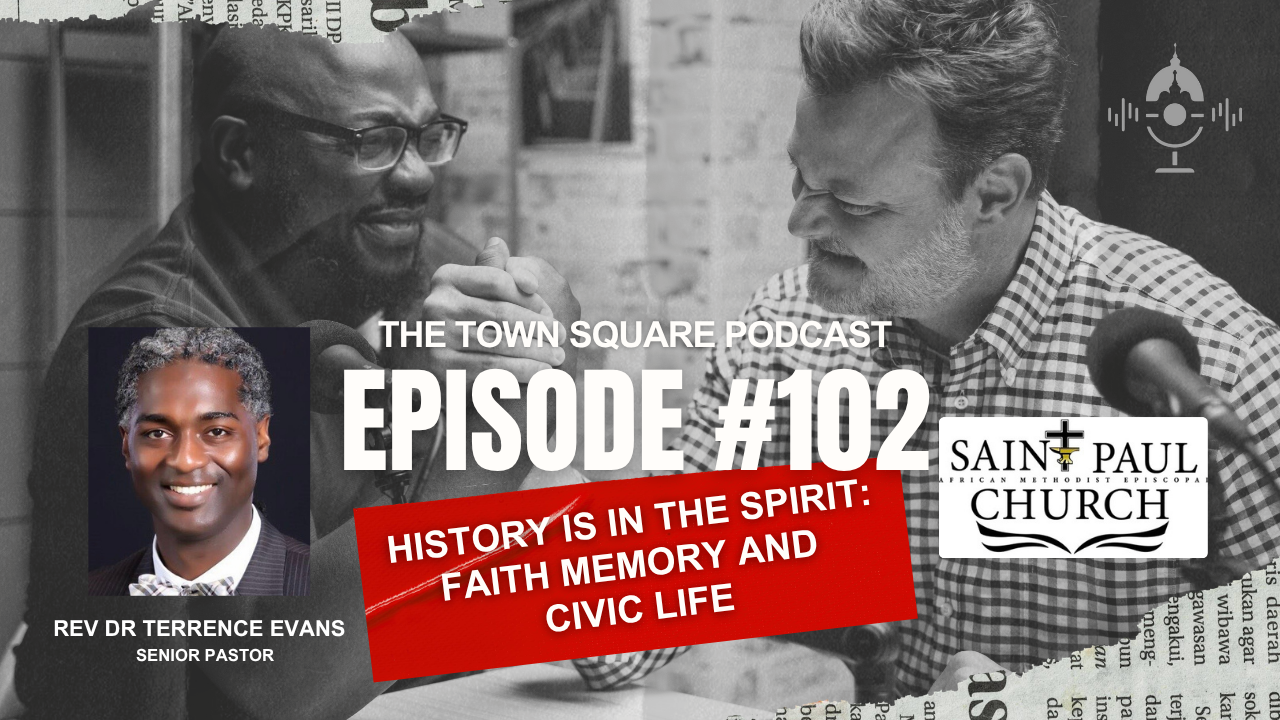
History Is in the Spirit: Rev. Dr. Terrence Evans on Faith Memory and Civic Life
Town Square Podcast Episode 102 | Faith and Community
Watch the conversation on YouTube: https://youtu.be/73cI1WtGUGg
A church can hold a community’s history in ways that a courthouse file or a history book cannot. St. Paul African Methodist Episcopal Church has served Covington since 1878. Its congregation rebuilt after fires, lived through segregation and integration, helped people register to vote, and carried its ministry from Stone Mountain Street to a larger home on Brown Bridge Road.
In Episode 102 of the Town Square Podcast, Rev. Dr. Terrence Evans joins the Faith and Community series to talk about the life behind that history. His story moves from Opa-locka and Miami to Georgia State basketball, eighteen years serving people experiencing homelessness, a call to ministry, and his 2023 appointment as senior pastor of St. Paul AME Church in Covington.
The conversation also offers a plain-language introduction to the AME tradition: why the denomination was formed, how its structure works, and why worship, memory, social action, and grace remain connected.
The Barbershop Test
Before Evans was a pastor, he was Sherry and Willie’s son, a six-foot-seven basketball player from Opa-locka, Florida, and a young man deciding where a scholarship might take him. He knew Miami. Atlanta was new.
Georgia State began to feel like home almost immediately. Evans arrived without having gotten a haircut, asked his coach for help, and was taken straight to a local barbershop. That ordinary act told him something important: he could find community here.
His years as a Panther also shaped his approach to leadership. Evans remembers one coach as quick and direct and another as deeply relational. The second model is especially visible in his ministry now. He believes leaders should offer clear direction, trust people to use their gifts, receive feedback, and pivot when a better path serves the church and the gospel.
Grace in Action at Jefferson Place
After earning a criminal justice degree with a minor in sociology, Evans considered law enforcement. His mother, a Miami police officer, urged him to remain in Atlanta. A summer youth-employment job opened the door to Fulton County government, and an overnight position at Jefferson Place became an eighteen-year vocation.
Jefferson Place was a transitional housing program located in the former Fulton County jail. Evans began by checking residents in at night and later became a case manager. He watched men complete technical training, build businesses, restore family relationships, and move toward stability. He also witnessed relapse, disappointment, and the painful consequences of rules that could not simply be wished away.
That work changed his understanding of ministry before he had a pulpit. “It helped me to see grace in action,” Evans says. “It helped me to see how it is that there are consequences.” Holding those truths together became part of his pastoral formation: compassion does not erase accountability, and accountability does not cancel a person’s humanity.
A Call and an Immediate Assignment
Evans was raised Baptist and did not grow up expecting to enter ordained ministry. While serving at Jefferson Place, raising three children with his wife, and worshiping in an AME congregation, he began to recognize a persistent call. He entered the AME Board of Examiners process and studied at Turner Theological Seminary at the Interdenominational Theological Center.
The transition from preparation to pastoral responsibility came quickly. In 2010, almost immediately after his ordination as an itinerant deacon, a presiding elder told him about a small church that needed a pastor. His first appointment was St. Paul AME Church in Dallas, Georgia. He later served Greater Ward Chapel AME Church in Columbus before being appointed to St. Paul in Covington in June 2023.
There is a fitting symmetry in beginning and continuing his pastoral work at congregations named St. Paul. There is also a consistent thread: Evans’ ministry grew from service, relationships, and the belief that God was already present in places he had not expected to go.
What African Methodist Episcopal Means
For listeners who have seen the initials without knowing the distinctions, Evans breaks the name into three parts. African points to a church founded by people of African descent. Methodist identifies its Wesleyan theological roots and disciplined approach to Christian life. Episcopal describes a structure of governance led by bishops, with pastors appointed to congregations and layers of accountability that extend from the local church to the denomination’s General Conference.
Evans describes a connectional church rather than a collection of independent congregations. St. Paul belongs to the East District of the Atlanta North Georgia Annual Conference, within the Sixth Episcopal District. Local church conferences, quarterly conferences, district and annual conferences, and the denomination’s quadrennial General Conference each have a role.
The structure can sound complicated from the outside. Evans sees strength in its checks, relationships, shared doctrine, and wider mission. The local congregation is rooted in Covington, but it belongs to an international church.
A Church Born from Worship and Protest
The AME story begins with the Free African Society, organized in Philadelphia in 1787 by Richard Allen, Absalom Jones, and others. After Black worshipers at St. George’s Methodist Episcopal Church faced racial discrimination, Allen and others pursued a place where people of African descent could worship freely and serve one another fully. Allen established Bethel in 1794, and in 1816 representatives of Black Methodist congregations formed the African Methodist Episcopal Church.
Evans emphasizes that this history is not only denominational history. It is American history. The church grew from a refusal to accept dehumanization inside Christian worship and from a commitment to mutual aid, religious autonomy, and the full dignity of Black people.
That founding story still asks something of the church. Evans argues that remembering injustice is not an exercise in resentment. It is a way to understand the cost of progress, honor those who endured and resisted, and recover the church’s responsibility to serve people whose dignity is still challenged.
St. Paul Carries Its History Forward
St. Paul’s own story reflects that resilience. Founded in Covington in 1878, the congregation rebuilt after multiple fires and continued serving across generations. Its history includes voter registration and civil rights work, and that legacy now lives through its Social Action Ministry.
The congregation hosts a polling place, organized a candidate forum, and works with community partners to help new voters understand the political process and identify the offices and people on their ballots. Evans is careful about the distinction: this is nonpartisan participation, not an instruction about whom to support.
The point is access and responsibility. Local elections can be decided by a handful of votes, while many residents do not know who represents them or how local offices affect daily life. For St. Paul, encouraging informed participation is connected to the sacrifices of people who fought for voting rights.
When the congregation moved from its historic site to Brown Bridge Road, some members worried about leaving physical history behind. Evans offers a line that captures the transition: “History is not in the walls. History is in the spirit.” A larger campus did not discard the story. It gave that story more room to continue.
What a Sunday at St. Paul Feels Like
Evans describes St. Paul as a congregation where a visitor should feel like family. The service follows a recognizable AME order that includes the doxology, prayer, Scripture, music, and preaching. First Sundays lean more traditional, with hymns that carry theology and memory across generations. Contemporary music has a place too.
Evans calls himself a teacher and storyteller more than a “whooper,” though he acknowledges that the energy can rise. He often works from the lectionary and has also begun preaching in series. Preparation matters, but so does listening. He describes preaching as a collective moment shaped not only by the person in the pulpit but by the congregation’s response, silence, faces, and later conversations.
Sunday school begins at 9:30 a.m., and worship begins at 11 a.m., as stated in the episode. St. Paul AME Church is located at 13108 Brown Bridge Road in Covington. Visitors can learn more at https://www.stpaulamecov.org.
A God Who Is Available
Asked what he would say if all of Newton County and the surrounding community were listening, Evans returns to grace: “We have a God that is available.” He means available in success and disappointment, trauma and healing, clarity and uncertainty.
His own path gives the statement weight. The young athlete did not know he would become a pastor. The county employee did not know that overnight work in a transitional housing program would become ministry. The newly ordained deacon did not know a pastoral appointment was waiting before he left the building.
Faith, in Evans’ telling, is not an escape from community life. It is a reason to enter it with humility, memory, service, and hope. St. Paul’s history belongs to Covington, but its work is happening now, in worship, voter education, hospitality, and the ordinary relationships through which a community learns to see one another more fully.
Links Mentioned
Watch Episode 102 on YouTube: https://youtu.be/73cI1WtGUGg
St. Paul AME Church in Covington: https://www.stpaulamecov.org
St. Paul AME Church history and pastor biography: https://www.stpaulamecov.org/about-us
African Methodist Episcopal Church history: https://www.ame-church.com/our-church/our-history/
Luther Rice College and Seminary: https://www.lutherrice.edu
Bizzy Bee Exterminators: https://www.bizzybeeexterminators.com
Sponsors and Advertisers
Luther Rice College and Seminary
Luther Rice offers biblically grounded, accredited, 100 percent online programs for traditional students, adult learners, ministry leaders, and working professionals. Explore undergraduate, graduate, certificate, and doctoral options at https://www.lutherrice.edu.
Bizzy Bee Exterminators
Bizzy Bee Exterminators is a full-service pest-control company serving homes and businesses in Covington and beyond. Request service at https://www.bizzybeeexterminators.com or call 770-787-3718.