
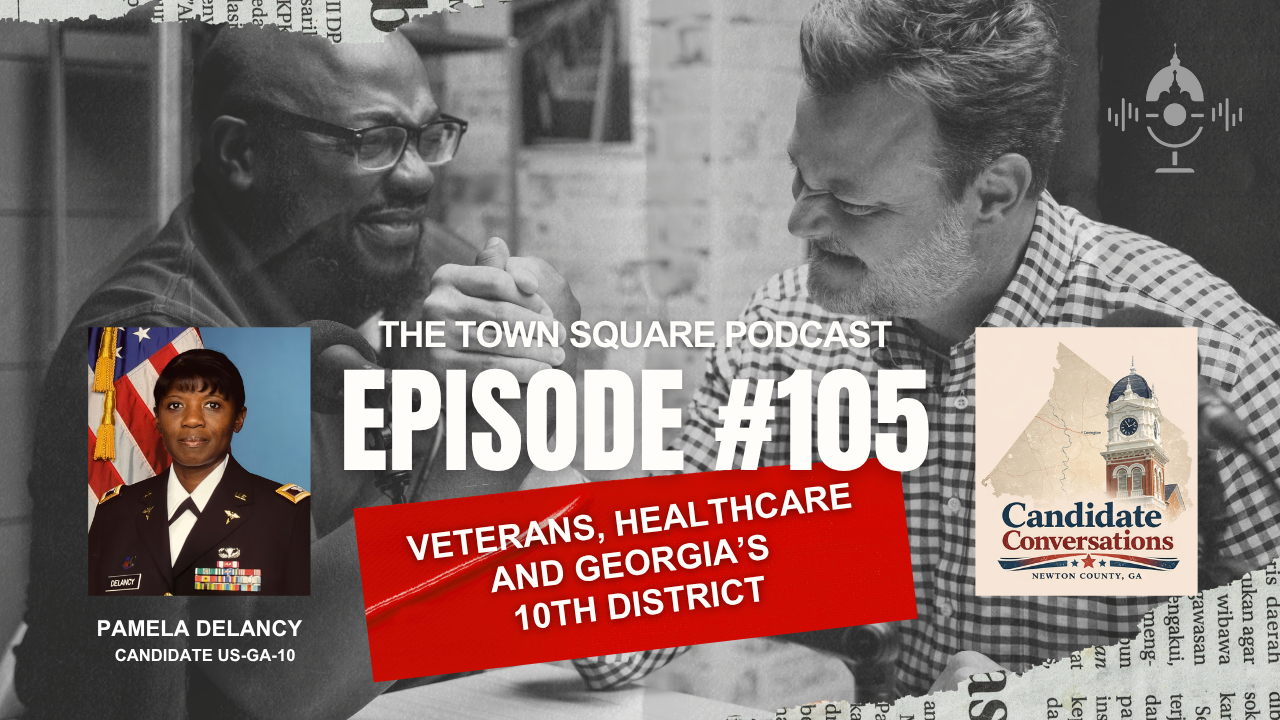
Pamela DeLancy on Veterans, Healthcare and Georgia’s 10th District—Episode 105
Click one of the following links to listen on
Apple Podcasts or Spotify. Or click on the photo below to watch on YouTube.
A grocery bill. A long drive to medical care. A veteran still trying to get help. When Pamela DeLancy talks about the people she meets on the campaign trail, those are the kinds of concerns she brings to the table.
In Episode 105, our Candidate Conversation series continues with DeLancy, a retired Army colonel and registered nurse running for US Congress in Georgia’s 10th District. She joins us to discuss the experiences that shaped her, why she decided to run, and what she hears from residents across a district that takes serious windshield time to cover.
She is direct about her convictions. She also has stories to tell, beginning long before she ever thought about putting her name on a ballot.
Learning to lead before she had a title
As the oldest of six children, DeLancy describes taking on family responsibilities early. After her parents divorced, her mother worked nights as a licensed practical nurse. DeLancy helped get her siblings up, fed, and ready for school so that the morning could run smoothly when her mother came home.
She also recalls her younger brother’s serious medical needs and the family’s move from Louisiana to Houston to find care. Helping her family was part of daily life. Looking back, she sees those experiences as the beginning of her understanding of accountability and service.
At 17, she asked her mother to sign the paperwork allowing her to join the Army. She saw a way to continue her education, support herself, and send money home. The plan eventually led her into nursing and a military career that lasted much longer than she initially imagined.
From enlisted soldier to Army colonel
Early in the interview, DeLancy corrects the hosts’ notes: her service totaled 39 years, including 31 on active duty and eight in the Army Reserve. She describes beginning as an enlisted soldier, taking college classes while stationed in Germany, and later returning to school full time.
Through ROTC and nursing school, she became an officer. She tells the story of discovering that the Army needed her back on active duty as a nurse, a development she now sees as one of the best turns her career took.
The conversation also addresses the challenges she experienced as a Black woman in leadership. DeLancy says she learned to stay focused on her work and goals even when others questioned her authority. Her advice to younger soldiers was practical: be dependable, meet the standard, and do not let someone else’s behavior determine the course of your career.
Why she decided to run
DeLancy says her decision grew out of concerns about constitutional rights and the direction of the country. She emphasizes the military oath to the Constitution and argues that public officials should serve the people rather than pledge loyalty to a particular administration.
Her experience surviving gallbladder cancer also changed how she thought about the time ahead of her. She describes surgery, chemotherapy, and the importance of advocating for herself as a patient. After a long career of service, she felt called to do more.
There is a candid campaign origin story, too: a YouTube class, advice about raising money, and a prospective campaign manager whose discounted fee was still beyond what she had available. DeLancy kept going. A friend’s phrase, “Pam speaks boldly,” becomes a recurring thread in the interview.
What she hears on the road
Asked what residents tell her, DeLancy returns to affordability. She describes concerns about groceries, housing, fuel, and wages, along with the practical difficulty of finding services in rural communities. Some of the conversations she recounts involve limited access to dental care, maternity care, or a nearby grocery store.
For DeLancy, those issues connect. A job needs to pay enough to support a household, and a community needs the services that allow people to keep living and working there. She argues for stronger wages and career training, including opportunities for people who do not pursue a four-year degree.
She also talks about farmers who want to preserve agricultural land as pressure for development grows. The needs of a rural community, she says, cannot be understood solely from a distance. That is part of why she puts so much emphasis on visiting people in person.
Veterans and the work of getting help
Veterans’ care is one of the most personal parts of the episode. DeLancy describes people she has met who spent years trying to secure benefits, and she recounts her uncle’s experience seeking disability compensation. She says his approval arrived the day before the family buried him.
Her central argument is that veterans should not have to struggle through an exhausting process to obtain support connected to their service. She calls for more consistent access to mental healthcare, with attention to continuing treatment and prevention as well as crisis response.
She also describes an idea for a public-service employment and training program inspired by earlier conservation efforts. In her proposal, veterans and workers who need additional skills could train for jobs that meet needs in their own communities. She connects that idea to rural employment and the care an aging population will require.
Affordability without a magic wand
The hosts ask what Congress can realistically do about food and housing costs. DeLancy acknowledges that Congress cannot simply make prices fall overnight. She discusses supporting locally grown food, scrutinizing corporate pricing, and improving pay so that more families can cover basic expenses.
She also argues that debates about food assistance need to account for what people earn. In her view, it makes little sense to criticize families for needing help while accepting wages that leave them unable to pay for necessities.
Her answers place household stability at the center of her campaign. They also give listeners a useful starting point for follow-up questions about the federal policies, costs, and partnerships that would be needed to carry out her priorities.
Data centers and the people living nearby
When the conversation turns to data centers, DeLancy questions whether the promised economic benefits adequately account for the burdens on nearby residents. She raises concerns about water use, electricity demand, noise, and the protection of farmland.
She argues that developers should bear responsibility for addressing resource needs and community impacts. She also suggests that residents should share more directly in the benefits of projects built near them. These are her policy views and concerns; the interview is not a technical assessment of a particular facility.
The hosts acknowledge that they have heard different perspectives on data centers across the podcast. This conversation adds DeLancy’s priorities to that wider discussion: protect essential resources and ask who receives the benefit when a community accepts a major development.
Voting and the meaning of representation
DeLancy recounts receiving a voter-registration mailing that concerned her and contacting election officials about it. The experience becomes part of a larger conversation about access to voting and the importance she places on constitutional rights. For official registration and polling information, Georgia listeners can use the state’s My Voter Page: https://mvp.sos.ga.gov/s/
The hosts also ask her to identify both a difference and a point of agreement with her Republican opponent. DeLancy draws a sharp distinction between their approaches and says the shared pursuit of the office is the only common ground she can name. It is a revealing answer in a series built to let candidates explain where they stand.
She closes by asking voters to consider a candidate’s values and commitment to representation. Her case for running rests on the idea that serving people has been the consistent work of her life. Hear her make that case, weigh the ideas, and bring your own questions to the conversation.
Watch Episode 105: https://youtu.be/zHkwm1U8VKA
Links Mentioned and Listener Resources
Pamela DeLancy campaign website https://www.votepamdelancy.com
Watch Episode 105 https://youtu.be/zHkwm1U8VKA
Georgia My Voter Page — official voter information resource https://mvp.sos.ga.gov/s/
Town Square Insiders. https://TheTownSquarePodcast.com/insiders
Sponsors and Advertisers
Bizzy Bee Exterminators
Thank you to Bizzy Bee Exterminators for supporting this episode. Bizzy Bee provides pest control for homes and businesses, including termite and mosquito services. Visit https://www.bizzybeeexterminators.com to explore their services and request help with unwanted pests.
Headbangers Taphouse
Welcome to our newest sponsor, Headbangers Taphouse! The episode’s sponsor spot introduces a Covington gathering place with food, beer on tap, sports, music bingo, and live music. Bring your friends and get to know the business helping support these local conversations. Visit https://headbangerstaphouse.com for more information.