

Covington Police Chief Brent Fuesting: Compassion, Accountability, and a Safer City — Episode 71
Use the audio-player above to listen here, or click one of the following links to listen on
Apple Podcasts or Spotify. Or click on the photo below to watch on YouTube.
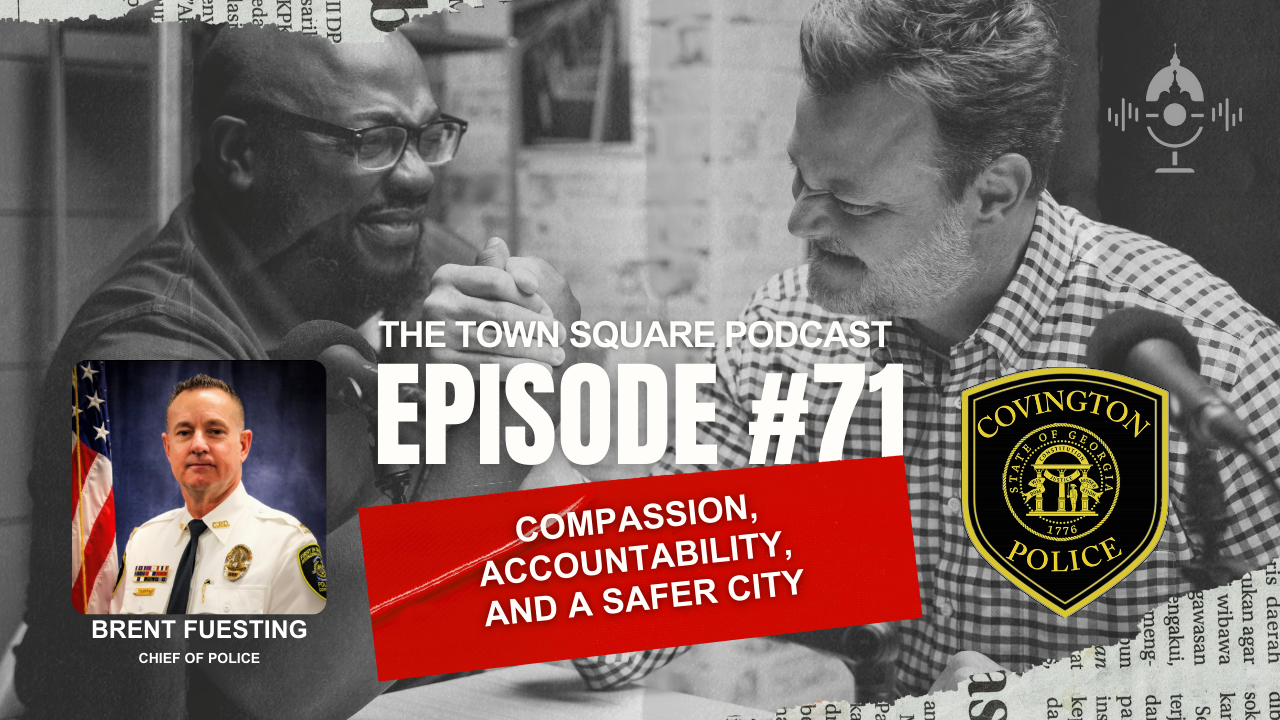
Every now and then, we get a guest on The Town Square Podcast who reminds you there’s a whole lot more happening behind the scenes than what most of us see on Facebook or the evening news.
This week, we sat down with Covington Police Chief Brent Fuesting, a man who has quietly served this community for 23 years, and who was officially named Chief just recently—after stepping into the role as interim chief in May 2025.
And what made this conversation special wasn’t just learning “what a police chief does.” It was getting to know who he is—what drives him, what he values, what he worries about, and what he hopes Covington becomes as it keeps growing at a pace that, frankly, feels unreal to most of us.
Chief Fuesting didn’t show up with big bravado or polished talking points. He showed up like a guy who actually believes what he’s doing matters… and who still sees policing, at its core, as a form of public service.
Which, in 2026, is a pretty refreshing thing to hear.
“How have we not met?”
Before we even hit record, I had one of those Covington moments: How have we not crossed paths before?
Because here’s the thing—both of us have lived in this community for decades. We’ve run in overlapping circles. We know a lot of the same people. And yet, like a lot of folks in public service, Chief Fuesting has been out there doing his job without necessarily being a public-facing personality.
He even joked that opportunities like this—long-form conversations with the public—don’t happen very often outside of events, neighborhood watch meetings, or community outreach programs.
That’s one of the big reasons we wanted him on.
When a city is growing fast, visitors are pouring in from all over the world, and public confidence in institutions is… complicated… it matters that you know the people leading those institutions.
And Chief Fuesting is now leading one of the most important ones.
Why policing?
When I asked him what got him into law enforcement, his answer was simple: family.
His dad was a police officer. His brother became a police officer too. Law enforcement was in the blood—though Chief Fuesting admitted he actually fought it for a while. He wanted to do something different than what his family had done.
But life has a way of circling you back to what fits.
The story that finally pushed him into the academy is peak small-town Covington: his mom lived across the street from a well-known local figure, Ken Malcom, who literally brought an application over “on his mom’s behalf.” Two weeks later? Police academy.
Now it’s been 23 years—all of them right here with the City of Covington Police Department.
That’s a pretty strong statement, whether you realize it or not.
The brotherhood thing is real
We spent a few minutes talking about something you hear a lot—especially from military families—about the “bond” formed when people work in hard environments together.
Chief Fuesting didn’t hesitate: it’s real.
Policing forms a family-like bond because the work is intense, unpredictable, and often dangerous. The shared principles, the shared experiences, the “in the trenches” moments… it creates something deeper than normal coworker relationships.
And for folks like my daughter Anna Beth in the Marine Corps, that kind of bond is familiar. Different uniform, similar dynamic: a strong sense of mission, teamwork, and sacrifice.
Patrol is the foundation
Chief Fuesting started where most do: patrol, which he calls the foundation of good policing.
Patrol, he explained, exposes officers to every aspect of community life. It forces you to apply policy, training, and decision-making in real-world conditions—where things are messy and unpredictable, and where a textbook doesn’t show up to help you.
Interestingly, he said becoming Chief was never his original goal.
But as he moved into supervisory and command roles, the “leadership side” began pulling him in:
organizational leadership
strategic planning
developing personnel
making decisions under pressure
And that “developing people” part? That’s clearly a big deal to him.
What he loves about the job
If you had to boil down his “why,” Chief Fuesting said it plainly:
Helping people in need.
Yes, police enforce laws. Yes, they respond to crimes. Yes, there are moments where someone ends up in handcuffs.
But the side of policing that keeps him motivated is the part most people don’t think about first: compassion, empathy, and service—meeting needs when someone doesn’t know who else to call.
He even said it out loud: enforcement is “nuts and bolts,” but there’s another side that draws him—the compassionate side.
And I’ll be honest—he used those words repeatedly throughout our conversation, which tells me it’s not just a convenient phrase. It’s a value.
Life outside the badge
I asked what he does when he’s not at the police station.
His answer was exactly what you’d hope a leader in a high-stress job would say:
Family time.
That’s how he recharges. That’s how he stays grounded. That’s what keeps him focused.
And no—at home, they don’t call him “Chief.” (He made sure we knew that.)
Who leads the department with him?
We talked about how a police department actually sets direction.
Chief Fuesting described a command staff that helps craft a five-year vision for the department. And he was clear: it isn’t the city manager or city council “telling them what to do” operationally.
Instead, the vision is shaped by:
community concerns
data and call trends
city growth
deployment needs
staffing and development priorities
He also gave the community a real look at the leadership team behind the scenes, including:
Assistant Chief Gene Nuqui
Captain Mike Tinsley (Patrol)
Captain Mark Jones (Community Support / Outreach)
Lieutenant Shockley (Training)
Lieutenant Digby (Special Investigations)
Lieutenant Slade McCullough (Criminal Investigations)
Lieutenant Chris Cain (Patrol)
Lieutenant Alan Seebaran (Patrol)
If you know Covington, you’ve probably heard a few of those names.
Covington has changed — fast
One of the most relatable moments of the episode was how Chief Fuesting described Covington then vs. now:
He remembers when, at 5:00 p.m., it felt like the sidewalks rolled up around the Square.
Now? It’s vibrant, busy, active—often late into the evening. And the city isn’t just full of locals anymore. We’re seeing tremendous visitors “from all over the world.”
That’s a whole new policing dynamic.
And he said straight up: the pace of growth has been “unreal” since he started.
A downtown precinct is coming back
One of the biggest concrete initiatives he shared is this:
Covington PD is working to open a downtown precinct inside the old police department building.
It’ll be staffed by a sergeant (including the sergeant over community outreach), and it will help with:
golf cart permitting
reports and walk-in needs
Square parking issues
trails and parks responsibilities
But the big idea is simple:
More visible presence downtown.
More accessibility for citizens.
A “return” to the Square without undoing what the newer, more functional department building has solved
That struck me as a smart move—practical and symbolic at the same time.
Transparency and the citizen review board
We also hit the topic everyone wants to know about: transparency.
Chief Fuesting pointed to several ways Covington PD tries to be an “open book,” including:
an annual report with statistics (call volume, complaints, use of force, etc.)
open records processes
community outreach events and initiatives
But the standout piece was the Citizen Review Board.
He explained that Covington PD is one of only three departments in Georgia with a board like this:
Atlanta PD
Athens-Clarke County
Covington PD
And here’s why that’s significant: Covington PD is much smaller—69 sworn officer positions—yet still maintains this level of outside oversight.
The board, made up of citizens appointed by city council, reviews use-of-force complaints and examines how the department responded, including video and evidence.
Whether you’re pro-police, skeptical, or somewhere in the messy middle, that’s a meaningful transparency mechanism.
The biggest challenge: recruitment & retention
If you expected him to say “crime” was the biggest obstacle, he didn’t.
He said the biggest issue facing law enforcement today is:
Recruitment and retention.
It’s difficult to get people into policing now. He pointed to cultural shifts, media narratives, and changes over time that have made the profession less attractive.
But he also said something hopeful: he believes the “pendulum is swinging back” in a more positive direction.
Still, his focus is on building a culture officers actually want to stay in—one that feels like family, where people can build a long-term career.
“Police Who Care” and the golden rule culture
One of the more surprising things Chief Fuesting shared is that Covington PD has a strong internal culture of service through Police Who Care (PwC).
He said every officer has money allotted that can be used to help people in need when they encounter them in the community.
That means the department isn’t only responding to crime—it’s responding to people.
And his “culture statement” for how officers should treat the public was about as straightforward as it gets:
Treat everyone you come in contact with like you’d want your family member treated.
He acknowledged there are moments when someone’s behavior changes what’s possible. But he said 99% of the time, that’s the goal.
His leadership style: servant leadership + accountability
I asked him to describe his leadership style.
He said:
Servant leadership, with a high profile for accountability.
Meaning:
he wants to serve the community and support his officers
but officers will be accountable for their actions
That combination matters. Too much “servant” with no accountability becomes chaos. Too much accountability with no servant mindset becomes cold and rigid.
He’s aiming for both.
He also shared a story that really captured this culture: the department recently made a five-year-old with a terminal illness an honorary police officer for the day, complete with a real badge and a full experience—an event that many officers participated in.
Again: compassion showing up in a real way.
Youth engagement is a future priority
When we talked about community needs beyond crime prevention, Chief Fuesting identified one big gap:
Youth don’t have enough to do.
He talked about how limited recreational options can create conditions where “juvenile stuff” happens. So the department is exploring longer-term ideas like:
after-school programming
a police activity league concept
homework help + sports / activities afterward
He was honest: it will take time, money, and investment.
But he sees it as a real need—and a real opportunity to prevent problems before they start.
Technology is changing policing
Another theme he was genuinely excited about: technology.
He described how investigations have evolved dramatically from “boots on the ground knocking on doors” to a world where emerging technology shapes crime-solving and prevention.
He also emphasized the need for oversight and careful use of tools, mentioning audit trails and safeguards.
We also touched briefly on cybercrime—he clarified that if a person is a victim within Covington city limits / jurisdiction, the department can investigate and they do have personnel with specialized skill sets for that work.
What calls do they get the most?
I asked a question I like asking public safety leaders: “What’s the most common call you get?”
Unlike fire services (which often surprise people by saying medical calls), Chief Fuesting said policing is too diverse to narrow to one category.
But he said common categories include:
accidents and traffic-related calls
thefts
domestic situations
property crimes
And he explained the challenge clearly: every call comes with its own variables. Nothing is “one size fits all.”
Training never stops — and shifts are intense
He explained that Georgia POST requires 24 hours of yearly training, but Covington PD aims to go beyond that—training never really stops.
We also got a peek at the patrol schedule:
12-hour shifts
a 3-2-3 schedule (3 on, 2 off, 3 on… alternating patterns across weeks)
investigators typically work 8–5 but are on call
And like most departments, shortages increase workload and caseload pressure.
“How safe is Covington?”
I asked him directly.
His answer:
Covington is safe.
He explained that each shift is staffed, with roughly:
eight officers per shift (24/7)
plus traffic units part-time
plus K-9 presence
He also shared that early indicators suggest some violent crime is dropping, while the department continues working property crime and the usual breadth of calls.
His point was reasonable: as call volume increases with growth, staffing will have to increase too.
The “Less Crime Act” and how to redirect state taxes to PwC
Before we wrapped, Chief Fuesting shared something that many citizens and businesses will want to know about.
Covington PD’s Police Who Care is now a certified public safety foundation, which allows participation in a 2023 law:
The Less Crime Act (HB 531C, as he referenced it)
In plain terms, he explained it like this:
If you (as an individual or business entity like an LLC/S-Corp) owe Georgia state income tax, you may be able to redirect a portion of what you owe to support Covington PD’s Police Who Care foundation instead of sending that portion to the state.
Those funds support initiatives like:
helping people in need
supporting officer families when an officer is injured or killed in the line of duty
community support efforts connected to the department
He said details can be found through the department’s website (and we’ll include the link in the show notes).
That’s the kind of practical, local lever that can make a real difference—and it’s exactly the kind of thing most people don’t know exists.
Final takeaway
This conversation wasn’t a crime report. It wasn’t a political debate. It was something simpler—and maybe more important:
A chance to meet the person leading the Covington Police Department, understand how he thinks, what he values, and what direction he’s trying to take the department as the city grows.
Whether you’re a long-time Covington native or a new resident still learning the culture of this place, Chief Fuesting made his message clear:
Covington PD wants to be visible, accessible, and engaged
They want transparency and accountability
They want officers who lead with empathy and compassion
They need more good people to join the profession
And they’re planning for the future, not just reacting to the past
If you’ve ever wondered what your police department is really like—beyond headlines and hot takes—this episode is worth your time.
Links Mentioned / Resources
Covington Police Department Recruiting / Careers: www.comingtopolice.com
City of Covington website (jobs / info): cityofcovington.org
Police Who Care / Less Crime Act info: covingtonfuzzrun.com
Sponsors
Bizzy Bee Exterminators
Locally owned and operated. Bug and mosquito season is right around the corner.
Phone: 770-787-3718
Website: BizzyBeeExterminators.com
Main Street Land & Properties
Commercial + residential property management, brokerage, development, and construction management.
Address: 2141 Emory Street NW, Covington, GA
Website: mslap.com
Rapid Tax Services (Covington)
Trusted tax prep partner for more than 20 years.
Phone: 678-658-8601
Website: taxpreprt.com