
Commissioner LeAnne Long: Data Centers, Back-Room Silence, and a Facebook-Fueled Uprising – Episode 72
Use the audio-player above to listen here, or click one of the following links to listen on
Apple Podcasts or Spotify. Or click on the photo below to watch on YouTube.
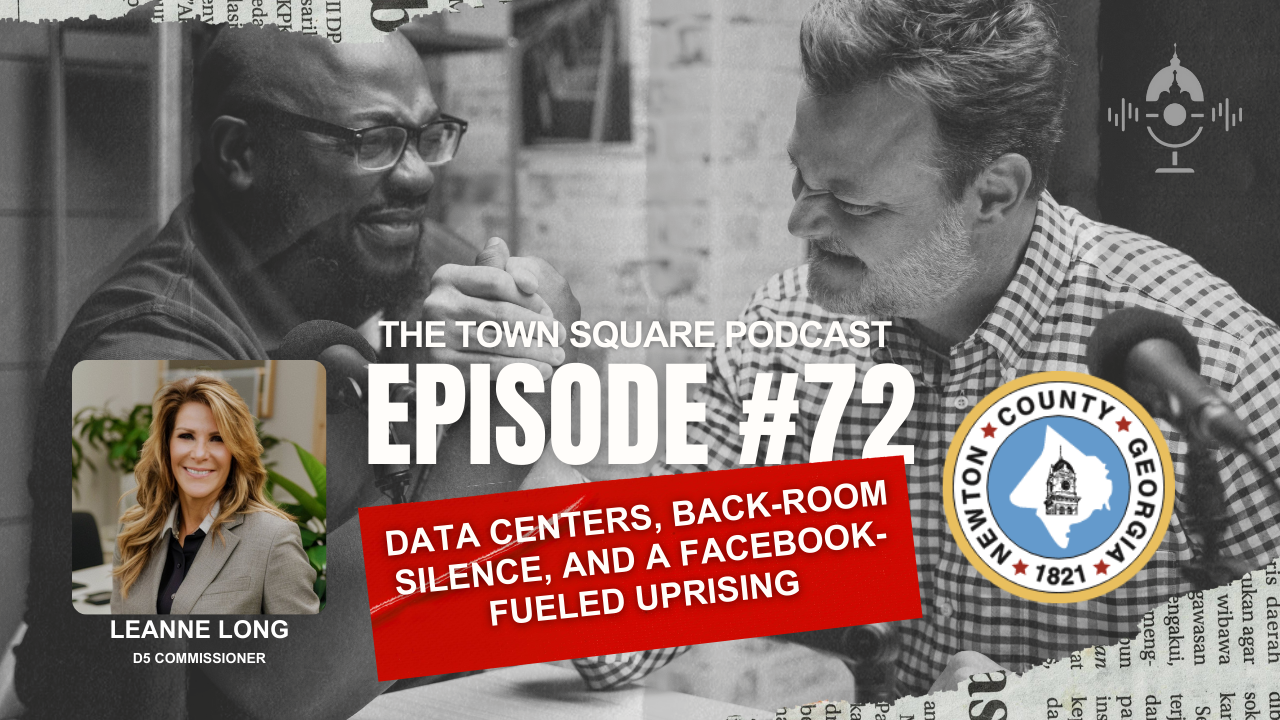
Data Centers, Communication, and the New Newton County Conversation
If you’ve been anywhere near Newton County or the handful of Facebook pages out there, the last few months, you’ve felt it: the volume is up, the stakes feel higher, and the words annexation, zoning, moratorium, and especially data centerare showing up in everyday conversations like they’ve always been part of the local vocabulary.
They haven’t.
And that’s part of why this episode matters.
In Episode 72 of The Town Square Podcast, we sat down again with District 5 Commissioner LeAnne Long for her second appearance—about a year after our last conversation. The unofficial theme this time? The good, the bad, and the ugly of public service in 2025… with a very specific emphasis on how communication (and yes, transparency) has become the battleground in Newton County’s growth debates.
LeAnne doesn’t pretend to be everyone’s cup of tea. She’s blunt, high-energy, and unapologetically direct. But what’s impossible to miss is this: she’s been a major catalyst in getting regular citizens to pay attention again—especially around development pressure, annexation requests, and the rapid emergence of data center proposals.
And love her approach or not, the impact is real.
The “Good” in 2025: Citizens Woke Up
LeAnne says her biggest accomplishment in 2025 isn’t a single vote or a flashy project—it’s engagement.
Newton County isn’t a small city where everyone bumps into each other at the square and hears news by accident. District 5 includes large rural stretches, and people are busy living life outside the county for work, school, and schedules. That makes engagement harder—and it also makes “surprise outcomes” more likely.
Her solution has been consistent: put information where people already are.
That mostly means Facebook.
She describes her approach as part public service, part community organizing, and part marketing. She posts often, posts long when she has to, and (this part matters) she engages in the comments. The goal isn’t to “win the internet.” The goal is to reduce misinformation and stop the rumor mill from setting the narrative first.
A line that captures her mindset:
“If you’re not telling your story, somebody else is going to tell your story.”
This is the heartbeat of the episode: whether you like the method or not, she believes the people deserve the information early enough to respond.
“My Style Doesn’t Work for Everybody” (And She Knows It)
LeAnne doesn’t hide the fact that her style ruffles feathers. She’s not a “sugar-coater.” She chooses clarity over smoothness, and she’s willing to call out when conversations drift into personal attacks or off-topic narratives.
Her reasoning is simple: vague communication is a breeding ground for confusion—and confusion is where mistrust thrives.
She also admits she’s learned over time. She talked about the value of pausing, re-reading posts, deleting drafts, and listening to a trusted voice (including her daughter, who sometimes has to tell her to “take a chill”).
So no—this isn’t a story of someone who thinks they’re perfect. It’s a story of someone who feels responsibility so intensely that it occasionally overwhelms them… and still shows up the next morning ready to keep going.
The Flashpoint: Annexations + “Too Quiet” Data Center Moves
A big chunk of the episode centers on two annexation situations connected to the City of Covington:
The Falconwood annexation request on Highway 278
A proposed data center tied to the Elks Club Road area
LeAnne’s concern wasn’t that the process was “illegal” or that someone was doing something shady. In fact, she repeatedly acknowledged that the city followed the steps correctly.
Her frustration was this: the process can be “correct” and still be too quiet.
Here’s what she was watching for:
Citizens not finding out until late in the game
No signage (because sometimes it isn’t required at that stage)
Public discussion delayed until the moment of a vote
The fear that once something gets deep enough into the process (including potential state-level review), it becomes harder to stop—or even influence
She explains that annexations often begin with a request to the city, followed by courtesy notification to the county. The county response is time-sensitive and not structured like a full public hearing where people can step up and speak.
So her logic was: If the normal process doesn’t naturally “surface” the situation to the people early enough… then I will.
That’s what kicked off the online storm.
The Outcome: Covington Votes “No” (and the Clock Resets)
LeAnne and the hosts note that both annexations were voted down by Covington City Council on January 20, 2026(as referenced in the conversation). That matters for two reasons:
It reduced immediate pressure on those specific proposals.
It validated the power of citizen engagement—people showed up, spoke, and participated.
LeAnne also referenced the idea that after a denial, there’s typically a waiting period before the same property can come back again for annexation consideration (she wanted to confirm details with legal, but the practical point stands: it slows the momentum and creates breathing room).
And that breathing room is exactly what she’s been advocating for—not to stop growth entirely, but to make sure growth happens with eyes open.
Data Centers: Not “Anti-Growth,” Just Pro-Balance (and Pro-Information)
If you only caught the headlines, you might assume LeAnne is “anti data center.”
Her actual stance in the episode is more nuanced:
Data centers can belong in the right places.
Some have been positive partners (she mentions the growth of the Meta/Facebook presence in the region and how big it became “under our nose”).
But Newton County is now dealing with volume: she references up to 12 proposals at one point in the conversation.
The county ordinances haven’t historically been written for the speed and scale of what’s coming.
She also references training/classes taken through a county commissioners association and notes that many communities are pausing to update ordinances (buffer requirements, generator standards, lighting/noise impacts, acreage minimums, etc.).
And she brought up something most regular folks don’t think about until it hits their property line: the power infrastructure. Transmission lines, right-of-way negotiations, and how a single route can change what a landowner can do with acreage in the future.
In other words: the data center conversation isn’t just about one building. It has tentacles—water, power, noise, land use, long-term exit plans, and what happens if the technology changes faster than the county can adapt.
Communication Isn’t a “Bonus” — It’s the Job
One of the most important parts of the episode is LeAnne’s push for better county communication systems—not just one commissioner doing heavy lifting online, but a structure where citizens can easily find what’s happening near them.
She argues that residents shouldn’t have to file (and pay for) open records requests just to understand a zoning issue next door.
She wants:
information posted earlier,
more accessible links and documentation,
online meeting access,
clearer agendas and public notice that normal people can understand without a law degree.
Her logic is blunt: this is 2026. If other counties can do it, Newton County can do it too.
And she shares a quote that captures modern civic reality perfectly—something a resident told her:
“We elected you to go to the meetings. If we wanted to go to the meetings, we would’ve run for office.”
That’s not an excuse for apathy—but it is a reminder: participation has barriers (time, childcare, work schedules). If government wants informed citizens, it has to meet them where they are.
Property Rights: Both Sides Have Them
This is where the “messy middle” shows up.
LeAnne acknowledges the tension:
landowners have rights,
neighbors have rights,
and zoning exists because “highest and best use” for one person can destroy the quality of life for the next person.
She’s not arguing for a world where nobody can develop. She’s arguing for a world where the rules are clear, the community is informed early, and decisions aren’t made while the public is still trying to figure out what the proposal even is.
Why These Conversations Matter (Even When They Get Messy)
LeAnne believes the hard conversations are healthy.
Not because conflict is fun, but because silence is expensive.
She’s candid about how heavy the job can feel—how overwhelming it gets when growth feels like it’s moving faster than the community can process. She admits she’s gone home frustrated and emotional. But she keeps coming back to the same guiding principle:
No surprises.
And that’s what this episode really is: a behind-the-scenes look at how one commissioner thinks about communication, accountability, growth pressure, and the responsibility to represent people who don’t have time to chase paper trails.
Whether you agree with her methods or not, this is the kind of conversation Newton County needs more of—because growth is coming either way. The question is whether the public gets to participate in shaping it.
Links Mentioned
YouTube episode link: Episode 72: LeAnne Long
SCB Construction Group: https://scbcg.com
Luther Rice College & Seminary: https://www.lutherrice.edu
Commissioner LeAnne Long (Facebook): https://www.facebook.com/leannelongdistrict5
Email mentioned: llong@co.newton.ga.us
Georgia Association of County Commissioners (ACCG): https://www.accg.org
Sponsors / Advertisers
SCB Construction Group
Website: https://scbcg.com
What they do: Commercial general contracting across Georgia and beyond—turnkey design-build, design-bid-build, and full commercial contracting services. Their projects range from manufacturing and distribution facilities to churches, sports complexes, office spaces, and retail. Locally owned and repeatedly recognized in the community.
If your next project needs a contractor who can plan, build, and execute at a high level—SCB Construction Groupbrings precision and professionalism from the ground up. Learn more at scbcg.com.
Luther Rice College & Seminary
Website: https://www.lutherrice.edu
What they do: Accredited, biblically grounded Christian education—100% online—including dual enrollment, undergraduate degrees, certificate programs, and doctorate-level study. Built for students and working adults who want education shaped by a Christian worldview.
Whether you’re a student exploring dual enrollment, an adult learner deepening biblical knowledge, or a professional seeking leadership development—Luther Rice offers flexible, fully-online programs designed for your calling. Visit lutherrice.edu.