

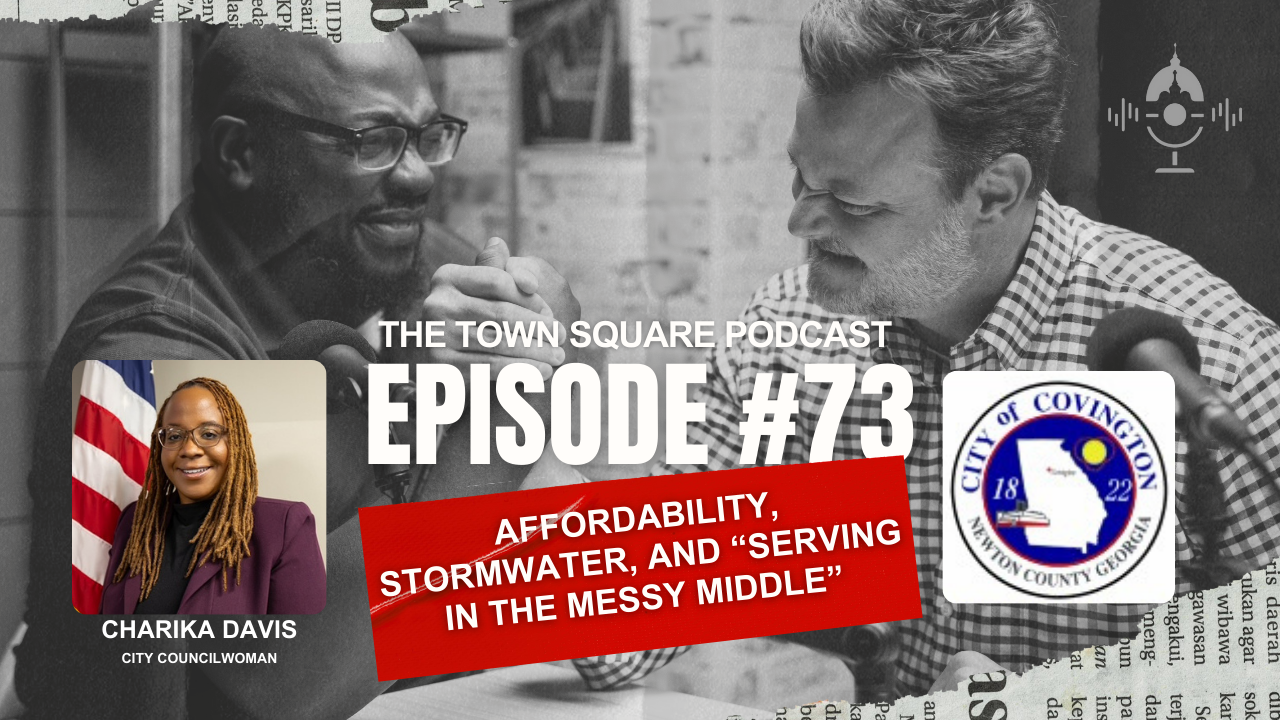
Councilwoman Charika Davis: Affordability, Stormwater, and “Serving in the Messy Middle” — Episode 73
Use the audio-player above to listen here, or click one of the following links to listen on
Apple Podcasts or Spotify. Or click on the photo below to watch on YouTube.
If you’ve been anywhere near local government conversations lately—city council meetings, social media threads, neighborhood group chats, or just the line at the coffee shop—you’ve heard the same word on repeat:
Affordability.
It’s not a trendy political slogan anymore. It’s a pressure point. A real-life math problem families are trying to solve every month: rent, groceries, utilities, gas, childcare… and now, depending on where you live, fees you didn’t even know existed until the bill showed up.
That’s why this episode matters
In our first recording of 2026, we sat down with Covington City Councilwoman Charika Davis, fresh off a reelection campaign and stepping into her second term. And she didn’t come in with polished talking points. She came in with something you can feel through the mic—conviction, fatigue, gratitude… and a genuine desire to be the kind of public servant who doesn’t forget what it’s like to live on a budget.
“I made it to 2026.”
That’s how Charika answers our opening “what’s good in your world?” question—and it sets the tone.
2025 was a grind. She describes the reality of running for reelection while still doing the job: door knocking, listening sessions, community events, and all the invisible emotional weight that comes with being the person people call when they’re frustrated.
And here’s the part that’s easy to overlook if you’ve never run for office:
Even at the city level, where government feels “closer,” you still can’t promise the world.
Charika says it plainly: “I’m one vote.”
That sentence comes up again and again throughout the conversation, because it explains one of the biggest misunderstandings residents often have about local government. People assume a councilmember has executive power—can hire, fire, fix everything, and change policy with a snap. But as Charika explains, the city manager runs operations: staffing, HR, internal processes, and day-to-day execution. Councilmembers vote on policy, budget priorities, and direction—but they’re not the CEO.
And that misunderstanding gets messy fast when emotions are high.
Why she ran again: “There was still work that needed to be done.”
This was her second race, and she had an opponent again—something she describes as humbling.
Not because she doubts her work, but because campaigning forces you to face the truth: you can do a hundred good things and still lose. You have to show up, ask for trust, and take the risk publicly.
So why do it again?
Charika’s answer comes back to one theme: advocating for working- and middle-class residents—especially when the costs of living rise faster than people’s paychecks. She talks openly about the fear many residents have: that they’ll be priced out of the city they call home.
And she admits something interesting: during her first term campaign, she was advised to avoid the affordability conversation. It was treated like a “code word,” something that might be interpreted as only relevant to certain socioeconomic groups.
But now? She says you can’t avoid it.
If you’re going to claim you’re “for the people,” you have to talk about what people are actually carrying.
The other side of Charika: corporate America, quiet mornings, and soft skills
A lot of folks only know Charika from council meetings and civic debates. But she shares a snapshot of her day-to-day life outside council—working in corporate America (now from home), starting her mornings slowly, and valuing a calmer pace than the old “rat race” schedule.
That contrast becomes important later, because she makes a point that’s easy to miss:
Serving on council doesn’t feel like “work” to her.
It’s purpose. It’s passion. It’s giving back.
And that makes late meetings, community events, and phone calls feel different than a normal job—even when they’re exhausting.
When we ask what she learned from her corporate career that translates into public service, she goes straight to something schools rarely teach directly:
Soft skills.
· How to handle high-stakes situations.
· How to communicate without detonating relationships.
· How to control emotion when the moment is intense.
And if you’ve ever watched a public meeting on a hot-button issue, you already know why that matters.
Born and raised here—and proud of it
Charika is Covington through and through: born at the local hospital, raised on Oxford Road, Newton High, and a childhood that included the movie theater, the skating rink, and the kind of community identity that sticks with you.
She talks about how her early involvement in student leadership, her time at Georgia College, and her connection to service through Delta Sigma Theta shaped her mindset: be the voice for people who feel unheard.
She even answers the “why didn’t you leave?” question in the most honest way possible:
She stayed because she didn’t want to pay rent.
It’s funny, but it’s also quietly profound—because it’s a reminder that many of the “big” life decisions are shaped by very practical realities. And that’s a theme that keeps surfacing all episode long.
How she got into politics: a mentor, a family push, and a legacy transition
Charika explains that she didn’t wake up one day and decide to run. A family member—Councilman Morgan, her cousin—encouraged her after a funeral. That conversation led to a connection with a respected community figure and mentor, Hani Thea Williams, who served for years and helped Charika learn the ropes before stepping away.
That kind of transition matters. Local leadership is often less about ideology and more about mentorship, relationships, and trust built over time.
“People think we have more power than we really do.”
This might be the most important civic education line in the whole episode.
Charika describes taking calls from city employees early on—complaints about workplace issues—and having to explain she didn’t control HR outcomes. She wasn’t the boss. She couldn’t “fix” personnel matters.
Her job, as she sees it, is to:
listen to residents,
advocate where policy can help,
make calls to connect issues to the right department,
and vote based on what’s fair and workable.
She can help get your trash picked up.
She can help push a concern to the right staff.
But she can’t magically install a stop sign overnight just because someone wants it.
That’s not an excuse—it’s the structure. And understanding the structure is the difference between frustration and productive engagement.
The stormwater conversation: “Paying for the rain” (and why people were angry)
Then we hit the topic that lit up a lot of community conversation: stormwater billing.
If you’ve never dug into stormwater, you’re not alone. Charika admits she didn’t understand it before homeownership either. But the concept is simple in theory:
When rain hits roofs, driveways, streets, and parking lots, it has to go somewhere. The city maintains systems—pipes, drains, tunnels, and infrastructure—to manage runoff so it doesn’t flood roads and properties.
But the controversy isn’t the concept. It’s the implementation—and the human impact.
Charika talks about residents feeling blindsided when the stormwater charges arrived, with different amounts based on impervious surface measurements (like roof size and paved area). People didn’t know why their bill was higher than their neighbor’s. Some didn’t even know what they were paying for.
And for folks who don’t feel like they benefit—people whose yards still flood, or who don’t see drainage improvements near their homes—the fee feels insulting.
One resident told her they were told, essentially: you shouldn’t have bought a house in that area.
Charika’s response is immediate: that’s a slap in the face. People don’t house-shop during a thunderstorm. They don’t know how water is going to behave after years of development and shifting runoff patterns.
This is where Charika’s “messy middle” approach shows up:
Yes, stormwater systems are real and need funding.
But people are real too.
And policy must be compassionate—not just technically correct.
The fear factor: what happens if stormwater moves onto a utility bill?
One of the most emotionally charged parts of the conversation is the discussion about enforcement.
If stormwater is billed annually and someone can’t afford it in the moment, the consequence might be a lien—but they’re still in their home. Their lights stay on.
But if stormwater gets rolled into monthly utilities and someone can’t pay, now you’re talking about shut-offs and essential services—something that disproportionately impacts seniors on fixed incomes, residents with disabilities, and households already operating close to the edge.
That’s where Charika says her mind goes: worst-case scenario, and who pays the price.
She mentions learning that around 90% of residents are already paying—and she raises the question many people are afraid to ask out loud:
Are we reorganizing the whole system to chase the remaining 10%?
She also describes the moment in council when she thought a particular action might pass—and she wasn’t willing to “take that chance.”
So she dug in. She spoke up. She made sure her constituents’ concerns were on record.
Even when you lose a vote, there’s a kind of integrity in being able to say: I didn’t stay quiet.
The other major topic: property tax relief, PILOT revenue, and what’s next
From stormwater we pivot into another huge area of public curiosity: the city’s long-term financial strategy—especially related to major economic development
The conversation touches on PILOTs (payments in lieu of taxes), Industrial Development Authority agreements, and how future revenue could help offset burdens on residents.
Charika confirms council voted unanimously on a resolution tied to homestead-style relief concepts (as discussed in the episode), with the idea that state approval could make it possible to reduce or eliminate certain city property taxesstarting in a future year if approved by the General Assembly and signed by the governor.
We talk about what that could mean:
Relief for homeowners (especially those feeling squeezed)
How renters fit into the picture
Whether relief could unintentionally lead to rent increases
Charika’s hope is clear: the benefit won’t be “taken back” from renters through higher costs, and the broader community will feel the positive impact of better financial footing.
We also discuss a major demographic fact that shapes everything: a large share of city residents are renters, not homeowners. Whether you love that or hate it, it’s reality—and it changes how policy lands.
Charika makes a thoughtful point: if you can reduce the burden on homeowners, maybe some long-term renters can finally cross the line into ownership.
Growth pressures: trucks, roads, sidewalks, and infrastructure that wasn’t built for this
If affordability is the emotional center of the episode, infrastructure is the practical center.
Charika describes a situation many residents have lived: increased truck traffic—delivery fleets, commercial flow, industrial growth—moving through subdivisions and streets that were designed for normal neighborhood use.
Those roads weren’t built for constant heavy loads. The result is predictable:
more wear,
more potholes,
more reactive repairs,
and higher costs.
She argues the city has to become more proactive instead of constantly playing defense.
We also revisit something you can’t unsee once it’s pointed out: pedestrian safety on high-traffic roads where people are walking, pushing strollers, or even using wheelchairs near the edge of the roadway.
Charika points to sidewalk work as a tangible, quality-of-life improvement that connects people to the square, to commerce, and to safer movement in the city.
The budget reality: “If more people understood it, they might say… okay, I see.”
One of the best “inside baseball” parts of the conversation is budget transparency—not in the political sense, but in the comprehension sense.
Charika says she wishes more residents attended budget sessions. Not because they need to agree with everything—just because understanding changes the tone.
A lot of residents feel:
“I pay taxes. That should be enough.”
And sometimes, unfortunately, it’s not. Not if infrastructure was delayed for years. Not if growth demands more capacity. Not if maintenance gets more expensive as the city ages.
She also says something leaders rarely admit publicly: you can cut costs, but only so far. Eventually you hit the point where cuts start harming essential services.
And that takes us right back to the messy middle:
You need good roads and drainage and safety.
Those things cost money.
People are already stretched thin.
So the tension isn’t going away. The question is whether the city handles it with clarity and empathy.
What Charika wants to accomplish this term
When we ask what she wants to be able to “claim” at the end of this term, she doesn’t hesitate:
Affordability.
Not as a buzzword—as a moral commitment to the people who built this place, who work here, teach here, protect here, and want to stay.
She’s proud of being born and raised in Covington, and she doesn’t want it to become a city only certain income levels can access. She wants working-class families to be able to live where they want to live—not be pushed out by the rising cost of simply existing.
East vs West: is it real?
We also ask about the perception that the city is divided—east side vs west side, ward lines becoming identity lines.
Charika rejects the division.
She says she takes calls from people across the city, not just her ward. And when residents see a sign, recognize a name, or hear a councilmember speaking up, they reach out—because when people have a problem, they don’t always care about maps. They care about whether you listen and respond.
Links mentioned in the episode
City of Covington — City Council page: https://cityofcovington.org/index.php?section=visit-calendar
Covington — Main site: https://www.cityofcovington.org/
Our advertisers
Appalachia Insurance Group
Independent coverage. Local relationships. Real humans when you call.
Bobby Stephens – bobby@appgroupins.com
Luther Rice College & Seminary
Flexible, affordable Christian higher education for busy adults—online and in person.
How to reach Councilwoman Davis
Charika encourages residents to contact her through the City Council page, where her contact info is listed. She also shared a phone number during the conversation and mentioned she’s not personally active on social media.