
Richard Wright: The Limping Rapper, CPA, and Moderate Democrat | Candidate Conversations — Episode 84
Use the audio-player above to listen here, or click one of the following links to listen on
Apple Podcasts or Spotify. Or click on the photo below to watch on YouTube.
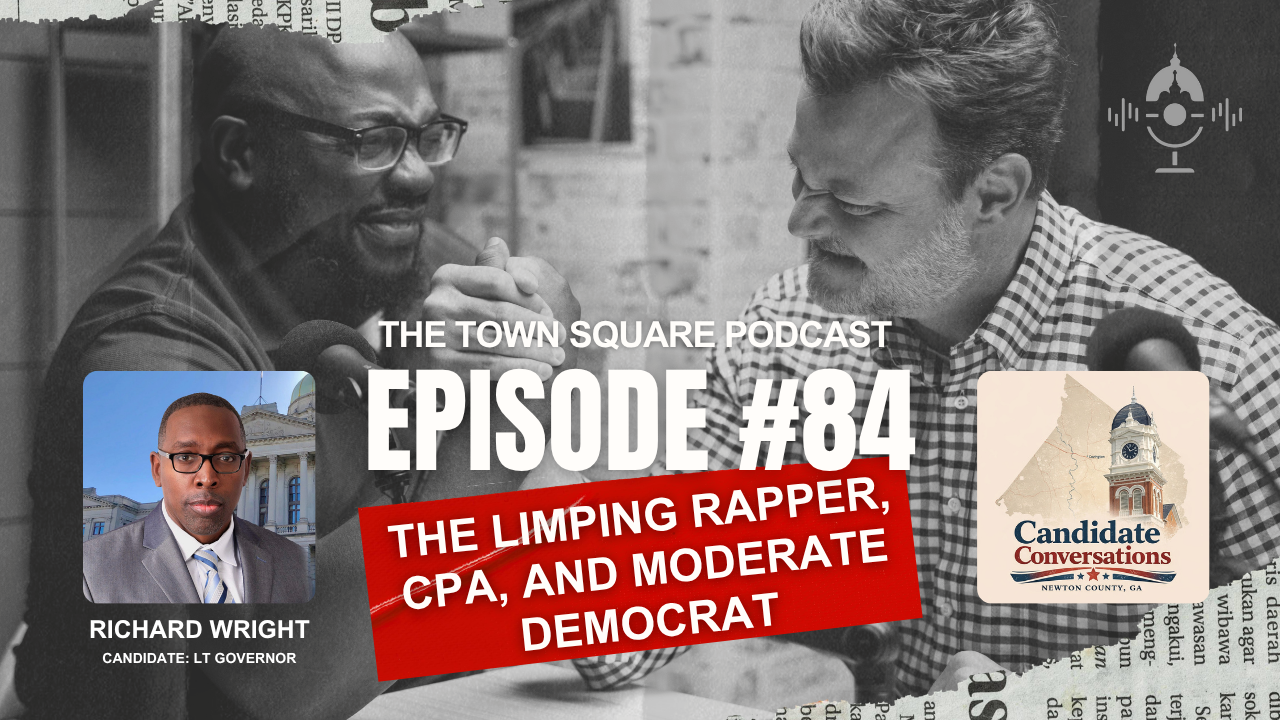
There are some interviews where you can feel within the first two minutes that the conversation is going to be different.
That was this one.
In Episode 84 of The Town Square Podcast, Trey Bailey welcomed Richard Wright, Democratic candidate for Lieutenant Governor of Georgia, into the studio for a conversation that was funny, thoughtful, policy-heavy, personal, and refreshingly unpolished in the best possible way. Wright’s campaign describes him as a financial professional and community-minded leader running to bring “common sense leadership” to Georgia. By the end of the episode, listeners got a strong sense of what that means in his own words.
This episode is part of The Town Square Podcast’s ongoing Candidate Conversations series — a public-service effort to help voters hear directly from candidates in a long-form, less combative setting. Rather than sound bites, gotchas, or rehearsed talking points, the format invites candidates to explain who they are, what shaped them, and how they think.
Richard Wright did exactly that.
A statewide race with a very personal story
The office of lieutenant governor is a big one in Georgia. The position presides over the State Senate and helps shape the flow of legislation in a meaningful way. As Trey noted early in the episode, this is one of those offices that most citizens know is important, but many couldn’t fully describe day to day. Wright’s candidacy is for a statewide seat, and that alone made this conversation significant for your audience in Newton County, Rockdale, DeKalb, Jasper, Morgan, and beyond. Georgia voters will choose their next lieutenant governor in the 2026 cycle, with the primary scheduled for May 19, 2026.
But Wright didn’t begin by trying to impress listeners with credentials.
He began with a story.
And it is a story.
He told Trey that he moved to Atlanta from North Carolina in 1997 with no real career plan beyond trying to make it in music. He came to the city hoping to become a rapper and, if that failed, maybe walk on at Georgia Tech. It already sounds like an unusual opening chapter for someone now running for lieutenant governor, but the story got even more memorable as Wright explained how he injured his ankle playing basketball just before moving, arriving in Atlanta not as a rising star, but as what Trey jokingly called “the limping rapper.”
The humor worked because Wright embraced it. He laughed at himself, talked about his old rap names, and let listeners hear the messiness of the journey before the success.
That matters.
In a political environment where too many candidates sound polished to the point of lifelessness, Wright came across as someone who actually remembers where he came from.
From dropped out student to CPA
One of the strongest parts of the episode was hearing the arc of Wright’s educational story. He openly said he dropped out of high school. He also described the jobs he worked, the instability of those early years, and the influence of his mother, whose prayers and persistence clearly helped redirect his life. Eventually, he went to college, earned an undergraduate degree, later earned an MBA, became a CPA, and also attended Georgetown Law School, all details that line up with how his campaign presents him publicly as an experienced financial professional rather than a career politician.
And that’s one of the central contrasts he seems to want voters to notice.
Richard Wright is not running on the claim that he has spent years climbing a partisan political ladder. He is running on the idea that his life experience, financial background, and ability to talk to ordinary people give him a different kind of credibility.
That theme surfaced again and again throughout the episode.
He framed his CPA background not merely as a résumé line but as preparation for governing. He talked about budgets, tax structures, incentives, and return on investment in a way that felt natural. Whether listeners agreed with every proposal or not, there was no mistaking that this is a candidate who enjoys thinking through how money moves and how policy affects real people.
A “moderate Democrat” in the messy middle
At several points, Trey and Wright locked in on one of the themes that has become central to both The Town Square Podcast and this campaign: the political middle.
Wright describes himself as a moderate Democrat. His website makes the same case — that Georgia needs leadership centered on “common-sense solutions,” collaboration, and helping working families rather than feeding the loudest extremes.
That opened the door to one of the best stretches of the interview.
Trey, who often speaks from that “messy middle” perspective himself, noted that many people on both the left and the right would hear the phrase “moderate Democrat” and wonder if such a thing even exists anymore. Wright leaned into that tension. He argued that the far right and far left often dominate attention, fundraising, and headlines, but that most Georgians are more practical than ideological. In his framing, the loudest people may get the microphones, but they do not necessarily represent the majority of people trying to raise families, pay bills, and live responsibly.
That idea clearly resonated with the tone of the show.
Wright repeatedly emphasized that people want effective schools, reasonable taxes, economic opportunity, and practical leadership. He argued that the middle is not weak or confused; it is just underrepresented and often drowned out.
That is exactly the kind of conversation Candidate Conversations was built to host.
Civility as a governing strategy
One of Wright’s clearest arguments for why he should be the Democratic nominee centered on civility.
Georgia’s lieutenant governor presides over the State Senate. In the current political environment, that means leading in a chamber where partisan tension is real and often public. Wright acknowledged the challenge directly. He said a Democrat walking into a Republican-controlled Senate must have emotional intelligence, self-awareness, and the ability to build consensus.
He argued that his experience as an outsider to the legislature could actually be an advantage. In his telling, existing relationships between some candidates and current lawmakers may already be damaged or hardened by partisan history. He suggested that he could enter the chamber with a different tone — not surrendering principles, but also not defining success as constant combat.
That doesn’t mean he presented himself as soft.
It means he presented himself as strategic.
He said he would always listen, even if he did not always agree. He described himself as someone willing to work with Republicans when the policy helped people and willing to push back when it didn’t. In a race where many candidates may define themselves by how fiercely they fight, Wright is trying to distinguish himself by how effectively he can govern.
Healthcare, Medicaid, and rural Georgia
If there was one policy area Wright kept circling back to, it was healthcare.
He believes Georgia must do more, especially on Medicaid expansion, rural hospital support, and healthcare access for working families. His campaign platform likewise includes healthcare-related priorities and positions expanding Medicaid as part of helping Georgia’s economy and families.
In the interview, Wright tried to break the issue down in practical terms. He talked about how reimbursement delays can hurt hospitals and providers, especially in rural communities where cash flow is already tight. He argued that state government should think more creatively and proactively about keeping rural hospitals open, not simply because healthcare is morally important, but because healthy communities are also economically viable communities.
That was one of his recurring strengths in the conversation: he linked issues together.
For Wright, healthcare is not just about compassion. It is also about workforce development, business recruitment, rural stability, and long-term economic growth. If a region has poor healthcare access, employers notice. Families notice. Doctors notice. Young professionals notice.
In his view, Georgia cannot claim to be one of the best states for business while underperforming on the health side of the equation.
He also spoke at length about how existing income thresholds and program structures can discourage marriage or leave working families stuck in a gap where they earn too much for one program but not enough to comfortably afford the alternatives. That part of the conversation was especially detailed and reflected the kind of numeric thinking Trey kept drawing out of him.
Rural hospitals and the “Georgia Jobs Act” idea
Wright also introduced a broader idea he called a Georgia Jobs Act, tying job creation and healthcare access together. He argued that helping hospitals stay open, especially in rural areas, is essential not only for current residents but also for future economic recruitment.
Again, he connected the dots:
If rural hospitals close, communities become less attractive for new business.
If communities are less attractive for new business, population and investment lag.
If population and investment lag, the tax base stays weak.
If the tax base stays weak, public services struggle.
Whether one sees that as a sweeping vision or an ambitious political stretch, it was undeniably a coherent one.
He wants voters to see public policy not as disconnected line items, but as an ecosystem.
Housing affordability and private equity
Another standout moment in the episode came when Trey asked Wright about affordability and housing.
Rather than stay at the surface level, Wright launched into a detailed explanation of private equity, carried interest, tax incentives, and how large-scale institutional ownership can reshape the housing market. He argued that private equity has become a major factor in housing affordability, especially in metro Atlanta and surrounding communities, by concentrating ownership and driving up prices.
For listeners who may not have expected a lieutenant governor candidate to spend that much time explaining tax treatment and investment mechanics, it was one of the more revealing parts of the interview. Wright clearly wanted to show that he has done the homework and understands the forces behind the issue, not just the slogans around it.
Trey played that segment well, helping translate and slow down the complexity for everyday listeners.
And that is probably one of the strongest values of this episode overall: it did not oversimplify Wright, but it did help humanize and interpret him.
Transportation and “One Georgia”
At one point the conversation turned toward transportation, and Wright laid out one of his most ambitious ideas of the interview: a more connected Georgia through expanded transit, including the possibility of heavier rail connections across major corridors.
He framed this as part of a “One Georgia” mindset — not just metro Atlanta versus everyone else, not urban versus rural, but a more connected state. He tied transportation to job creation, insurance costs, development, and regional accessibility.
This was not presented as a simple or immediate promise. It was more aspirational than near-term. But it fit a broader theme in Wright’s campaign: he wants to think beyond partisan talking points and ask what Georgia could become if leaders pursued long-range, integrated planning.
Listeners may differ on whether such projects are realistic, affordable, or politically achievable. But the interview gave them enough of Wright’s reasoning to evaluate the vision for themselves.
Farmers, rural voters, and a broader Democratic challenge
One of the most politically interesting parts of the episode came when Wright talked about farmers and rural voters.
He argued that Democrats often fail not simply because rural Georgians reject them on principle, but because too many Democratic candidates do not know enough about rural pain points to speak credibly to them. He mentioned farming, overhead, tariffs, labor concerns, and local economics as examples of issues that deserve more direct attention.
This was one of the more candid moments in the interview because Wright was not just criticizing Republicans. He was criticizing his own party’s habits too.
That theme came up multiple times: Democrats, in his view, must stop relying only on outrage, cultural conflict, or anti-Republican energy and start offering grounded, persuasive, useful ideas to people who may never have voted for them before.
That’s a hard message to deliver in a primary. But it also may be what makes his candidacy distinct.
A candidate who wants to explain, not inflame
If there is one sentence that might summarize Richard Wright’s interview style, it could be this:
He wants to explain things.
Not merely condemn, not merely campaign, not merely provoke.
Explain.
That does not mean he lacks sharp opinions. He clearly has them. But throughout the episode he kept returning to the idea that public life gets worse when leaders emotionalize people without educating them. He argued that fear is often easier to use than reason, but that fear rarely produces durable solutions.
That was one of the deeper philosophical threads of the conversation.
He wants voters to know what the lieutenant governor actually does. He wants them to understand what tax credits are, how policy tradeoffs work, why cash flow matters to doctors and hospitals, and why structural issues cannot be solved by slogans.
In other words, he wants politics to feel a little more grown up.
For The Town Square Podcast, that is fertile ground.
Final thoughts
Episode 84 is one of the more distinctive entries in the Candidate Conversations series so far because Richard Wright does not sound like a traditional candidate. He sounds at times like a teacher, at times like a tax advisor, at times like a preacher’s son with a testimony, and at times like a guy who still can’t quite believe his own life story.
That mix made for a compelling conversation.
Listeners will come away with a clear sense that Wright sees himself as a bridge candidate: someone trying to occupy the center, lower the temperature, and make the case that Georgia politics does not have to be held hostage by the loudest factions.
Whether that message breaks through in a statewide race remains to be seen. But as a podcast guest, he gave your audience something worthwhile — substance, story, humor, and a vision that is different enough to be memorable.
And in a season full of campaign scripts and partisan noise, memorable counts.
Links Discussed
Richard Wright for Georgia 2026
Wright’s official campaign website: wrightforgeorgia2026.com. The site includes his biography, platform, campaign updates, and donation page. His campaign message emphasizes common-sense leadership, collaboration, and opportunity for Georgians.
Episode Sponsors
All Air
When it comes to heating, cooling, and healthy air in Covington and the greater Atlanta area, All Air is a trusted local name. They provide repairs, maintenance, and full system installations, and they’re known for walking customers through their options with professionalism and care. They offer free estimates on replacements, free second opinions, flexible financing, and 10% off for military, veterans, and senior citizens. Mention this podcast for $25 off your next repair service.
Phone: 770-761-9914
Website: allairservices.com
SCB Construction Group
SCB Construction Group is a locally owned, community-driven commercial contractor serving projects across Georgia and beyond. An Engineering News-Record Top 100 Southeast contractor and repeated Best of Newton winner, SCB specializes in turnkey design-build, design-bid, and commercial contracting services for manufacturing facilities, distribution centers, churches, sports complexes, office spaces, and retail projects. Trey also notes Eastridge partnered with SCB on a 12,000-square-foot building project now known as Life Now Church.
Website: SCBCG.com