

Alan Fowler: Jobs, Hobbies, and Hope | Candidate Conversations — Episode 83
Use the audio-player above to listen here, or click one of the following links to listen on
Apple Podcasts or Spotify. Or click on the photo below to watch on YouTube.
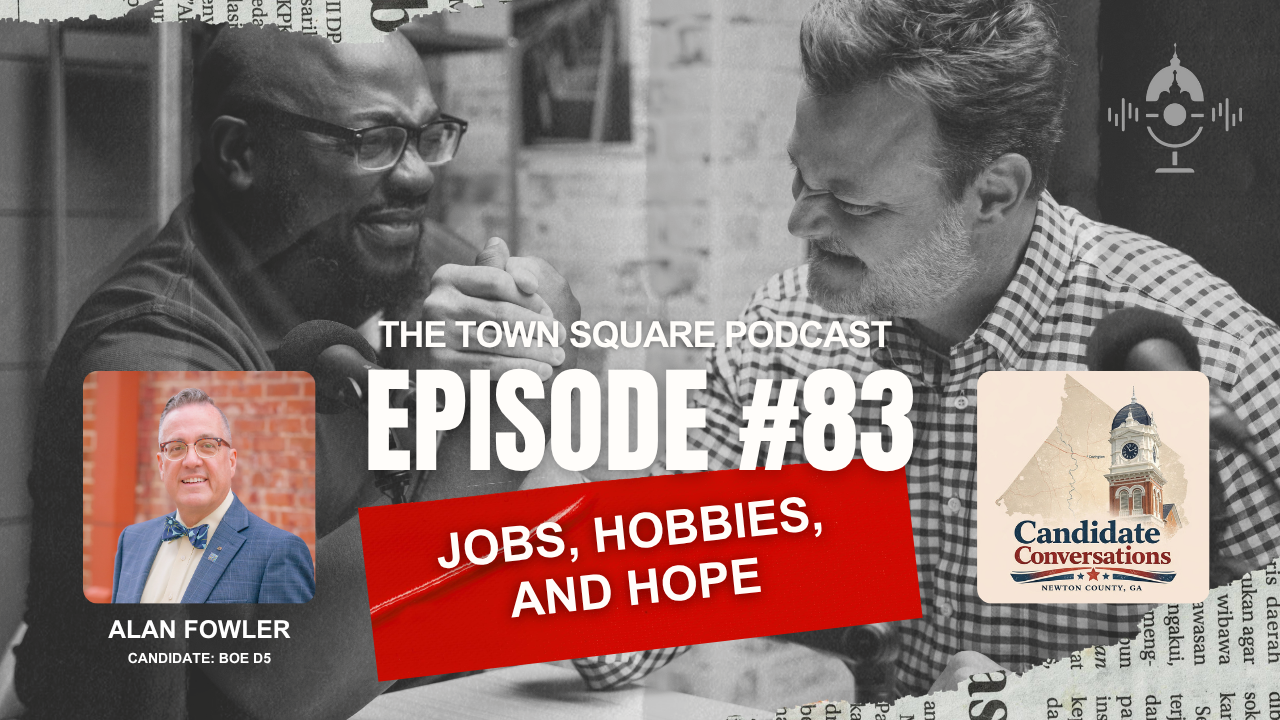
In Episode 83 of The Town Square Podcast, Trey Bailey and Gabriel Stovall continue their Candidate Conversations series with Alan Fowler, Republican candidate for the Newton County Board of Education District 5 seat. With current board chair Abigail Coggin retiring from the position, Fowler will appear on the November ballot, and this episode gives listeners an opportunity to hear directly from him about his background, philosophy, and vision for public education in Newton County.
For many in the community, Alan Fowler is already a familiar face. After all, he spent 26 years at Eastside High School, where he served as band director and helped shape generations of students. But this conversation goes much deeper than résumé lines or campaign language. It offers a look at the heart of a longtime educator, husband, father, music leader, and community member who believes deeply in public schools and the people they serve.
The episode begins with Fowler sharing the personal foundation of his life: his family. He describes himself first as the father of two daughters and the husband of his wife, Susan. That opening set the tone for the rest of the discussion. Before Alan Fowler is a candidate, he is a family man whose life in Newton County has been built over decades of service, relationships, and roots.
Fowler and his wife moved to Newton County in 1995 after graduate school. He took a job at Salem High School, while Susan began teaching at Livingston Elementary. Not long after, the band director position at Eastside High School opened, and Fowler moved there the following year. That transition would become one of the defining turns in his life and career. What started as a professional opportunity became a long-term commitment not only to one school, but to an entire community.
One of the more charming stories from the interview involved the couple’s first introduction to Newton County. While looking for a house, they picked up a copy of The Covington News and read about a July 4th concert by the community band on the Square. Fowler recalled that one of their earliest experiences in the county was attending that celebration, meeting local people, and seeing the community gather around music. Looking back, it feels fitting that his introduction to Newton County came through the arts and public life—two things that would define his years here.
Listeners also got a fuller picture of Fowler’s background before Newton County. He was born at South Fulton Hospital, spent part of his childhood in Delaware, graduated from North Clayton High School, and later attended the University of Georgia. Both he and Susan were involved in the Redcoat Marching Band, though they somehow never met until their senior year despite overlapping in the same organization for three years. Their eventual connection, sparked by a key to a storage room and followed by a whirlwind early romance, made for one of the most memorable and warmest parts of the conversation.
As the conversation shifted toward education, Fowler offered a thoughtful reflection on what he learned over more than three decades in the classroom. He described three major lessons that shaped him.
The first was that leadership is not about the individual—it is about the team. He traced that lesson all the way back to his early days at Eastside, when he was tasked with building a marching band program from the ground up, with students who had never marched before and without much funding. He quickly realized that success would require teamwork from students, staff, helpers, graduates, and the broader community. That mindset clearly still guides him today.
The second lesson came through fatherhood. Fowler spoke candidly about how becoming a parent made him a better educator. When his oldest daughter was born, he said he immediately understood with greater clarity that he was teaching other people’s children—their “little babies”—and that realization carried a new weight of responsibility. Later, when his daughter moved through the school system and eventually joined the band program, the work became even more personal. His students were no longer just young people he was helping along their journey; they became part of his own journey too.
The third lesson may have been the most philosophical and perhaps the most revealing. Fowler shared how deeply he had been influenced by the statement often heard from Principal Jeff Cher at Eastside High School: “There’s no such thing as an unimportant person or an unimportant day.” Over time, he came to believe that the statement was even more powerful without the limiting phrase “at Eastside High School.” In his view, there is no unimportant person or unimportant day anywhere—not at Eastside, not at Newton, not at Alcovy, and not in any school or community. That belief seemed to capture the heart of his public service philosophy: people matter, every day matters, and every school matters.
When asked how those lessons inform his decision to run for elected office, Fowler’s answer was straightforward. The same values that shaped him as a teacher and statewide education leader are the values he would bring to the Board of Education. In his current role as Executive Director of the Georgia Music Educators Association, he leads an organization with approximately 3,500 members. He spoke about the importance of supporting educators, staying connected to students, and making sure people feel heard. It is clear that he does not see school board service as a place to impose himself, but as a place to collaborate, listen, and help lead responsibly.
That idea came into clearer focus when the hosts asked about the actual responsibilities of a school board member. Fowler identified four key areas: fiscal responsibility, policymaking, climate management, and strategic planning. He emphasized that no single board member arrives and changes everything alone. Instead, school board work is team-based work. It requires relationships, consensus-building, and a willingness to move the group forward together.
Because of his years in education and his current statewide work, Fowler brings a broad view to local issues. He has visited 216 schools in the last three and a half years, keeping himself closely connected to what is happening on the ground in Georgia schools. That exposure has given him both appreciation for what Newton County does well and awareness of where improvement may be possible.
On the positive side, Fowler said Newton County Schools compares favorably when it comes to school safety protocols. He noted that not all school systems have the same level of controlled access and security procedures, and he was direct in saying Newton County is doing well in that area. That kind of comparative perspective is particularly valuable because it comes not from theory, but from firsthand observation.
He also pointed to areas where other systems may have advantages. One was stronger support for fine arts professional development and staffing, particularly in districts that have dedicated fine arts supervisors. Another was the idea of direct feeder patterns from elementary to middle to high school. Fowler said there is great value in systems where students grow up with a strong sense of where they are headed—academically, athletically, artistically, and socially. He acknowledged the complexity of Newton County’s current structure but clearly sees feeder alignment as an idea worth considering.
The conversation turned next to major challenges facing students and school systems. Fowler framed the issue in two connected parts: the challenges facing schools and the challenges facing students are deeply related. One major challenge, he said, is financial pressure—doing more with less in a time when the cost of everything continues to rise. He did not pretend that these issues are easy or avoidable. Rather, he spoke about them as real and pressing.
That perspective is informed by his own leadership experience. When Fowler took over at the Georgia Music Educators Association, the organization had run deficits for seven consecutive years. He shared that they are now about to report a fourth straight year in the black. Again, he was quick not to make it about himself alone, but the experience clearly gives him credibility when it comes to watching budgets, asking hard questions, and helping organizations regain financial stability.
He also addressed another modern challenge: technology and screens in schools. Fowler was careful not to demonize technology outright, but he did express concern that schools across the country may have leaned too heavily into screens after COVID. He talked about the need to “rein that in” and preserve forms of teaching and learning that involve real interaction, discussion, movement, and presence. It was a nuanced answer—one that recognized the usefulness of technology while still asking whether too much screen-based learning can come at the expense of human development.
Teacher support and retention were another major topic, and Fowler’s answer there was one of the clearest and strongest in the episode. He said teachers are professionals and should be treated like professionals. He also stressed that they need to be heard. That line resonated in the conversation because it reflected both respect and practical wisdom. Supporting teachers is not just about compensation, though pay matters. It is also about listening, honoring expertise, and building a system where educators feel valued.
Fowler also praised the district’s efforts to recognize support staff, particularly through recent Hero Awards that honored people such as custodians and school nutrition employees. He clearly sees schools as whole communities, where success depends on far more than classroom instruction alone.
One of the most memorable sections of the conversation came when Fowler articulated his philosophy of education in the simplest possible terms: the purpose of the school system is to develop great citizens. For him, that is the central mission. Anything else that does not support that mission should be secondary. He spoke about the need for students to leave school prepared not just for tests or credentials, but for life—for jobs, hobbies, hope, civic engagement, and contribution to the community.
That philosophy shaped his comments on workforce development and student readiness. Fowler reflected on a time when schools seemed to push nearly every student toward college, even when that was not necessarily the right fit. In his view, that kind of one-size-fits-all thinking misses the reality that students are different, gifted differently, and headed toward different futures. Some may pursue university degrees. Others may thrive in technical programs, coding, welding, animation, agriculture, or other trades and professions. The role of the school system, as he sees it, is not to funnel everyone through the same narrow definition of success, but to prepare each student for the future that best fits them.
That belief was illustrated through his own daughters, who have very different interests and goals. Fowler used their stories to underscore a broader truth: children are not cookie-cutter versions of each other, and schools should not treat them that way.
Late in the episode, Trey Bailey asked Fowler how he stays grounded amid so many responsibilities. The answer came back where the conversation began: family. But Fowler also connected that answer to why he is running in the first place. In a moving story, he described taking up running in 2017 after seeing a challenge online. What began as an unlikely experiment became a lasting discipline. He said he is now thousands of miles into that journey, and it all began because he wanted to be healthy and present for his younger daughter.
That same instinct—to be present, to invest, to show up for children—seems to animate his candidacy. He said plainly that he is running because he wants the best for his own children and for the children across the county. He wants the best for the kids down the street, in every neighborhood, in every school. It is hard to hear that part of the conversation and not recognize how deeply personal public education is to him.
Fowler also shared that he had opportunities in past years to leave Newton County for other jobs. In one especially powerful story, he recounted taking a job elsewhere in 2006, writing a resignation letter, and then realizing—through a mix of grief, conviction, and physical unease—that leaving would be a mistake. He backed out. Another opportunity came later, and again he stayed. His conclusion was simple: he and his wife are who they are because they stayed. Newton County became home, and staying shaped their identity and service.
That story gave emotional weight to the campaign message. Fowler is not running as an outsider stepping in with theories. He is running as someone who has built his life here, stayed here intentionally, worked here, raised children here, and believes this community is worth continued investment.
As the episode closed, the hosts asked how listeners could support the campaign. Fowler pointed people to his website, email, and Facebook presence and acknowledged that like every local campaign, help is needed—from signs to donations to general support.
More than anything, though, this episode did what Candidate Conversations is designed to do: help the community hear the person behind the campaign. Alan Fowler came across as thoughtful, warm, experienced, and deeply committed to the formation of young people. Whether listeners know him from Eastside High School, the music world, or are hearing from him for the first time, Episode 83 offers a meaningful introduction to both the candidate and his convictions.
In the end, one of the best summaries of Fowler’s vision came in a simple phrase he used near the close of the conversation. He wants young people to have jobs, hobbies, and hope. That line, like much of the interview, reflects a belief that education is not merely about achievement metrics. It is about building lives, strengthening communities, and helping students become the kind of citizens who will carry Newton County forward.
Alan Fowler Contact Information
Campaign Website: FowlerForNewton.com
Campaign Email: FowlerForNewton@gmail.com
Facebook: Fowler For Newton
Episode Sponsors
All Air
When it comes to heating, cooling, and healthy air in Covington and the greater Atlanta area, All Air is committed to doing things the right way. Locally owned and professionally operated, All Air provides repairs, maintenance, and full system installations with reliable service and highly trained technicians who take time to walk customers through their options. They offer free estimates on replacements, free second opinions, flexible financing options, and 10% off for military, veterans, and senior citizens. Mention The Town Square Podcast for $25 off your next repair service.
Phone: 770-761-9914
Website: allairservices.com
Relevant IT Services
Relevant IT Services partners with businesses and nonprofits to improve productivity and cybersecurity through customized technology solutions that actually fit each client’s needs. From computers, networks, printers, and phone systems to cybersecurity training and support for remote or multi-location teams, Relevant IT helps organizations stay secure and run smoothly behind the scenes. Town Square Podcast listeners can mention the show to receive 25% off onboarding, and businesses can schedule a free assessment through their website or by phone.
Phone: 470-864-4037
Website: RelevantSvcs.com
Offer: 25% off onboarding for Town Square Podcast listeners