
Use the audio-player above to listen here, or click one of the following links to listen on
Apple Podcasts or Spotify. Or click on the photo below to watch on YouTube.
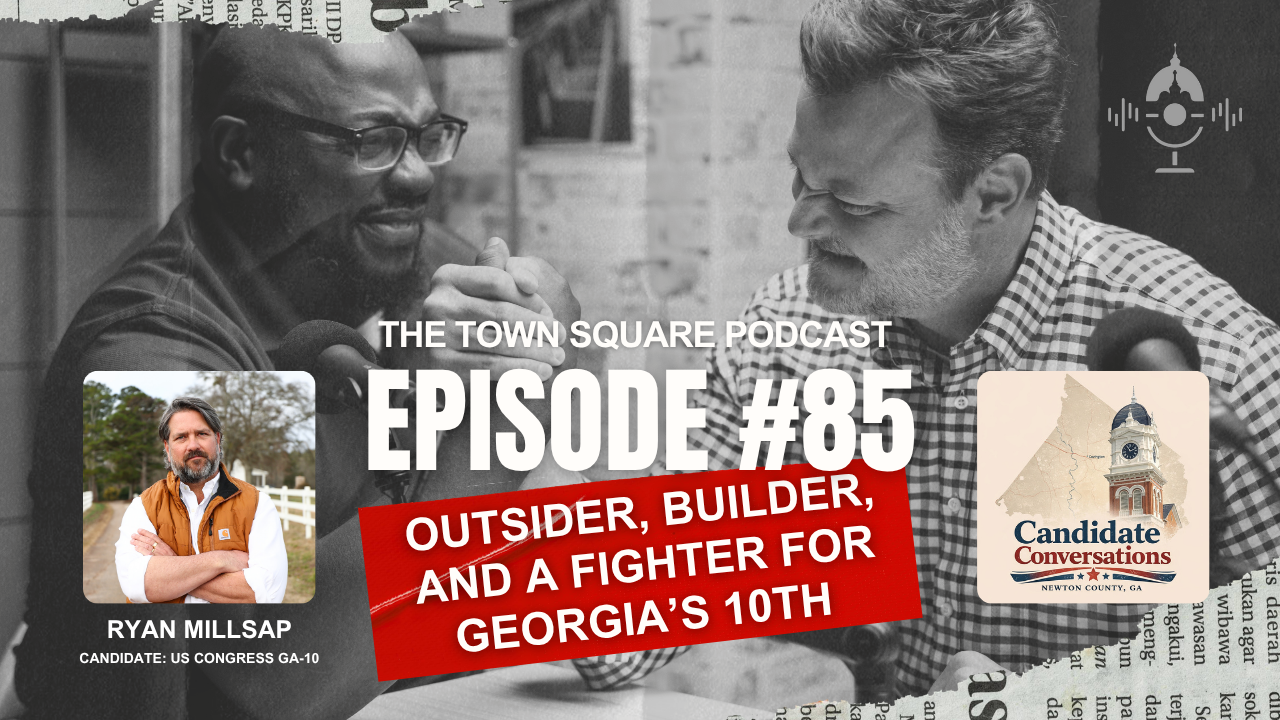
In Episode 85 of The Town Square Podcast, Trey Bailey and Gabriel Stovall continue their Candidate Conversations series with Ryan Millsap, Republican candidate for U.S. Congress in Georgia’s 10th District. The seat is currently held by Congressman Mike Collins, and with voters preparing for another important election cycle, this conversation was designed to help listeners better understand one of the candidates asking for their vote.
As always, the goal of The Town Square Podcast is not to create uniformity, but to create understanding. In that spirit, this episode gives Ryan Millsap room to tell his story, explain his worldview, and make his case directly to the people of District 10.
What follows is a candidate who is anything but conventional.
A Candidate with an Unusual Backstory
At first glance, some listeners may assume they know who Ryan Millsap is based on campaign rhetoric, short clips online, or the forceful style he brings to a room. But this conversation quickly revealed a far more layered personal story.
Millsap was born in southern Missouri, where his father’s family had deep roots going back generations. His mother grew up on a cattle ranch in northern Nebraska, and that upbringing — wide open land, hard work, and a culture of toughness and independence — clearly shaped the values Millsap still talks about today.
His father was a recon Marine in Vietnam, a Purple Heart recipient and Bronze Star honoree who returned home carrying the scars of war, including PTSD. Millsap described growing up in a home shaped by both discipline and intensity, with a tom-boy mother who loved college football and a family environment that felt more like a locker room than a quiet suburban home.
The family later moved to Phoenix, Arizona, and then to central California, where Millsap says he spent his teenage years in a deeply conservative farming community. That blend of Midwestern roots, Southwestern grit, and West Coast business exposure became an unusual but formative mix.
More Depth Than Expected
One of the most surprising turns in the episode was hearing how academically layered Millsap’s background really is.
He attended Biola University, where he studied philosophy, and later studied at Oxford, focusing on issues related to time, eternity, and divine omniscience. He also played American football at Oxford and rowed there — experiences that Trey clearly did not expect to come up in what he assumed would be a more conventional campaign interview.
After Oxford, Millsap pursued graduate studies at USC in real estate development. From there, he began doing real estate deals at a young age and eventually built a substantial career in apartment acquisitions, development strategy, and complex deal-making.
For several years, he even taught real estate at USC as a professor, developing course material designed to teach students what real-world entrepreneurship actually looks like. That detail added another layer to Millsap’s profile: not just businessman, but teacher and thinker as well.
Building Wealth, Business, and Opportunity
Millsap described himself repeatedly as an entrepreneur — and in the conversation, that seems to be the identity he values most.
He explained how he partnered with investors after the 2008 financial collapse to acquire thousands of apartment units across the South at a time when the economy was in chaos. He said he saw that moment as one of the greatest buying opportunities of a generation and used it to build a massive real estate portfolio in Atlanta and surrounding Southern cities.
Eventually, that business success brought him to Georgia full time. He moved here in 2014, drawn by both the economics of the region and the opportunities he saw in a growing Southern market.
Then came one of the more unexpected chapters of his story: film studios.
After recognizing what he believed was an overlooked real estate opportunity in Georgia’s booming movie industry, Millsap built an 850,000-square-foot movie studio inside the perimeter of Atlanta. He later leased that studio to major entertainment companies including Disney, Sony, Warner Brothers, HBO, and Netflix. Films such as Jungle Cruise,Jumanji, Venom, Godzilla, andnTomorrow War were among the projects made on the property.
It was a reminder that Millsap did not enter politics from political circles, legislative offices, or advocacy groups. He came from business, development, and entrepreneurship.
Why Politics? Why Now?
That is where the conversation took a more urgent turn.
Millsap said plainly that he never expected to run for office. In fact, he claimed he had little real interest in politics until a long-running conflict involving land he owned in DeKalb County changed the course of his life.
He recounted a years-long land swap deal with DeKalb County that eventually left him in possession of property next to the area now associated with Atlanta’s police training center, often referred to by critics as “Cop City.” According to Millsap, activists later moved onto his property, used it as a staging ground, and occupied the land for an extended period while local authorities failed to act.
He described the ordeal as a five-year war with Antifa, involving litigation, vandalism, threats, public attacks, and government inaction. Whether listeners agree with every part of his interpretation or not, there was no mistaking the intensity with which he told the story. In Millsap’s telling, this experience exposed what he sees as the weakness of government institutions, the danger of ideological extremism, and the unwillingness of career politicians to confront the deeper problems facing the country.
That, he says, is what pulled him into the race.
An Outsider’s Case for Congress
Throughout the interview, Millsap returned again and again to the same core idea: America needs fewer career politicians and more proven outsiders.
He argued that many people in Washington are detached from real American life and have never built anything, risked anything, or had to navigate the pressures of the private sector. In contrast, he sees his own story — raising a family, building businesses, hiring people, managing risk, and absorbing loss — as the kind of preparation voters should value.
He said politics has become a place where the wrong people accumulate power, and he wants to challenge that culture by bringing entrepreneurial thinking into public office.
Whether one agrees with his tone or not, Millsap was clear about how he views the race: not as a gradual climb into political life, but as a disruption of a system he believes is already broken.
The Constitution, Americanism, and Representation
Millsap spoke often and passionately about the Constitution, which he described not just as a legal framework, but as a moral document and the bedrock of American life.
He argued that many Americans misunderstand the country as a pure democracy when, in his view, the United States was intentionally founded as a constitutional republic designed to protect liberty against mob rule. He repeatedly framed his worldview around “Americanism,” which for him means individual liberty, constitutional limits, strong local communities, and a resistance to collectivist thinking.
That constitutional lens shaped nearly every policy topic discussed in the interview. It was central to how he talked about free speech, the Second Amendment, federal overreach, taxation, and civic education.
In his words, even representing a large and diverse district means first representing the Constitution itself.
His Vision for Georgia’s 10th District
District 10 is a massive congressional territory, covering all or parts of numerous counties across east and central Georgia, including Newton County. Millsap repeatedly emphasized that the district should be more organized, more connected, and more self-aware.
He argued that many voters do not even realize they live in the 10th District, let alone understand what shared values connect the region. As congressman, he said he would want to provide not just a vote in Washington, but visible, local leadership back home — helping residents think of themselves as part of a distinctly American, strongly constitutional district.
It was one of the more interesting themes in the episode: Millsap seems to view the office not only as legislative representation, but as a platform for cultural and civic organizing across the district.
Economy and the “Flywheel of Fraud”
Another major theme of the episode was what Millsap called the “flywheel of fraud.”
He argued that federal programs, bureaucracy, illegal immigration, and government-aligned organizations often form self-reinforcing systems that expand political power while wasting taxpayer money. In his view, many of the country’s financial struggles stem not just from bad policy, but from entrenched networks of public spending, political protection, and institutional corruption.
He linked that critique to his support for efforts like DOGE and his admiration for Elon Musk’s willingness to challenge bloated systems. Millsap said he wants to bring a similar entrepreneurial and confrontational energy to Congress, with the goal of shutting down sources of waste and redirecting money back into what he described as the real economy.
His language was often sharp, but the principle was consistent: government should be smaller, more accountable, and far less dependent on permanent bureaucratic structures.
A Strongly Local View of Charity and Community
One of the more unexpected and thoughtful turns in the episode came during a discussion about poverty, charity, and safety-net programs.
Despite his hard criticism of federal welfare structures, Millsap did not argue for indifference to the poor. Instead, he made the case that care works best locally — through churches, families, and communities that actually know the people they are helping.
He contrasted impersonal federal systems with relational, accountable support systems rooted in neighborhoods and congregations. His argument was not that suffering should be ignored, but that help is most transformative when it is personal, communal, and tied to accountability rather than bureaucracy.
That section of the interview revealed something that came up several times: beneath all the forceful rhetoric, Millsap sees many national problems as the result of local structures being hollowed out or replaced.
Faith, Church History, and Surprise Depth
Near the end of the conversation, another side of Millsap emerged.
He spoke openly about his Christian faith, his transition from evangelical Protestantism into Greek Orthodoxy, and his deep interest in church history and theology. He referenced the Nicene Creed, the early councils of the church, and the importance of preserving mystery rather than over-systematizing every theological idea.
It was, frankly, not the direction the hosts expected the conversation to go — and they said as much. But it added a level of depth that likely would not be obvious to many listeners based only on campaign appearances or short-form media clips.
It also helped explain why Millsap so often speaks in terms not only of politics, but of morality, order, inheritance, and foundations.
Final Impressions
Ryan Millsap is not running as a polished institutional candidate. He is running as a forceful outsider with a businessman’s résumé, a storyteller’s instincts, a fighter’s tone, and a deep conviction that the country is in a moment of real danger and real opportunity.
Listeners will have their own reactions to his style, his language, and his policy framework. Some will find his urgency compelling. Others may find it intense. But either way, this episode delivers exactly what the Candidate Conversations series is supposed to provide: a long-form, substantive opportunity for voters to hear directly from a candidate in his own words.
For the people of Georgia’s 10th District, this conversation offers a much fuller introduction to Ryan Millsap than a debate clip, social media reel, or campaign mailer ever could.
And in a season where voters are being asked to make important decisions, that kind of deeper understanding is exactly the point.
Links Discussed
Ryan Millsap Campaign Website:
Ryan Millsap Social Media:
Episode Sponsors
All Air
When it comes to heating, cooling, and healthy air in Covington and the greater Atlanta area, All Air is a trusted local name known for doing things the right way. From repair and maintenance to full HVAC system installation, their team provides reliable, professional service with free replacement estimates, free second opinions, flexible financing options, and special discounts for veterans and senior citizens. Mention The Town Square Podcast for $25 off your next repair service.
Contact All Air:
Phone: 770-761-9914
Website: allairservices.com
Luther Rice College & Seminary
Luther Rice College & Seminary is a fully online, biblically grounded, accredited institution designed to help students pursue their calling from a Christian worldview. Whether you are a high school student seeking dual enrollment, an adult learner deepening your biblical knowledge, or a working professional looking to grow in leadership and purpose, Luther Rice offers affordable and accessible options ranging from certificates to doctoral-level study.
Contact Luther Rice College & Seminary:
Website: lutherrice.edu