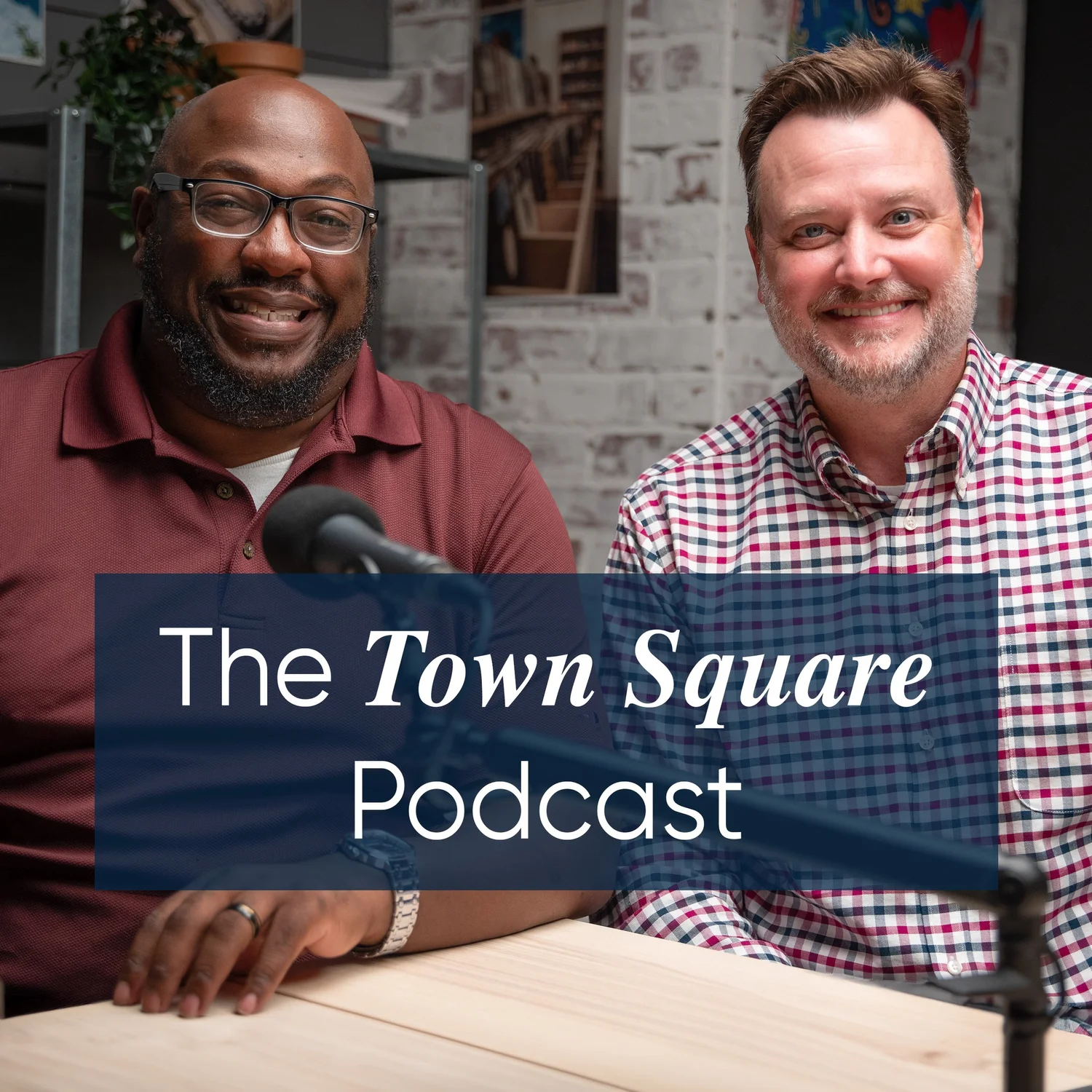

Marshall McCart of The Piedmont Chronicles: Politics, Privacy, and Local Music — Episode 97
Use the audio-player above to listen here, or click one of the following links to listen on
Apple Podcasts or Spotify. Or click on the photo below to watch on YouTube.
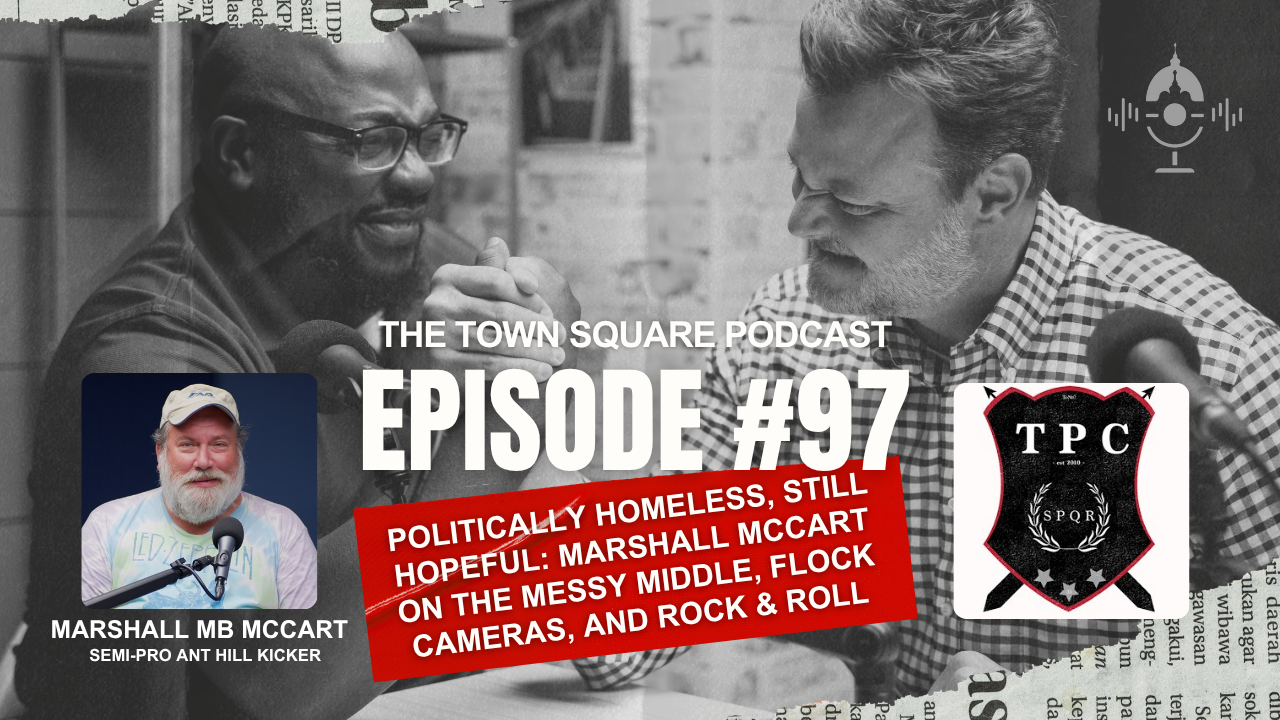
Politically Homeless, Still Hopeful
Marshall McCart returns to The Town Square Podcast for a candid trip through political burnout, public surveillance, permanent standard time, Covington music history, and the stubborn hope that keeps him from hanging up his boots for good.
Marshall McCart has spent roughly 25 years kicking at political anthills.
Sometimes the ants bite back.
On Episode 97 of The Town Square Podcast, the writer and local-history enthusiast behind The Piedmont Chronicles returns nearly a year after his first appearance. The self-described “semi-professional anthill kicker” arrives with fewer political sparks flying than usual—but not because he has stopped paying attention.
He is tired.
After years of party politics, grassroots advocacy, citizen journalism, and public argument, Marshall has pulled back to ask a difficult question: after all that banging against the proverbial brick wall, what is there to show for it?
That question opens a wide-ranging conversation about public trust, political identity, technology, music, family, local memory, and the possibility that the sensible center is larger than the loudest voices make it appear.
When political engagement becomes political exhaustion
Marshall traces his civic involvement through the Libertarian Party, the GOP, independent efforts, grassroots groups, and his work with The Piedmont Chronicles. He has not stopped caring about local issues, but he has deliberately unplugged from some of the daily political combat.
Part of that fatigue, he says, comes from feeling politically homeless. He does not recognize himself in the loudest parts of the MAGA movement, and he has no interest in the socialist wing of the Democratic Party. If those are the only choices being offered, he argues, a great many people are being left without a political home.
That is where the Town Square idea of the “messy middle” comes in.
Marshall’s sharpest political observation may also be the episode’s most hopeful: the opposing fringes can dominate attention without representing most people. “The messy middle is the majority,” he says. The challenge is getting that majority to stop treating exhaustion as surrender—and to start building relationships broad enough to matter.
Flock cameras and the price of security
The conversation turns local when Trey and Marshall discuss automated license plate readers, including the Flock camera systems now familiar along roads, near schools, and across multiple jurisdictions.
Both acknowledge the strongest argument for the technology: it can help law enforcement locate wanted vehicles, develop leads, protect campuses, and solve serious crimes. Marshall does not wave those benefits away. His concern is what happens when a powerful tool built for a legitimate purpose becomes part of a much larger surveillance network.
The question is not whether the cameras can be useful. It is whether usefulness alone should settle the debate.
Marshall argues that privacy and Fourth Amendment concerns deserve more than a shrug—especially when ordinary people who are suspected of no crime have their vehicle movements captured and made searchable. Trey wrestles with the same tradeoff from the perspective of school safety: a little more warning can matter enormously, but that does not erase the civil-liberties question.
Their practical conclusion is refreshingly unglamorous. If residents object, the answer is not vandalism. It is coalition-building, public comment, and votes before city councils and county commissions when contracts come up for approval or renewal.
A surprisingly serious argument about the clock
Marshall has another long-running civic cause: ending the twice-yearly time change.
But he is not campaigning for permanent daylight saving time. He wants permanent standard time—what he calls natural time.
His case begins with winter mornings. In the western portion of a time zone, permanent daylight saving time can push sunrise uncomfortably late. He also points to the disruption people experience when clocks spring forward and fall back. His preferred answer is not to keep rearranging the clock, but to return to standard time year-round.
Trey gives him room to make the full argument, and Marshall brings the enthusiasm of a man who has apparently been waiting 15 years for somebody to ask.
Rock and roll is not dead
Then the episode changes key.
Marshall is a lifelong musician whose musical Mount Rushmore begins with Led Zeppelin and Steely Dan. He and Trey trade favorite records, marvel at John Bonham’s impossible-sounding right foot, and swap stories about the strange studio tricks producers use to capture the right tone.
The conversation becomes a piece of Covington and Newton County music history. Marshall remembers a spring 1996 show at the Wiley farm in North Oxford, where his band Southern Freight shared the bill with Trey’s Rocketboy. There was a homemade stage, a natural amphitheater, hundreds of people, and—if memory serves—a bass player in a dress. The statute of limitations has probably expired.
They name-check musicians, bands, old venues, and friendships that formed a local scene: Sweet Harmony, Fox Hill Road, Chris, Jon and Scott, Hannah Thomas, Thomas Tillman, Corey Crowder, Drew Parker, and others. Marshall also sends listeners toward King Gizzard & The Lizard Wizard and Black Pumas, while Trey makes the case for the Appalachian rock of Cigarettes @ Sunset.
The thread running through it all is not nostalgia for nostalgia’s sake. It is the way music preserves a community’s memory. A farm show, a Christmas-light rivalry, a set at a local pub, or a band that lasted only a season can still become part of the story a town tells about itself.
Homeownership, the economy, and the American promise
Because Marshall also works in real estate and real estate education, the conversation eventually returns to economics. He describes the Covington, Newton County, and East Metro market as location-dependent and generally steady, while noting that values and sales activity can vary sharply by property and neighborhood.
The larger discussion is less about a market forecast than about ownership itself. Trey wonders what happens when younger adults are told to believe in the American dream but cannot see a realistic path to owning a home or building a stake in the system. Marshall connects that frustration to a political economy dominated less by open competition than by alliances among big government, big business, and other concentrated interests.
Whether listeners share every part of that diagnosis or not, the underlying concern is worth hearing: people invest in a system when they believe they can belong to it.
The reason he has not quit
Near the end, Trey asks Marshall what gives him hope.
Marshall pauses, then comes back to faith and people.
“I believe in people,” he says. There are bad actors, certainly, but there are also a great many people who care about their neighbors and want life to be better for their children. The world will never be perfect, but that does not excuse us from trying to improve the piece of it within reach.
Marshall says he will get back into the fray at some point. For now, the anthill kicker is catching his breath, listening to a little Zeppelin, and waiting for the right moment to lace up the boots again.
That may be the messy middle in its most honest form: tired, skeptical, occasionally cranky—and not quite ready to give up.
Links Mentioned
1. Watch Episode 97 on YouTube:https://youtu.be/NYvszSlLlKk
2. The Piedmont Chronicles:https://www.thepiedmontchronicles.com/
3. The Town Square Podcast:https://www.thetownsquarepodcast.com/
4. Support The Town Square Podcast:https://www.thetownsquarepodcast.com/donate
5. Flock Safety license plate readers:https://www.flocksafety.com/products/license-plate-readers
6. Rocketboy: https://www.rocketboylives.com
7. Fox Hill Road:https://www.foxhillroad.com/
8. Cigarettes @ Sunset:https://www.cigarettesatsunset.com/
9. King Gizzard & The Lizard Wizard:https://kinggizzardandthelizardwizard.com/
10. Black Pumas:https://www.blackpumas.com/
Sponsor / Advertiser
Angel Pitts, United Bank Wealth Management
This episode is made possible in part by Angel Pitts, United Bank Wealth Management Advisor, serving Covington and Madison, Georgia. Angel helps clients think through long-term investing, diversification, and personalized financial planning while building relationships that go beyond investments.
Phone: 770-412-4932
Website: https://www.accessunited.com/wealth-management
When you contact Angel, please let her know The Town Square Podcast sent you.
Disclosure: Wealth Management Services are not FDIC insured, not bank guaranteed, may lose value, are not a bank deposit, and are not insured by any federal government agency.