
Larry Cox Explains Data Centers, School Funding & the Future of Rockdale County — Episode 96
Use the audio-player above to listen here, or click one of the following links to listen on
Apple Podcasts or Spotify. Or click on the photo below to watch on YouTube.
Data Centers, School Budgets & Speaking Your Mind with Larry Cox
One of the greatest challenges facing local communities today isn't a lack of information—it's determining which information to trust.
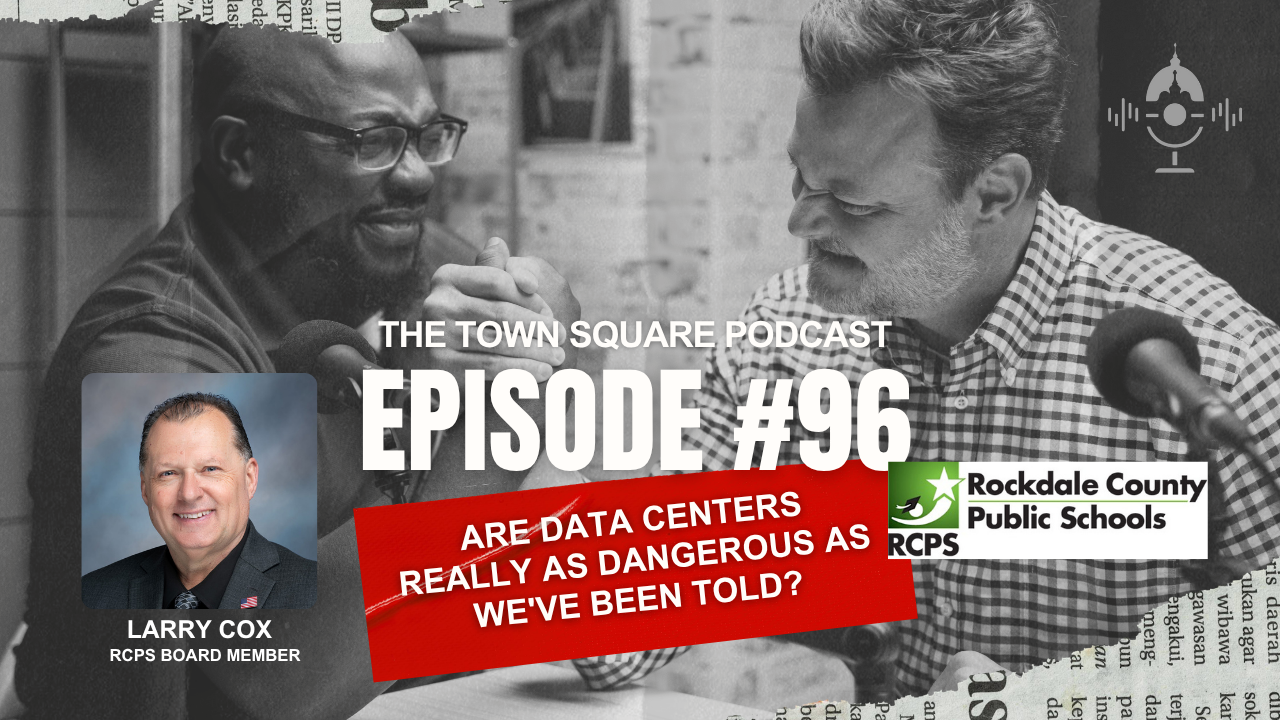
That theme surfaced repeatedly during Episode 96 of The Town Square Podcast as Rockdale County Board of Education member Larry Cox joined Trey Bailey and guest co-host Dr. Gregory Brown for a wide-ranging discussion about public education, school funding, and one of Georgia's hottest local government topics: data centers.
Known throughout Rockdale County for his "Speak Your Mind" podcast, Cox has built a reputation for saying exactly what he thinks. Whether listeners agree with him or not, one thing is certain—he rarely leaves anyone wondering where he stands.
But this conversation wasn't simply about opinions.
It was about understanding how decisions are made and why good public policy requires more than headlines and social media posts.
From Construction to Community Leadership
Before entering public office, Larry Cox spent more than three decades in the construction industry, serving as Vice President of the highway division for one of the Southeast's leading concrete cutting companies.
His work has taken him across airports, military installations, and major interstate projects throughout the Southeast. That background shaped the way he approaches government.
Rather than viewing public service through an ideological lens, Cox says he tends to approach problems the same way he approaches construction projects: identify the issue, gather the facts, and solve the problem.
That practical mindset eventually led him to seek public office after years of community involvement.
A Different Kind of Campaign
When Larry Cox first ran for the Rockdale County Board of Education, he wasn't well known.
His second campaign was very different.
Rather than avoiding controversial issues, Cox openly campaigned on changing district leadership, reducing spending, restoring classroom discipline, increasing transparency, and pursuing additional tax relief for senior citizens.
According to Cox, voters weren't looking for vague promises.
They were looking for someone willing to explain exactly what he intended to do.
Now, roughly halfway through his first term, he believes much of that campaign agenda has already begun taking shape.
School Boards: What They Actually Do
One of the most helpful portions of the conversation focused on a question many citizens misunderstand:
What does a school board actually do?
Cox explained that while many residents expect school board members to solve day-to-day operational issues, Georgia law assigns boards three primary responsibilities:
Hiring and evaluating the superintendent
Fiscal oversight of the district
Establishing board policy
Everything else is largely delegated to district administration.
That distinction matters because many of the complaints school board members receive are actually operational concerns rather than governance issues.
Understanding that difference helps citizens better direct their questions and expectations.
School Budgets Are More Than Numbers
The conversation then shifted toward one of Trey Bailey's favorite themes—viewing a school budget as a moral document.
Every budget reflects priorities.
Every dollar spent communicates what a district values.
But budgets also represent something else: the burden placed on taxpayers who fund those priorities.
Larry Cox argued that districts must consider not only what happens inside the classroom but also the financial realities families face outside school.
He challenged listeners to think about the "whole child" differently.
While educators often define the whole child through academic, emotional, and social support, Cox suggested another perspective.
Children spend far more time outside school than inside it.
If excessive taxes make it harder for grandparents to buy medicine or families to afford housing, those financial pressures ultimately affect students as well.
For Cox, stewardship means balancing educational investment with community affordability.
Why School Funding Is So Complicated
The discussion naturally moved into Georgia's school funding formula.
School districts receive much of their funding through the state's Quality Basic Education (QBE) formula, but local property taxes remain a critical piece of the equation.
That creates challenges.
Enrollment shifts.
Healthcare mandates increase costs.
Retirement obligations grow.
Meanwhile, districts often have little control over many of those expenses.
Cox described how Rockdale County reduced its operating budget while simultaneously absorbing state-mandated cost increases—a reminder that reducing spending on paper often requires significantly larger internal cuts.
The conversation also explored the long-term sustainability of relying so heavily on property taxes to fund public education.
Both hosts agreed that conversations at the Georgia Capitol will likely continue for years as lawmakers search for more sustainable funding models.
Finding the Next Superintendent
Another timely topic involved Rockdale County's search for its next superintendent.
Rather than discussing specific candidates, Cox shared the qualities he believes matter most.
He wanted someone with demonstrated success—not simply theories or promises.
He wanted a leader who understood fiscal responsibility.
And perhaps most importantly, he wanted someone prepared to make difficult decisions if enrollment declines eventually require districts to redraw attendance zones or repurpose school facilities.
Those aren't easy conversations.
But leadership often requires preparing for tomorrow's challenges rather than reacting to yesterday's problems.
(At the time of airing this episode, Dr. Stephanie Johnson has been named the new superintendent of Rockdale County Schools, click HERE for the press release.)
The Data Center Debate
The second half of the episode focused on one of the fastest-growing issues facing communities across Georgia.
Data centers.
As artificial intelligence continues expanding, demand for large-scale computing facilities has exploded.
With that growth has come concern.
Residents worry about water usage.
Electricity demand.
Noise.
Environmental impacts.
Tax incentives.
Infrastructure.
Rather than relying on internet searches or social media discussions, Larry Cox spent weeks interviewing mechanical engineers, acoustic engineers, and leaders from Georgia's Public Service Commission.
His goal wasn't to convince people.
His goal was to understand the facts.
Those interviews challenged several assumptions he previously held.
According to experts featured in his series, modern data centers increasingly rely on closed-loop or waterless cooling systems that dramatically reduce ongoing water consumption.
Infrastructure costs, Cox noted, are generally paid upfront by developers rather than existing ratepayers.
Georgia's electrical grid, according to Public Service Commission leadership, is being expanded alongside this growth rather than after it.
While public debate often centers on potential risks, Cox argues communities should also carefully evaluate economic opportunities—including expanded commercial tax bases that could eventually reduce the tax burden on homeowners.
He also acknowledged that earlier generations of data centers created many of the concerns still circulating today.
Technology, however, continues to evolve rapidly.
Separating Facts from Fear
Perhaps the most important takeaway from Episode 96 had nothing to do with school budgets or data centers.
It had to do with information.
Throughout the discussion, the hosts repeatedly encouraged listeners not to settle for headlines or viral posts.
Instead, they urged citizens to attend meetings.
Ask questions.
Read source documents.
Listen to experts.
Evaluate competing claims.
Only then can communities make informed decisions about issues that will shape their future.
In an era where information is abundant but trust is scarce, thoughtful civic engagement remains one of the most valuable tools citizens possess.
Final Thoughts
Episode 96 reminds us that healthy communities require more than strong opinions.
They require strong conversations.
Whether discussing public education, taxation, or emerging technologies, lasting solutions are usually found somewhere in the messy middle.
That has always been the mission of The Town Square Podcast.
Not uniformity.
But unity.
Built one conversation at a time.
How to Find Larry Cox
Episode Sponsor
All Air Services
When your home deserves dependable comfort, call the local professionals at All Air Services.
Whether it's routine maintenance, emergency repairs, or a complete HVAC replacement, All Air Services has built its reputation on honest advice, exceptional workmanship, and customer-first service.
Mention The Town Square Podcast when scheduling your repair and receive $25 off your service call.
📞 770-761-9914