
Brett Mauldin: Faith, Freedom & Local Control | Candidate Conversations — Episode 80
Use the audio-player above to listen here, or click one of the following links to listen on
Apple Podcasts or Spotify. Or click on the photo below to watch on YouTube.
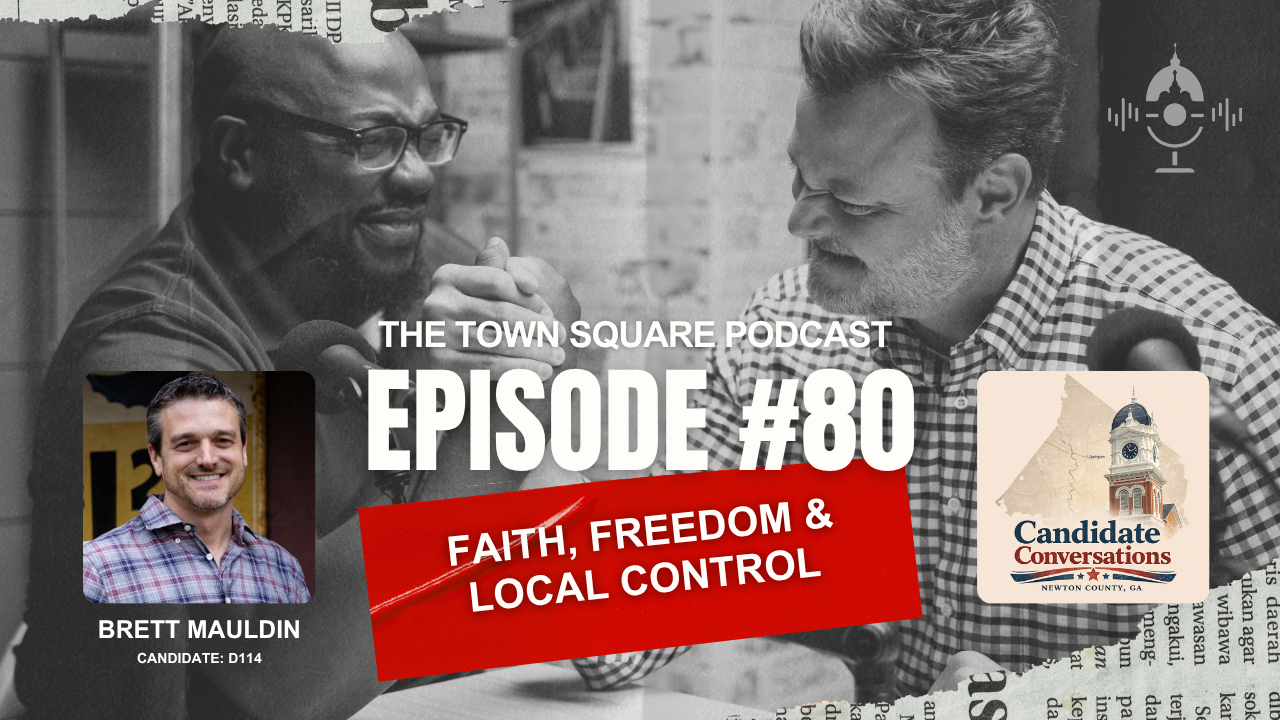
The Candidate Conversations series continues on The Town Square Podcast with Brett Mauldin, Republican candidate for Georgia House District 114. Covering Morgan County and parts of Newton and Walton counties, House District 114 includes communities that are deeply shaped by agriculture, small-town identity, conservative values, and growing concerns about development, taxation, and the future of local control.
For many listeners in Newton County, this episode may have served as their first introduction to Mauldin. Trey Bailey and Gabriel Stovall opened the conversation by helping listeners understand exactly who he is, where he comes from, and what motivates him to run for office. What followed was a candid, often personal conversation about family, faith, business, public service, and the kind of government Mauldin believes Georgia needs.
A Small-Town Background Rooted in Family
Mauldin described himself as a “small town guy,” someone who grew up around Greene, Putnam, and Morgan counties and who still identifies deeply with the country mindset and rural values of the region. He comes from a small-business family and says those experiences shaped the way he sees money, responsibility, and leadership.
He also spoke warmly about his family. He and his wife, Candice, recently celebrated 20 years of marriage. They have three children, and throughout the conversation Mauldin returned again and again to the importance of family life, raising children well, and creating a future worth passing on to the next generation.
His story included a year of football at the University of West Georgia, time at Lee University near Chattanooga, and a few laughs about his rugby days. But beneath the humor was a clear theme: his life has been shaped by discipline, teamwork, faith, and a willingness to work hard.
Leadership Shaped by Listening
One of the more interesting parts of the conversation came when Mauldin reflected on how different perspectives have shaped him. He spoke about the influence of his wife, noting that she came from a different socioeconomic background than he did. That experience taught him that leadership requires openness, humility, and a willingness to listen.
He shared a line from a mentor that captured his philosophy well: “Minds are like parachutes. The only time they work is when they’re open.”
That outlook has informed both his personal leadership style and the way he runs his business. Rather than surrounding himself with “yes men,” Mauldin said he values challenge, input, and honest disagreement. In his words, if all he wanted was agreement, he could just buy a parrot.
That idea carried throughout the episode. Even while articulating strong convictions, Mauldin presented himself as someone who believes leadership is strongest when it is accountable, participatory, and rooted in listening to others.
Business Experience and Decentralized Leadership
Mauldin currently leads his family’s cabinets and countertops business, which travels throughout the Southeast. He discussed the company’s journey, including the hardships of the Great Recession and the lessons learned through navigating both challenge and growth.
The company was recently recognized as a Family-Owned Small Business of the Year, but Mauldin was quick to redirect praise to his team. He described his leadership style as “decentralized command,” emphasizing that not every decision should run through one person. Instead, he believes strong organizations invite participation, encourage buy-in, and empower others to lead.
That same principle showed up repeatedly in the conversation as he described how he thinks government should work. In business and in government, Mauldin believes the closer power is kept to the people affected by it, the better the results will be.
Why He’s Running
Mauldin said the opening of the House District 114 seat created an opportunity for someone new to step forward and serve. But for him, running is about more than filling a vacancy. He believes good people must be willing to step into public life, especially when politics feels frustrating, divisive, or dirty.
He argued that one reason many good people avoid politics is because they do not want to deal with the messiness of it all. But in his view, that is exactly why strong, grounded men and women should be willing to step up. He believes public service should not be left only to the ambitious or the loudest voices, but should include people with real-world experience, strong values, and a desire to serve.
Throughout the episode, Mauldin emphasized that disagreement is not the problem. In fact, he sees disagreement as healthy. What matters is whether leaders are willing to challenge ideas honestly while still working toward the common good.
Protecting the Vulnerable
One of the strongest recurring themes in the interview was Mauldin’s belief that a just society protects its most vulnerable people. He connected this conviction both to his Christian faith and to his broader political philosophy.
He spoke emotionally about children in particular, arguing that society has a moral duty to defend those who cannot defend themselves. He referenced a friend who worked to rescue children from sex trafficking and said those realities deeply affect how he thinks about leadership and responsibility.
He also used an illustration about archaeologists discovering healed bones in ancient civilizations. For him, those healed bones reflect a society willing to care for those who could not survive on their own. In Mauldin’s view, civilization is measured in part by how it treats the weak, the elderly, children, and the vulnerable.
That theme surfaced in several policy areas he mentioned, including human trafficking, drug trafficking, support for law enforcement, and his views on unborn children.
Property Taxes, Fixed Incomes, and Staying in Your Home
When the conversation turned to issues facing District 114, Mauldin quickly raised concern about property taxes. He made the case that rising property values are putting serious pressure on people who have lived in their homes for decades, especially seniors and those on fixed incomes.
Even when millage rates remain the same, he noted, rising assessments can create a growing tax burden that many families simply cannot absorb. He argued that older residents who spent years contributing to schools and communities should not be forced out of their homes because taxes continue to rise faster than their income.
Rather than framing the issue in abstract budget terms, Mauldin spoke about the emotional and generational cost: losing not only a house, but a lifetime of memories.
Trey added his own perspective from the public education side, noting the tension between providing property tax relief and fully funding schools. Their exchange created one of the more substantive parts of the episode, as both acknowledged the need for thoughtful reform that protects taxpayers without undercutting education.
Government Efficiency and the Cost of Red Tape
Another major focus for Mauldin was government inefficiency and bureaucratic red tape. He spoke bluntly about frustrating state processes that slow down business and create unnecessary burdens for citizens.
One example he shared involved dealing with the Secretary of State’s office over a paperwork issue involving capitalization in a business name. Another involved identity verification questions so strange they became laughable. His broader point was that government processes often waste time and money in ways that frustrate ordinary citizens and business owners alike.
Mauldin said he wants to reduce those burdens and make state government more efficient. He argued that taxpayers deserve a government that serves them well, not one that creates obstacles for the sake of procedure.
He also floated ideas around incentivizing better stewardship inside government agencies. Rather than simply cutting budgets with a blunt instrument, he suggested looking for ways to reward efficiency and redirect savings toward priorities like employee compensation or taxpayer relief.
Growth, Development, and Preserving Rural Character
One of the most important parts of the conversation centered on growth. District 114 includes places experiencing change, pressure from metro expansion, and concern over what development may do to local culture and land use patterns.
Mauldin made clear that he is deeply proud of the district’s agricultural heritage. He spoke about Mansfield, Newborn, Morgan County, and the Social Circle portion of Walton County as places shaped by farming, land stewardship, and a way of life worth protecting.
He expressed concern that too often “the only thing growing is concrete,” and he pushed back on development philosophies that prioritize dense residential and industrial expansion without enough regard for the communities already there.
At the same time, he did not present himself as someone trying to impose a one-size-fits-all answer. Instead, he returned to the principle of local control. In his view, local communities, mayors, city councils, county commissioners, and other local officials are best positioned to decide what kind of growth fits their area.
That means his role as a state representative, as he sees it, would not be to dictate local outcomes, but to help facilitate what local communities actually want.
Local Control as a Governing Philosophy
If there was one phrase that tied the whole interview together, it was this: keep power closer to the people.
Mauldin repeatedly returned to the idea that authority should move downward whenever possible. Powers unnecessarily concentrated in Washington should be brought back to the state. Powers unnecessarily concentrated at the state level should be returned to local governments.
He believes the more local the decision-making, the more accountable government becomes. People can more easily meet with city council members, county commissioners, sheriffs, and school leaders than with state or federal officials. Because of that, he sees local engagement as one of the most important responsibilities citizens have.
This philosophy shaped how he answered questions about growth, schools, taxation, and governance. It also influenced how he discussed his own role. He said the office is not really “his seat” at all, but something temporarily rented in service to the district. If done well, he said, people should remember the district more than the person who occupied the office.
Top Priorities at the Gold Dome
When asked what he would most like to accomplish if elected, Mauldin identified three broad priorities.
First, he wants to reduce the tax burden on citizens and help Georgians keep more money in their pockets.
Second, he wants to reduce government red tape and unnecessary regulation that complicates life for businesses and ordinary people.
Third, he wants to resist what he sees as ideological agendas being pushed onto children and families.
Even when discussing these priorities, Mauldin framed them less as political slogans and more as reflections of his underlying values. He told listeners that if people understand his core beliefs and character, they should have a pretty good sense of how he would vote and govern.
Staying Connected to the District
One of the standardized candidate questions in this series asked how he would stay connected to the people of District 114 once in office. Mauldin said he wants to remain accessible through town halls, phone calls, meetings with local elected leaders, and ongoing presence in the community.
He acknowledged that no representative can personally connect with every constituent all the time, but he said accountability matters. Returning calls, listening carefully, and staying in regular communication with mayors, county commissioners, city council members, and sheriffs would all be part of how he intends to stay informed.
At the same time, he showed awareness of a real leadership challenge: the loudest voice is not always the most representative voice. He said elected officials must use discernment to distinguish between individual agendas and the broader concerns of the people they serve.
Working with People Who Disagree
Another standardized question asked how he would work alongside people who strongly disagree with him. Mauldin answered by returning to perspective-taking and common sense.
Drawing on his work in the builders’ association, he described times when people from very different viewpoints arrived at similar conclusions for different reasons. In those situations, he said, the key is not necessarily whether everyone shares the same worldview, but whether they can find genuine common ground around a policy outcome.
He made clear that some issues are non-negotiable for him, especially those involving the Second Amendment, unborn children, and the role of government in personal life. But on many other issues, he believes there is room for practical problem-solving, so long as leaders are not driven by ego or self-interest.
Faith as the Foundation
Faith was not just a sidebar in this interview. It was central.
Mauldin spoke openly about his relationship with Christ and the ways his faith shapes his values, his sense of accountability, and his understanding of public service. He referenced Matthew 5:16 as a life verse and said he believes people should live in a way that points others not to themselves, but to God.
When Gabriel asked whether compromise in public life ever creates tension with his faith, Mauldin answered that if someone is truly grounded in God, that faith should permeate every part of life. He said his deepest accountability is not to public opinion, but to God Himself.
That answer gave listeners one of the clearest windows into how Mauldin thinks about integrity. For him, character is not just about public reputation. It is about who you are when no one else is looking.
Final Message to Voters
At the close of the episode, Mauldin was asked the now-familiar Town Square “bullhorn” question: if he had one message to broadcast to the whole district at once, what would it be?
His answer was direct and simple. He said people want to be left alone, they want more money in their pockets, and they want less government in their lives. He framed his campaign around service, not self-promotion, and said that reducing government burdens and helping people keep more of what they earn is what voters deserve.
That closing answer summed up the episode well. Whether listeners agree with every position or not, they got a clear sense of who Brett Mauldin is, what he believes, and how he would approach public office.
Final Thoughts
This episode is exactly what your Candidate Conversations series is supposed to do. It gives voters the chance to hear directly from a candidate in a long-form setting, beyond slogans and yard signs. Mauldin came across as grounded, values-driven, strongly conservative, and deeply committed to local control, family, and faith.
For voters in House District 114, this conversation offers a meaningful look at the man behind the campaign and the ideas driving his candidacy.
How to Connect with Brett Mauldin
Website: votebrettmauldin.com
Email: brett@votebrettmauldin.com
Facebook: Brett Mauldin for Georgia
Personal Facebook: Brett Mauldin
Phone: 706-717-0307
Sponsors / Advertisers
Appalachia Group Insurance
When it comes to protecting your family, home, car, or business, Appalachia Group Insurance offers independent coverage options designed to work for you. Bobby Stevens and Matt McLean are licensed in Georgia and Tennessee and bring a combined 36 years of insurance experience. Because they are independent, they can shop multiple carriers to help find the best coverage at the best price.
Phone: 770-728-1880
Email: bobby@appgroupins.com
Luther Rice College and Seminary
Luther Rice College and Seminary offers biblical, affordable, accredited, and 100% online education for students at many stages of life. From dual enrollment and undergraduate degrees to certificate programs and doctorate-level study, Luther Rice equips students to serve the church, the marketplace, and the world from a Christian worldview.
Website: LutherRice.edu