

Everton Blair: A New Generation of Leadership | Candidate Conversations — Episode 81
Use the audio-player above to listen here, or click one of the following links to listen on
Apple Podcasts or Spotify. Or click on the photo below to watch on YouTube.
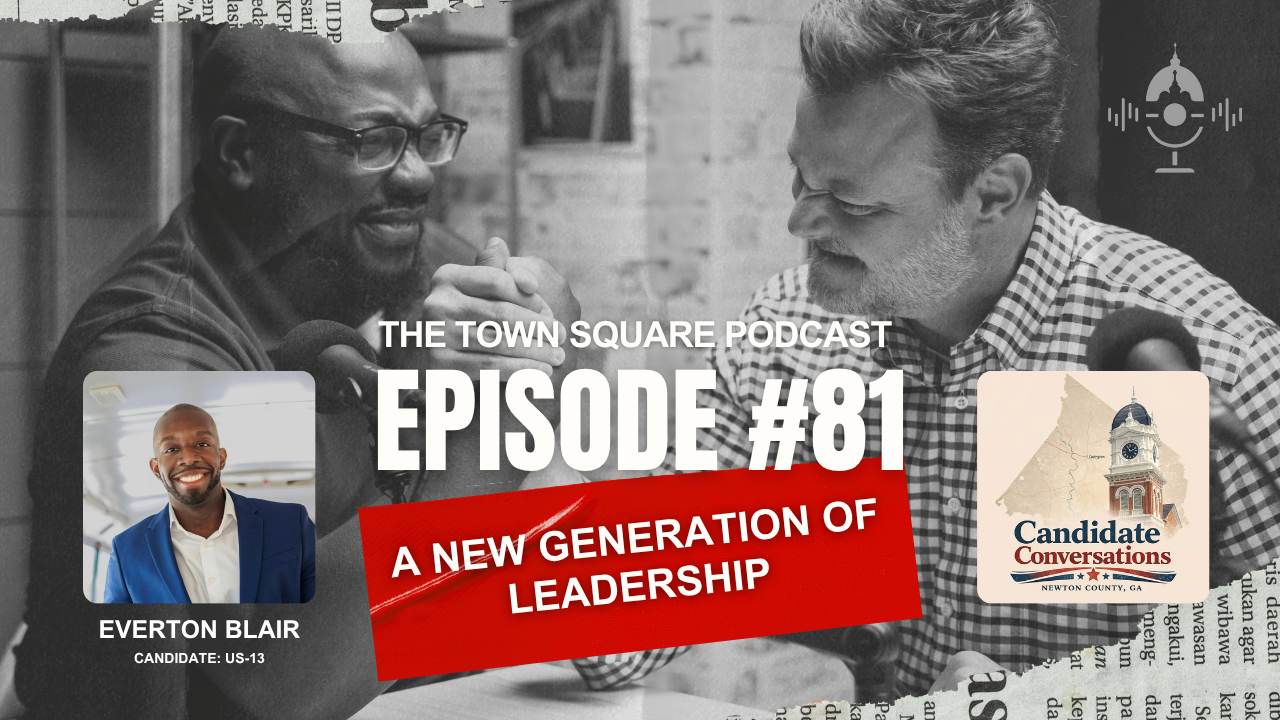
The Candidate Conversations series continues on The Town Square Podcast with a conversation that widens the lens beyond local races and into the national arena. In Episode 81, Trey Bailey sits down with Everton Blair, a Democratic candidate for the United States House of Representatives in Georgia’s 13th Congressional District.
For listeners in Newton County and across the district, this conversation offers something the modern political cycle rarely provides: time. Time to hear a candidate explain not just what he believes, but why he believes it. Time to hear the story behind the résumé. Time to move beyond campaign signs, social media posts, and party talking points into a fuller picture of a person asking to represent hundreds of thousands of people in Congress.
Blair enters the race with a background that combines public education, local governance, and community-rooted leadership. He is not new to public service, and he is not unfamiliar with the pressures that come with leadership during turbulent times. In fact, some of the most compelling moments in the episode come when he reflects on serving on the Gwinnett County Board of Education during the pandemic and how those years shaped his perspective on what it means to lead during uncertainty.
A Homegrown Story Rooted in Family and Community
One of the first things listeners learn is that Everton Blair’s story is deeply rooted in metro Atlanta. Born and raised in the Snellville and Stone Mountain area, Blair is the son of Jamaican immigrants who made their home in Gwinnett County during a very different era in the county’s history. As he describes it, he grew up watching a community change and diversify around him.
That experience clearly shaped his identity.
He attended Shiloh Elementary, Middle, and High School and describes himself as both a high-achieving student and a student leader. He was the kind of kid teachers noticed — the kind of student whose path was made possible in part because educators believed in him, challenged him, and opened doors for him.
That early support mattered. It gave him both opportunity and perspective.
From there, Blair went to Harvard, an experience that widened his exposure to ambition, talent, and influence. But instead of following many of his peers into finance or consulting, he chose a different route. He came back home and became a high school math teacher at KIPP Atlanta Collegiate. In the episode, he describes that work as both his most difficult and his most rewarding job.
That detail matters, because it reinforces something listeners hear throughout the conversation: Blair’s public identity is not built primarily around political ambition. It is built around service, systems, and a desire to make institutions work better for ordinary people.
From Public Education to Public Leadership
Blair’s background in education is central to the conversation. Trey, as a fellow public education advocate and school board member, is able to engage him in a way that opens up some of the most substantive moments in the interview.
Blair explains that he was first elected to the Gwinnett County Board of Education in 2018, a historic moment in several ways. He became the youngest person ever elected to the board, its first person of color, and its first openly gay member. He was not just entering office; he was entering as a symbol of change in one of the largest and most diverse school districts in the state.
But as he notes, being first is not always easy. The “first” can quickly become “the only,” and being the only often comes with pressure, scrutiny, and weight that others do not have to carry.
Still, he stepped into the role.
And then, just a few years later, he found himself in one of the most difficult leadership contexts imaginable: chairing the board during the COVID-19 pandemic.
For listeners who served in public leadership during those years — especially in education — this part of the conversation will resonate. Trey reflects on his own experience during that same period, and both men acknowledge something many in the public still may not fully appreciate: just how difficult those decisions were.
School boards were making choices that affected children, families, teachers, budgets, safety, and the emotional well-being of entire communities. In Gwinnett’s case, that meant making decisions for roughly 185,000 students. Blair talks about the pressure, the uncertainty, and the importance of using federal relief funds to provide hotspots, laptops, meals, and flexibility for families and staff.
He also expresses confidence in the decisions he and the board made, even when those decisions were unpopular. That willingness to stand by difficult choices is part of the leadership profile he brings into this congressional race.
Why Congress? Why Now?
One of the clearest themes in the interview is Blair’s argument that Congress needs generational change.
He does not dance around that point.
He argues that too many elected officials stay in office too long, become disconnected from the realities of daily life, and fail to respond to the speed at which society, technology, and the economy are changing. In his view, that disconnect is especially dangerous right now, as the nation navigates rising costs, technological disruption, public frustration, and deep political division.
For Blair, this race is not simply about party alignment. It is about whether Georgia’s 13th District will be represented by someone who is present, responsive, and able to communicate clearly with the people he serves.
He describes the district as both diverse and dynamic — the kind of place that needs a representative who understands its complexity and is willing to do the work of staying connected to it. That includes Rockdale County, parts of Newton County including Covington, Porterdale, and Oxford, and portions of Henry, Clayton, and Gwinnett.
It is a large district, a diverse district, and in Blair’s view, a district ready for fresh leadership.
The Primary Matters
Another important thread in the episode is the role of the Democratic primary.
Trey and Blair both emphasize that in a district like Georgia’s 13th — one where the Democratic nominee will likely have a major advantage in the general election — the primary is where the real choice happens for many voters.
That means the election date matters.
It means early voting matters.
And it means voters need to do the work of learning about the candidates before November.
Term Limits and Accountability
One notable portion of the conversation centers on term limits.
Blair says plainly that he supports them. He argues that if the Constitution sets a minimum age for office, it makes sense to also have some limit on how long someone should remain there. In his view, a reasonable cap would be around 12 years, enough time for someone to do the work while still ensuring regular opportunities for renewal and accountability.
This part of the conversation ties into one of his larger concerns: incumbency can create passivity. When officeholders remain in place for decades, voters may assume they are still active and effective simply because they continue to see their names on the ballot. Meanwhile, Blair argues, communities can be changing rapidly while their representation remains stagnant.
Whether listeners agree with him or not, this section offers insight into how he thinks about leadership — not as possession, but as stewardship.
A Foundation in Servant Leadership
When Trey asks where Blair’s servant-leader mentality comes from, the answer is deeply personal.
Blair describes himself as a “church boy,” raised in a family where faith, service, profession, and education were closely intertwined. His mother is both a pediatrician and a minister. His grandfather is a Pentecostal bishop who had also worked as a carpenter. That example — of vocation and calling working together — clearly shaped his view of life and leadership.
He recalls hearing throughout childhood that the two most important things you could have were a good salvation and a good education.
“People Before Profit”
Perhaps the biggest policy theme in the episode is Blair’s emphasis on affordability and his phrase “people before profit.”
This is where the conversation becomes especially substantive.
Blair argues that many of the systems shaping daily life in America — the tax code, labor conditions, housing markets, healthcare access, and even food systems — increasingly serve the wealthy few rather than working families. He pushes back against traditional economic indicators like the Dow and unemployment rate as incomplete measures of prosperity, arguing that they often fail to reflect what life actually feels like for people trying to pay bills, buy groceries, raise children, and maintain stable housing.
In his view, the real questions are more practical:
Can one full-time job support a family?
Can a person afford a doctor visit?
Can a young adult buy a home?
Can a family build wealth across generations?
These are the questions, he suggests, that should define economic policy.
Blair supports raising the minimum wage, expanding child tax credits, and shifting the tax burden more heavily onto billionaires and large corporations. His core argument is simple: ordinary families are already paying enough, while the wealthiest institutions and individuals are not contributing proportionately.
Housing and the Middle Class
One of the strongest policy exchanges in the episode concerns housing.
Blair argues that homeownership remains one of the clearest pathways into the middle class and one of the most important tools for building generational wealth. But he says that path is being blocked by a mix of corporate behavior, inadequate supply, and political neglect.
He points to private equity firms and large corporations buying up homes in growing communities and converting them into rental properties, reducing the available stock for individual buyers. He notes that the median age of a first-time homebuyer is now 42, a striking figure that underscores how difficult homeownership has become for younger adults.
In the Newton-Henry-Rockdale-Gwinnett corridor, that issue is not theoretical. It is deeply practical.
Listeners in fast-growing communities will likely connect with this section, because many have seen the same trend up close: homes bought quickly, neighborhoods shifting, rental portfolios expanding, and affordability slipping out of reach.
Blair’s proposed response is to create incentives that favor actual homeownership and discourage speculative accumulation by large firms. He also argues that leaders need to confront the long shadow of the 2008 housing crisis, saying the country has never fully recovered in ways that matter to ordinary buyers.
Public Education: A Core Calling
It is no surprise that the conversation returns in depth to public education.
Blair is passionate about it, and Trey knows how to ask the right questions to let that passion come through.
Blair talks about the danger of weakening the U.S. Department of Education and warns that the schools most likely to suffer are Title I schools and communities already facing resource gaps. He frames public education not only as an institution worth defending, but as a foundational pillar of opportunity.
Two education priorities stand out in particular:
Early Literacy
Blair argues that it is unacceptable for the country to still struggle so severely with reading outcomes. He calls for stronger investments in pre-K, Head Start, early literacy, and better compensation for paraprofessionals and early childhood workers.
Career and Technical Education
He also argues that the education system may have pushed too far in the direction of “college for all” without preserving enough dignity and opportunity around trades and technical careers. He supports stronger career pathways, more industry credentials in high school, and a more intentional connection between education and the workforce.
This part of the interview is especially strong because it connects education directly to economics. Blair is not merely arguing for more school funding. He is arguing for a system that prepares students for a changing labor market and offers real opportunity at different entry points.
Healthcare and Human Need
Healthcare is another central issue in the conversation.
Blair supports expanding Medicaid and is a proponent of Medicare for All, arguing that healthcare should be treated as a public good rather than a privilege tied primarily to employment or income. He acknowledges that universal coverage would cost more upfront, but says it would also create long-term savings by improving health outcomes, reducing instability, and removing employer dependency from the system.
Just as importantly, he frames healthcare as both a moral issue and an economic one.
A country that spends heavily but produces poor health outcomes, he argues, needs to rethink its priorities. He links this to broader concerns about insurance, pharmaceutical interests, food systems, and the incentives embedded in the current system.
Whether or not listeners agree with every policy proposal, the coherence of his worldview is clear: people should not be made sicker, poorer, or more vulnerable because systems are designed primarily to protect profit.
Immigration, Humanity, and the Courts
The episode also touches on immigration, and Blair approaches it from the standpoint of both order and dignity.
He argues that law-abiding, tax-paying undocumented residents who are already part of the fabric of community life should have a pathway to citizenship. He also calls for stronger funding of immigration courts so that people can actually have their cases heard in a timely way.
Rather than treating immigration as a fear-driven security issue alone, Blair argues that the current system is deeply backlogged, punitive, and dehumanizing. He warns that political narratives often distract from practical reforms that could create a more just and efficient process.
This section fits with one of the larger philosophical themes of the episode: Blair believes many divisive national issues are used to keep ordinary people distracted while more powerful interests continue to consolidate wealth and influence.
Bridge Building and Political Reality
Despite taking strong positions, Blair also emphasizes his belief in bridge building.
He says he has conservative friends, worked with people across ideological differences, and understands that effective representation requires finding common ground when possible. He does not present himself as naive about polarization, but he does present himself as committed to conversation.
That balance is one of the more interesting parts of the episode.
On one hand, he is willing to criticize systems, institutions, and political figures directly. On the other hand, he insists that he wants to represent people, not caricatures. For voters tired of both outrage and vagueness, that combination may prove compelling.
Staying Grounded
As the interview winds down, Trey asks Blair how he stays grounded in the middle of an ambitious congressional campaign.
The answer returns to family, community, and place.
Blair says this district is the only home he has really known. His family is here. His memories are here. His foundation is here. The people who shaped him are still around him. That rootedness, he says, helps him stay clear about the purpose of the campaign.
He also says something that lands especially well near the end of the episode: “Democracy is a group project.”
That line captures much of what he has been trying to say the whole time. He is not presenting himself as a savior. He is presenting himself as a representative — someone who wants to do the work with the people, not simply in front of them.
Final Thoughts
Episode 81 is one of the more substantive entries in the Candidate Conversations series so far because it combines biography, philosophy, and policy in a way that feels rooted rather than rehearsed.
Listeners will come away with a much clearer understanding of who Everton Blair is:
a son of immigrants
a former math teacher
a former school board chair
a public servant shaped by education and faith
and a candidate arguing that this moment requires a new generation of leadership
Whether voters agree with all of his ideas or not, the conversation gives them something increasingly rare in politics: the chance to hear a candidate think out loud, explain his values, and make the case in his own words.
And in a primary season where many races will be decided long before November, that kind of access matters.
How to Contact Everton Blair
For listeners who want to learn more about Everton Blair or support his campaign:
Website: evertonblair.com
Social Media: @evertonblair or @evertonblairjr
Primary Election Day Mentioned in Episode
May 19
Early Voting Mentioned in Episode
Begins April 27
Sponsors / Advertisers
SCB Construction Group / SteelCo Buildings
A strong building starts with the right materials, and SteelCo Buildings has been supplying top-quality steel solutions for more than 24 years nationwide. From warehouses and workshops to agricultural, commercial, and retail buildings, they provide pre-engineered metal buildings and components tailored to each project. Their team also helps guide customers through design and permitting with honesty and efficiency.
Website: SCB Group
Main Street Land and Properties
Main Street Land and Properties is a trusted local partner for commercial and residential property management, brokerage services, real estate development, and construction management. Whether buying, selling, investing, or managing property, Main Street offers a one-stop destination focused on building stronger communities and long-term partnerships.
Address: 2141 Emory Street NW, Covington, GA
Website: Main Street Land & Properties